


The pH optimum for yeast PGI (Product No. P5381) is 7, according to Marchand, M. et al., Eur. J. Biochem., 184, 455-464 (1989).
Fortfahren mit
P5381

Phosphoglucose-Isomerase aus Backhefe (S. cerevisiae)
Type III, ammonium sulfate suspension, ≥400 units/mg protein (biuret)
Synonym(e):
Anmelden zur Ansicht der Organisations- und Vertragspreise.
Größe auswählen
Ansicht ändern
| Ihnen/SKU | Verfügbarkeit | Preis |
|---|---|---|
1000 units | Warenkorb auf Verfügbarkeit prüfen | € 116,00 |
5000 units | Warenkorb auf Verfügbarkeit prüfen | € 420,00 |
50000 units | Warenkorb auf Verfügbarkeit prüfen | € 2.300,00 |
Über diesen Artikel
CAS-Nummer:
UNSPSC Code:
12352204
NACRES:
NA.54
EC Number:
232-603-1
MDL number:
Specific activity:
≥400 units/mg protein (biuret)
Biological source:
bakers yeast
Concentration:
≥3 mg/mL protein Biuret
Technischer Dienst
Benötigen Sie Hilfe? Unser Team von erfahrenen Wissenschaftlern ist für Sie da.
Unterstützung erhaltenbiological source
bakers yeast
Quality Segment
type
Type III
form
ammonium sulfate suspension
specific activity
≥400 units/mg protein (biuret)
mol wt
tetramer 119,500 Da±600
concentration
≥3 mg/mL protein Biuret
technique(s)
activity assay: suitable
color
white
Protein ID accession no.
UniProt accession no.
storage temp.
2-8°C
Gene Information
yeast ... PGI1(852495)
General description
Application
Phosphoglucose-Isomerase aus der Backhefe (S. cerevisiae) wird wie folgt eingesetzt:
- zur Umwandlung von Fructose-6-phosphat in Glucose-6-phosphat während der enzymatischen Messung der Mannose-Serumspiegel
- als eines der Enzyme in der Reihe von vier enzymgekoppelten Reaktionen zur Messung der Aktivität der Phosphomannomutase (PMM)
- zur Umwandlung von Fructose in Glucose und gleichzeitigen Beurteilung des Fructosegehalts der Kudzuwurzel
Biochem/physiol Actions
Phosphoglucose-Isomerase (PGI) ist ein Enzym, das für die Umwandlung von D-Glucose-6-phosphat in D-Fructose-6-phosphat von entscheidender Bedeutung ist. PGI ist für den zweiten Schritt der Glykolyse verantwortlich und an der Glukogenese und dem Pentose-Phosphat-Weg (PPP) beteiligt. Es ist hochkonserviert in Bakterien und Eukaryoten. PGI spielt eine entscheidende Rolle beim Überleben von A. fumigatus und weist verschiedene Funktionen auf, zu denen die Entwicklung, Biosynthese von Glukan für die Zellwand und die Virulenz gehören.Phosphoglucose-Isomerase fungiert als Isomerase, Neuroleukin, autokriner Beweglichkeitsfaktor sowie als Differenzierungs- und Reifungsvermittler.
Physical form
Kristalline Suspension in 2.6 M (NH4)2SO4, enthält 0.1 mM Magnesiumacetat, pH 7.0
Other Notes
Eine Einheit wandelt pro Minute 1,0 μmol D -Fructose-6-phosphat in D -Glucose-6-phosphat bei pH 7,4 und 25 °C um.
1 of 1
Dieser Artikel | |||
|---|---|---|---|
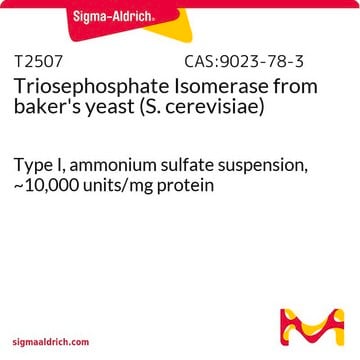
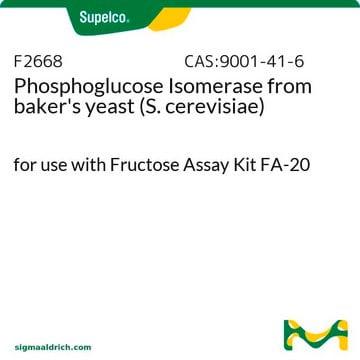
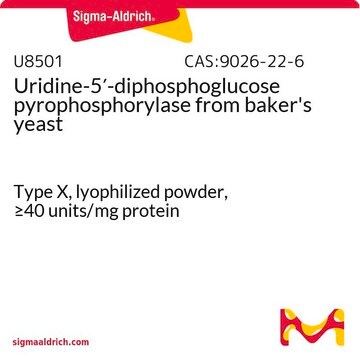
| description Type III, ammonium sulfate suspension, ≥400 units/mg protein (biuret) | description Type I, ammonium sulfate suspension, ~10,000 units/mg protein | description for use with Fructose Assay Kit FA-20 | description Type X, lyophilized powder, ≥40 units/mg protein |
| Gene Information yeast ... PGI1(852495) | Gene Information - | Gene Information - | Gene Information - |
| biological source bakers yeast | biological source - | biological source - | biological source bakers yeast |
| technique(s) activity assay: suitable | technique(s) - | technique(s) photometry: suitable | technique(s) - |
| specific activity ≥400 units/mg protein (biuret) | specific activity ~10,000 units/mg protein | specific activity - | specific activity ≥40 units/mg protein |
| concentration ≥3 mg/mL protein Biuret | concentration - | concentration - | concentration - |
| form ammonium sulfate suspension | form ammonium sulfate suspension | form - | form lyophilized powder |
Still not finding the right product?
Explore all of our products under Phosphoglucose-Isomerase aus Backhefe (S. cerevisiae)
signalword
Danger
hcodes
pcodes
Hazard Classifications
Resp. Sens. 1
Lagerklasse
10 - Combustible liquids
wgk
WGK 1
flash_point_f
Not applicable
flash_point_c
Not applicable
ppe
Eyeshields, Gloves
Hier finden Sie alle aktuellen Versionen:
Besitzen Sie dieses Produkt bereits?
In der Dokumentenbibliothek finden Sie die Dokumentation zu den Produkten, die Sie kürzlich erworben haben.
-
What is the pH optimum of Phosphoglucose Isomerase from baker's yeast (e.g., Product No. P5381)?
1 answer-
Helpful?
-
-
What is the substrate for Phosphoglucose Isomerase from baker's yeast (e.g., Product No. P5381)?
1 answer-
The substrate for PGI is D-fructose-6-phosphate, according to our Enzyme Assay procedure.
Helpful?
-
-
What is the Department of Transportation shipping information for this product?
1 answer-
Transportation information can be found in Section 14 of the product's (M)SDS.To access the shipping information for this material, use the link on the product detail page for the product.
Helpful?
-
-
What is the typical protein concentration for Product No. P5381 (PGI)?
1 answer-
The protein concentration of Product No. P5381 (PGI) can vary from lot-to-lot. It is typically in the range of 5-20 mg protein per mL. The lot-specific concentration will be given on the certificate of analysis.
Helpful?
-
-
What is the KM value for yeast PGI (Product No. P5381) with D-Fructose-6-phosphate as substrate, and what does that mean?
1 answer-
KM is the concentration of substrate that leads to half-maximal velocity. The KM value for yeast PGI (Product No. P5381) with D-Fructose-6-phosphate as substrate is 0.167, according to Marchand, M. et al., Eur. J. Biochem., 184, 455-464 (1989).
Helpful?
-