
E6908

pFLAG-CMV™-5.1 Expression Vector
shuttle vector for intracellular transient expression of C-terminal FLAG
Fortfahren mit
Technischer Dienst
Benötigen Sie Hilfe? Unser Team von erfahrenen Wissenschaftlern ist für Sie da.
Unterstützung erhaltenProduktname
pFLAG-CMV™-5.1 Expression Vector, shuttle vector for intracellular transient expression of C-terminal FLAG
tag
FLAG® tagged
grade
Molecular Biology
form
buffered aqueous solution
peptide tag location
C-terminal
shipped in
dry ice
storage temp.
−20°C
Application
pFLAG-CMV™-5.1 Expression Vector is suitable for transient or stable expression and secretion of N-terminal FLAG®-tagged fusion proteins in mammalian cells.
Biochem/physiol Actions
The promoter-regulatory region of the human cytomegalovirus drives transcription of FLAG®-fusion constructs. The multiple cloning region of the pFLAG-CMV™-5.1 vector is not preceded by a translational initiation signal. A translational start sequence must be included with the insert DNA. The multiple cloning region of the pFLAG-CMV-5.1 vector is compatible with other CMV vectors.
General description
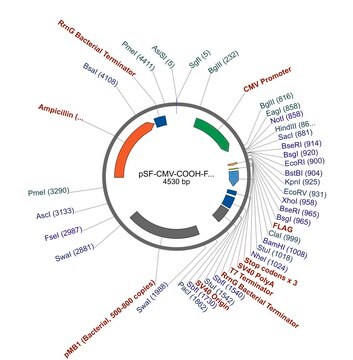
The pFLAG-CMV™-5.1 Expression Vector is a 4.7 kb derivative of the pCMV5 transient expression vector, used for establishing transient intracellular expression of C-terminal FLAG® fusion proteins in mammalian cells.
pFLAG-CMV-5.1 is a shuttle vector for E. coli and mammalian cells. Efficiency of replication and genomic integration is optimal when using an SV40 T antigenexpressing host.
The pFLAG-CMV-5b-BAP Control Plasmid is a 6.0 kb derivative of the pCMV5 transient expression vector for intracellular expression of C-terminal FLAG bacterial alkaline phosphatase fusion protein in mammalian cells.
Vector Maps and Sequences
pFLAG-CMV-5.1 is a shuttle vector for E. coli and mammalian cells. Efficiency of replication and genomic integration is optimal when using an SV40 T antigenexpressing host.
The pFLAG-CMV-5b-BAP Control Plasmid is a 6.0 kb derivative of the pCMV5 transient expression vector for intracellular expression of C-terminal FLAG bacterial alkaline phosphatase fusion protein in mammalian cells.
Vector Maps and Sequences
Other Notes
- pFLAG-CMV™-5.1 Expression Vector 20 μg (E7901) is supplied as 0.5 mg/ml in 10 mM Tris-HCl (pH 8.0) with 1 mM EDTA.
- pFLAG-CMV™-5b-BAP Control Plasmid 20 μg (P5225) is supplied as 0.5 mg/ml in 10 mM Tris-HCl (pH 8.0) with 1 mM EDTA.
Legal Information
FLAG is a registered trademark of Merck KGaA, Darmstadt, Germany
pFLAG-CMV is a trademark of Sigma-Aldrich Co. LLC
Lagerklasse
10 - Combustible liquids
Hier finden Sie alle aktuellen Versionen:
Besitzen Sie dieses Produkt bereits?
In der Dokumentenbibliothek finden Sie die Dokumentation zu den Produkten, die Sie kürzlich erworben haben.
Kristina W Thiel et al.
Proceedings of the National Academy of Sciences of the United States of America, 104(49), 19238-19243 (2007-11-29)
Structural studies of the extracellular and tyrosine kinase domains of the epidermal growth factor receptor (ErbB-1) provide considerable insight into facets of the receptor activation mechanism, but the contributions of other regions of ErbB-1 have not been ascertained. This study
Vladimir Majerciak et al.
Journal of virology, 81(3), 1062-1071 (2006-11-17)
Kaposi's sarcoma-associated herpesvirus (KSHV) ORF57 regulates viral gene expression at the posttranscriptional level during viral lytic infection. To study its function in the context of the viral genome, we disrupted KSHV ORF57 in the KSHV genome by transposon-based mutagenesis. The
Monica Red Brewer et al.
Proceedings of the National Academy of Sciences of the United States of America, 110(38), E3595-E3604 (2013-09-11)
The initiation of epidermal growth factor receptor (EGFR) kinase activity proceeds via an asymmetric dimerization mechanism in which a "donor" tyrosine kinase domain (TKD) contacts an "acceptor" TKD, leading to its activation. In the context of a ligand-induced dimer, identical
Ya-Fang Chiu et al.
Journal of virology, 86(18), 9647-9655 (2012-06-29)
Epstein-Barr virus (EBV) BBLF1 shares 13 to 15% amino acid sequence identities with the herpes simplex virus 1 UL11 and cytomegalovirus UL99 tegument proteins, which are involved in the final envelopment during viral maturation. This study demonstrates that BBLF1 is
Svetlana Gorokhova et al.
Human molecular genetics, 16(20), 2394-2410 (2007-07-04)
We characterized a family consisting of four mammalian proteins of unknown function (NKAIN1, 2, 3 and 4) and a single Drosophila ortholog dNKAIN. Aside from highly conserved transmembrane domains, NKAIN proteins contain no characterized functional domains. Striking amino acid conservation
Verwandter Inhalt
pFLAG-CMV-5.1
Instructions
Active Filters
Unser Team von Wissenschaftlern verfügt über Erfahrung in allen Forschungsbereichen einschließlich Life Science, Materialwissenschaften, chemischer Synthese, Chromatographie, Analytik und vielen mehr..
Setzen Sie sich mit dem technischen Dienst in Verbindung