
E6783

pFLAG-CMV-3 Expression Vector
shuttle vector for transient or stable expression of N-terminal FLAG
Fortfahren mit
Technischer Dienst
Benötigen Sie Hilfe? Unser Team von erfahrenen Wissenschaftlern ist für Sie da.
Unterstützung erhaltenProduktname
pFLAG-CMV-3 Expression Vector, shuttle vector for transient or stable expression of N-terminal FLAG
tag
FLAG® tagged
grade
Molecular Biology
form
buffered aqueous solution
peptide tag location
N-terminal
shipped in
dry ice
storage temp.
−20°C
Application
pFLAG-CMV™-3 Expression Vector is suitable for transient or stable expression and secretion of N-terminal FLAG-tagged fusion proteins in mammalian cells.
Biochem/physiol Actions
The promoter-regulatory region of the human cytomegalovirus drives transcription of FLAG-fusion constructs. The preprotrypsin leader sequence precedes the FLAG® sequence and directs secretion of the fusion protein into the culture medium. The aminoglycoside phosphotransferase II gene (neo-r) confers resistance to aminoglycosides such as G 418, allowing for selection of stable transfectants.
General description
The pFLAG-CMV™-3 Expression Vector is a 6.3 kb vector used for transient or stable expression in
mammalian cells. The vector is a derivative of pCMV5 used for transient or stable expression and secretion of a properly inserted open reading frame as an N-terminal FLAG fusion protein.
The pFLAG-CMV-3 Expression Vector is a shuttle vector containing both bacterial and SV40 origins of replication for propagation in both E. coli and mammalian cells. Efficiency of replication and genomic integration is optimal when using host cells that express the SV40 large T antigen.
The pFLAG-CMV-3-BAP Control Plasmid is a 7.7 kb derivative of pCMV51 used for transient expression and secretion of N-terminal FLAG bacterial alkaline phosphatase fusion protein in mammalian cells.
The FLAG® epitope is a small, hydrophilic 8 amino acid tag (DYKDDDDK) that provides for sensitive detection and high quality purification using ANTI-FLAG products available from Sigma-Aldrich.
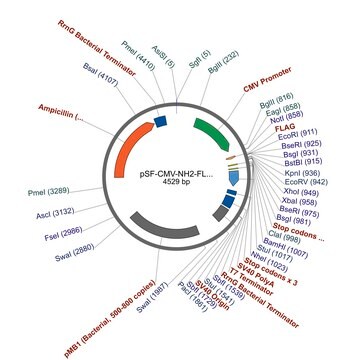
Vector Maps and Sequences
mammalian cells. The vector is a derivative of pCMV5 used for transient or stable expression and secretion of a properly inserted open reading frame as an N-terminal FLAG fusion protein.
The pFLAG-CMV-3 Expression Vector is a shuttle vector containing both bacterial and SV40 origins of replication for propagation in both E. coli and mammalian cells. Efficiency of replication and genomic integration is optimal when using host cells that express the SV40 large T antigen.
The pFLAG-CMV-3-BAP Control Plasmid is a 7.7 kb derivative of pCMV51 used for transient expression and secretion of N-terminal FLAG bacterial alkaline phosphatase fusion protein in mammalian cells.
The FLAG® epitope is a small, hydrophilic 8 amino acid tag (DYKDDDDK) that provides for sensitive detection and high quality purification using ANTI-FLAG products available from Sigma-Aldrich.
Vector Maps and Sequences
Other Notes
- pFLAG-CMV™-3 Expression Vector 20 μg (E8770) is supplied as 0.5 mg/ml in 10 mM Tris-HCl (pH 8.0) with 1 mM EDTA.
- pFLAG-CMV™-3-BAP Control Plasmid 20 μg (C3972) is supplied as 0.5 mg/ml in 10 mM Tris-HCl (pH 8.0) with 1 mM EDTA.
Legal Information
FLAG is a registered trademark of Merck KGaA, Darmstadt, Germany
pFLAG-CMV is a trademark of Sigma-Aldrich Co. LLC
related product
Produkt-Nr.
Beschreibung
Preisangaben
Lagerklasse
10 - Combustible liquids
Hier finden Sie alle aktuellen Versionen:
Besitzen Sie dieses Produkt bereits?
In der Dokumentenbibliothek finden Sie die Dokumentation zu den Produkten, die Sie kürzlich erworben haben.
Ahmet Sinan Sari et al.
Turkish journal of biology = Turk biyoloji dergisi, 45(3), 301-313 (2021-08-12)
Selective targeting of transfected mesenchymal stem cells (MSCs) carrying specific antioncogenes to the tumor was suggested as a treatment option. Bone morphogenetic protein-2 (BMP2) was shown to inhibit the proliferation and aggressiveness of osteosarcoma (OS) cells. Here, we aimed to
Chenyun Wang et al.
Journal of Huazhong University of Science and Technology. Medical sciences = Hua zhong ke ji da xue xue bao. Yi xue Ying De wen ban = Huazhong keji daxue xuebao. Yixue Yingdewen ban, 32(2), 299-302 (2012-04-25)
Many researchers employed mammalian expression system to artificially express cannabinoid receptors, but immunoblot data that directly prove efficient protein expression can hardly be seen in related research reports. In present study, we demonstrated cannabinoid receptor protein was not able to
Koichi Ushizawa et al.
PloS one, 4(6), e5814-e5814 (2009-06-09)
Ly-6 superfamily members have a conserved Ly-6 domain that is defined by a distinct disulfide bonding pattern between eight or ten cysteine residues. These members are divided into membrane-type and secretory-type proteins. In the present study, we report the identification
M Kokel et al.
Genes & development, 12(10), 1425-1437 (1998-05-29)
Receptor tyrosine phosphatases have been implicated in playing important roles in cell signaling events by their ability to regulate the level of protein tyrosine phosphorylation. Although the catalytic activity of their phosphatase domains has been well established, the biological roles
Aidan L Huene et al.
iScience, 24(7), 102811-102811 (2021-07-24)
Many organisms use genetic self-recognition systems to distinguish themselves from conspecifics. In the cnidarian, Hydractinia symbiolongicarpus, self-recognition is partially controlled by allorecognition 2 (Alr2). Alr2 encodes a highly polymorphic transmembrane protein that discriminates self from nonself by binding in trans
Verwandter Inhalt
Instructions
pFLAG-CMV-3 and pFLAG-CMV-4 Vector Maps
Active Filters
Unser Team von Wissenschaftlern verfügt über Erfahrung in allen Forschungsbereichen einschließlich Life Science, Materialwissenschaften, chemischer Synthese, Chromatographie, Analytik und vielen mehr..
Setzen Sie sich mit dem technischen Dienst in Verbindung