Direkt zum Inhalt
Merck

C7805

Anti-Collagen Type III (COL3A1) Antibody

mouse monoclonal, FH-7A

Synonym(e):

Anti-Collagen III antibody

Anmelden zur Ansicht der Organisations- und Vertragspreise.

Größe auswählen

100 μL

€ 573,00

0.2 ML

€ 648,00

€ 573,00


Warenkorb auf Verfügbarkeit prüfen
Für Ihr Target ist ein rekombinanter, konservierungsmittelfreier Antikörper verfügbar. Probieren Sie ZRB1167

Großbestellung anfragen

Über diesen Artikel

UNSPSC Code:
12352203
NACRES:
NA.41
MDL number:
Conjugate:
unconjugated
Clone:
FH-7A, monoclonal
Application:
DB, ELISA (i), IHC (f), WB
Citations:
54

Fortfahren mit

Technischer Dienst
Benötigen Sie Hilfe? Unser Team von erfahrenen Wissenschaftlern ist für Sie da.
Unterstützung erhalten

Produktname

Monoclonal Anti-Collagen, Type III antibody produced in mouse, clone FH-7A, ascites fluid

biological source

mouse

Quality Level

conjugate

unconjugated

antibody form

ascites fluid

antibody product type

primary antibodies

clone

FH-7A, monoclonal

mol wt

antigen 70 kDa

contains

15 mM sodium azide

species reactivity

human, rat

technique(s)

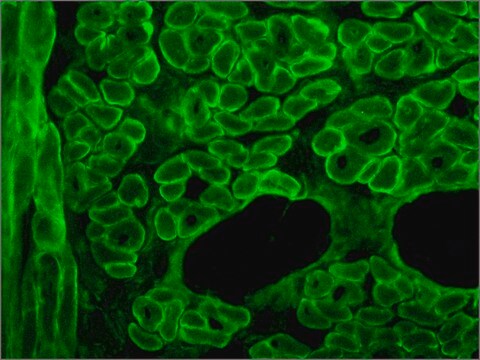
dot blot: suitable, immunohistochemistry (frozen sections): 1-4,000 using frozen sections of human skin, indirect ELISA: suitable, western blot: suitable using a denatured-reduced preparation

isotype

IgG1

UniProt accession no.

shipped in

dry ice

storage temp.

−20°C

target post-translational modification

unmodified

Gene Information

human ... COL3A1(1281)
rat ... Col3a1(84032)

Suchen Sie nach ähnlichen Produkten? Aufrufen Leitfaden zum Produktvergleich

Ähnliche Artikel vergleichen

Vollständigen Vergleich anzeigen

Unterschiede anzeigen

1 of 4

Dieser Artikel
MAB3392SAB4500367D8168
clone

FH-7A, monoclonal

clone

1E7-D7, monoclonal

clone

polyclonal

clone

MANDYS8, monoclonal

biological source

mouse

biological source

mouse

biological source

rabbit

biological source

mouse

antibody form

ascites fluid

antibody form

purified immunoglobulin

antibody form

affinity isolated antibody

antibody form

ascites fluid

conjugate

unconjugated

conjugate

-

conjugate

unconjugated

conjugate

unconjugated

Gene Information

human ... COL3A1(1281)
rat ... Col3a1(84032)

Gene Information

human ... COL3A1(1281)

Gene Information

human ... COL3A1(1281)

Gene Information

human ... DMD(1756)
mouse ... Dmd(13405)
rat ... Dmd(24907)

species reactivity

human, rat

species reactivity

rat

species reactivity

mouse, human, rat

species reactivity

chicken, rat, human, pig, rabbit, mouse

General description

Collagen is a fibrous protein present in the extracellular framework of all vertebrates. Collagen type III is a 300 kD molecule that belongs to fibrillar collagens family found mainly in skin, blood vessels, liver, placenta, tongue and thymus. This collagen is directly or indirectly involved in several genetic diseases like Ehlers-Danlos type IV disease. Monoclonal anti-collagen type III antibody can be used to determine the interstitial collagen I and III content in total protein homogenates. It is also used to study the immunolocalization of collagen type III in normal and neoplastic tissue. Mouse monoclonal anti-collagen type III antibody reacts specifically with native and denatured collagen type III but not with collagen types I, II, IV, V, VI, and X.
Monoclonal Anti-Collagen Type III (mouse IgG1 isotype) is derived from the FH-7A hybridoma produced by the fusion of mouse myeloma cells and splenocytes from BALB/c mice immunized with human collagen type III.

Immunogen

human collagen type III

Application

Monoclonal Anti-Collagen, Type III antibody produced in mouse has also been used in enzyme linked immunosorbent assay (ELISA) and immunohistochemistry.
Monoclonal anti-collagen type III antibody has been used in immunofluorescence and western blot.

Biochem/physiol Actions

Monoclonal Anti-Collagen Type III reacts specifically with native and denatured collagen type III. It does not recognize collagen types I, II, IV, V, VI, and X.
This collagen is directly or indirectly involved in several genetic diseases like Ehlers-Danlos type IV disease. Monoclonal anti-collagen type III antibody can be used to determine the interstitial collagen I and III content in total protein homogenates.

Disclaimer

Unless otherwise stated in our catalog or other company documentation accompanying the product(s), our products are intended for research use only and are not to be used for any other purpose, which includes but is not limited to, unauthorized commercial uses, in vitro diagnostic uses, ex vivo or in vivo therapeutic uses or any type of consumption or application to humans or animals.

Sie haben nicht das passende Produkt gefunden?  

Probieren Sie unser Produkt-Auswahlhilfe. aus.

related product

Lagerklasse

10 - Combustible liquids

wgk

WGK 2

flash_point_f

Not applicable

flash_point_c

Not applicable


Hier finden Sie alle aktuellen Versionen:

Analysenzertifikate (COA)

Lot/Batch Number

Die passende Version wird nicht angezeigt?

Wenn Sie eine bestimmte Version benötigen, können Sie anhand der Lot- oder Chargennummer nach einem spezifischen Zertifikat suchen.

Besitzen Sie dieses Produkt bereits?

In der Dokumentenbibliothek finden Sie die Dokumentation zu den Produkten, die Sie kürzlich erworben haben.

Die Dokumentenbibliothek aufrufen

R Mayne
Clinical biochemistry, 21(2), 111-115 (1988-04-01)
Monoclonal antibodies have recently been developed against all of the major collagen types isolated from both human and other species. These antibodies have several potential advantages over polyclonal antibodies, and a brief survey will be made of the different antibodies
Fluorescently labeled collagen binding proteins allow specific visualization of collagen in tissues and live cell culture
Krahn KN, et al.
Analytical Biochemistry, 350(2), 177-185 (2006)
The use of mesenchymal stem cells in collagen-based scaffolds for tissue-engineered repair of tendons
Butler DL, et al.
Nature Protocols, 5(5), 849-849 (2010)
Advanced glycation end products as a source of artifacts in immunoenzymatic methods
Kuzan A, et al.
Glycoconjugate Journal, 35(1), 95-103 (2018)
Corinne N Riggin et al.
Journal of orthopaedic research : official publication of the Orthopaedic Research Society, 37(9), 2035-2042 (2019-05-02)
Overuse-induced tendinopathy is highly prevalent in the general population. Percutaneous fenestration, or dry needling, techniques have been increasing in popularity, but despite their current use, there are no controlled laboratory studies to provide fundamental support for this practice. The objective

Verwandter Inhalt

Global Trade Item Number

SKUGTIN
C7805-.2ML04061837883538
C7805-100UL04061837883545

Questions

Reviews

No rating value

Active Filters

Unser Team von Wissenschaftlern verfügt über Erfahrung in allen Forschungsbereichen einschließlich Life Science, Materialwissenschaften, chemischer Synthese, Chromatographie, Analytik und vielen mehr..

Setzen Sie sich mit dem technischen Dienst in Verbindung