Direkt zum Inhalt
Merck

ABC102

Anti-CCN1/CYR61 Antibody

from rabbit, purified by affinity chromatography

Synonym(e):

Protein CYR61, CCN family member 1, Cysteine-rich angiogenic inducer 61, Insulin-like growth factor-binding protein 10, IBP-10, IGF-binding protein 10, IGFBP-10, Protein GIG1

Anmelden zur Ansicht der Organisations- und Vertragspreise.

Größe auswählen

100 μG

€ 478,00

€ 478,00


Warenkorb auf Verfügbarkeit prüfen

Großbestellung anfragen

Über diesen Artikel

UNSPSC Code:
12352203
NACRES:
NA.41
eCl@ss:
32160702

Fortfahren mit

Technischer Dienst
Benötigen Sie Hilfe? Unser Team von erfahrenen Wissenschaftlern ist für Sie da.
Unterstützung erhalten

Produktname

Anti-CCN1/CYR61 Antibody, from rabbit, purified by affinity chromatography

biological source

rabbit

conjugate

unconjugated

antibody form

affinity isolated antibody

antibody product type

primary antibodies

clone

polyclonal

purified by

affinity chromatography

species reactivity

human, mouse, rat

species reactivity (predicted by homology)

chimpanzee (based on 100% sequence homology)

technique(s)

immunohistochemistry: suitable (paraffin)
western blot: suitable

NCBI accession no.

UniProt accession no.

shipped in

wet ice

target post-translational modification

unmodified

Quality Level

Gene Information

human ... CYR61(3491)

Ähnliche Artikel vergleichen

Vollständigen Vergleich anzeigen

Unterschiede anzeigen

1 of 4

Dieser Artikel
SAB1402816ABS1627ABC10
Quality Level

100

Quality Level

100

Quality Level

100

Quality Level

100

biological source

rabbit

biological source

mouse

biological source

goat

biological source

rabbit

antibody form

affinity isolated antibody

antibody form

purified immunoglobulin

antibody form

affinity isolated antibody

antibody form

affinity isolated antibody

technique(s)

immunohistochemistry: suitable (paraffin), western blot: suitable

technique(s)

capture ELISA: suitable, indirect ELISA: suitable

technique(s)

neutralization: suitable, western blot: suitable

technique(s)

immunofluorescence: suitable, western blot: suitable

Gene Information

human ... CYR61(3491)

Gene Information

human ... CYR61(3491)

Gene Information

human ... CTGF(1490)

Gene Information

mouse ... Megf10(70417)

clone

polyclonal

clone

3C11, monoclonal

clone

polyclonal

clone

polyclonal

Analysis Note

Control
NIH/3T3 cell lysate
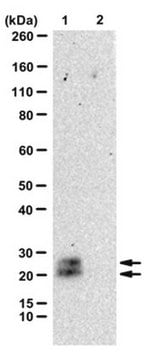
Evaluated by Western Blot in NIH/3T3 cell lysate.

Western Blot Analysis: 2 µg/mL of this antibody detected CCN1/CYR61 in 10 µg of NIH/3T3 cell lysate.

Application

Detect CCN1/CYR61 using this Anti-CCN1/CYR61 Antibody validated for use in Western Blotting, IHC(P).
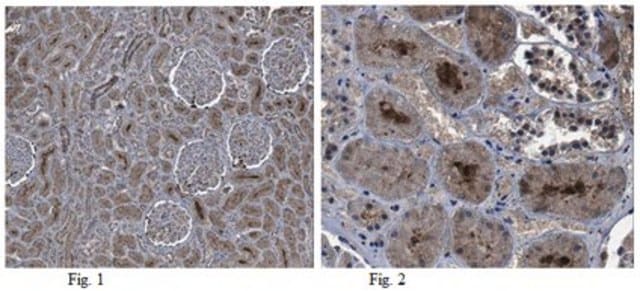
Immunohistochemistry Analysis: 1:200 dilution from a representative lot detected CCN1/CYR61 in human kidney tissue.
Research Category
Apoptosis & Cancer
Research Sub Category
Apoptosis - Additional

Biochem/physiol Actions

This antibody recognizes the CTCK domain of: CCN1/CYR61

Disclaimer

Unless otherwise stated in our catalog or other company documentation accompanying the product(s), our products are intended for research use only and are not to be used for any other purpose, which includes but is not limited to, unauthorized commercial uses, in vitro diagnostic uses, ex vivo or in vivo therapeutic uses or any type of consumption or application to humans or animals.

General description

CCN1 (cysteine-rich 61 or CYR61), a ubiquitous angiogenic factor, is a member of the CNN family, which is also comprised of CTGF, WISP-1, WISP-2, and WISP-3. It is a multidomain protein, containing one each of CTCK, IGFBP, TSP type-1, and VWFC domains. CCN1 is associated with the extracellular matrix and functions as a ligand for integrin receptors. It is expressed in response to growth factor stimulation, and mediates various cellular processes, including cell adhesion, migration, proliferation, angiogenesis, extracellular-matrix remodeling, and placental development. Previous studies have indicated that it may also play a role in wound healing by influencing the expression of genes required for this process, such as TIMP1, PAI-1, VEGA-A, VEGA-C, MMP1, MMP3, and uPA. CCN1 has also been implicated in breast cancer.
~53 kDa observed. The calculated molecular weight of this protein is 42 kDa, but can be observed at higher molecular weights due to glycosylation. A degradation fragment may be observed at ~15 kDa in some lysates. (Rother et al., 2010)

Immunogen

Epitope: CTCK domain
KLH-conjugated linear peptide corresponding to the CTCK domain of human CCN1/CYR61.

Other Notes

Concentration: Please refer to the Certificate of Analysis for the lot-specific concentration.

Physical form

Antigen Affinity Purified
Purified rabbit polyclonal in buffer containing 0.1 M Tris-Glycine (pH 7.4), 150 mM NaCl with 0.05% sodium azide.

Preparation Note

Stable for 1 year at 2-8°C from date of receipt.

Sie haben nicht das passende Produkt gefunden?  

Probieren Sie unser Produkt-Auswahlhilfe. aus.

Lagerklasse

12 - Non Combustible Liquids

wgk

WGK 1

flash_point_f

Not applicable

flash_point_c

Not applicable


Analysenzertifikate (COA)

Suchen Sie nach Analysenzertifikate (COA), indem Sie die Lot-/Chargennummer des Produkts eingeben. Lot- und Chargennummern sind auf dem Produktetikett hinter den Wörtern ‘Lot’ oder ‘Batch’ (Lot oder Charge) zu finden.

Besitzen Sie dieses Produkt bereits?

In der Dokumentenbibliothek finden Sie die Dokumentation zu den Produkten, die Sie kürzlich erworben haben.

Die Dokumentenbibliothek aufrufen

Weihua Li et al.
Molecular medicine reports, 12(3), 3359-3364 (2015-06-06)
MicroRNAs (miRNAs) are known to regulate the expression of a variety of genes, which are important in the development of several types of tumor, including Ewing's sarcoma (ES), at the post‑transcriptional level. Although previous studies have identified that the expression
James Hutchenreuther et al.
Cancer research communications, 4(2), 556-570 (2024-02-16)
Melanoma is the leading cause of skin cancer-related death. As prognosis of patients with melanoma remains problematic, identification of new therapeutic targets remains essential. Matricellular proteins are nonstructural extracellular matrix proteins. They are secreted into the tumor microenvironment to coordinate
Metformin improves tendon degeneration by blocking translocation of HMGB1 and suppressing tendon inflammation and senescence in aging mice.
Zhang, et al.
Journal of Orthopaedic Research : Official Publication of the Orthopaedic Research Society, 41, 1162-1176 (2023)
Tanguy Lechertier et al.
Nature communications, 11(1), 2810-2810 (2020-06-06)
The overexpression of the protein tyrosine kinase, Focal adhesion kinase (FAK), in endothelial cells has implicated its requirement in angiogenesis and tumour growth, but how pericyte FAK regulates tumour angiogenesis is unknown. We show that pericyte FAK regulates tumour growth

Questions

Reviews

No rating value

Active Filters

Unser Team von Wissenschaftlern verfügt über Erfahrung in allen Forschungsbereichen einschließlich Life Science, Materialwissenschaften, chemischer Synthese, Chromatographie, Analytik und vielen mehr..

Setzen Sie sich mit dem technischen Dienst in Verbindung