Direkt zum Inhalt
Merck

Fortfahren mit

AB2285

Anti-Glutamatrezeptor Delta 1/2-Antikörper

from rabbit, purified by affinity chromatography

Synonym(e):

GluR delta-1, glutamate receptor, ionotropic, delta 1

Anmelden zur Ansicht der Organisations- und Vertragspreise.

Über diesen Artikel

UNSPSC Code:
12352203
NACRES:
NA.41
eCl@ss:
32160702
Conjugate:
unconjugated
Clone:
polyclonal
Application:
WB
Citations:
2


biological source

rabbit

Quality Level

conjugate

unconjugated

antibody form

affinity isolated antibody

antibody product type

primary antibodies

clone

polyclonal

purified by

affinity chromatography

species reactivity

rat, mouse, primate, human

technique(s)

western blot: suitable

NCBI accession no.

UniProt accession no.

shipped in

wet ice

target post-translational modification

unmodified

Gene Information

human ... GRID1(2894)

General description

Die raschen exzitatorischen Transmissionen im Nervensystem werden mehrheitlich durch Glutamat-aktivierte Ionenkanäle vermittelt. Ionotrope Glutamatrezeptoren werden pharmakologisch unterteilt in AMPA (α-Amino-3-hydroxy-5-methyl-4-isoxazolpropionsäure), KA (Kainat) und NMDA-Subtypen (Monaghan et al., 1989). Diese Rezeptoren werden mit einer Reihe von physiologischen und pathologischen Prozessen in Verbindung gebracht. Während der Entwicklung sind Glutamatrezeptoren an der Differenzierung und Migration von Nervenzellen und der aktivitätsabhängigen Synapsenbildung beteiligt (Balazs et al., 1989; Brewer, 1989; Komoru and Rakic, 1993). In reifen Nervenzellen erfordern Langzeitpotenzierung und Langzeitdepression ionotrope Glutamatrezeptoren. Glutamat-gesteuerte Ionenkanäle spielen außerdem eine zentrale Rolle für die Vermittlung der exzitotoxischen Wirkungen von Glutamat (Olney, 1990). Pathophysiologische Prozesse, bei denen eine Beteiligung der Exzitotoxizität und Neurodegeneration von Glutamat vermutet wird, sind unter anderem Epilepsie, Schlaganfall, Morbus Parkinson, Morbus Alzheimer, Morbus Huntington und amyotrophe Lateralsklerose.
~ 114 kDa

Immunogen

Epitop: C-Terminus, zytoplasmisch
Synthetisches lineares Peptid zum C-Terminus, konjugiert an BSA.

Application

Der Anti-Glutamatrezeptor Delta 1/2-Antikörper detektiert den Gehalt an Glutamatrezeptor Delta 1/2 und wurde zur Verwendung in WB publiziert und validiert.
Forschungskategorie
Neurowissenschaft
Forschungsunterkategorie
Neurotransmitter & Rezeptoren
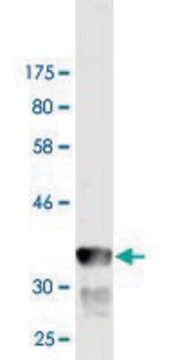
Western Blotting:
Humanes Kleinhirnlysat.

Biochem/physiol Actions

Best.-Nr. AB2285 reagiert mit dem C-Terminus von Glutamatrezeptor Delta 1/2.
Reagiert schwach mit Maus. Reagiert möglicherweise aufgrund von Sequenzhomologie mit Primaten. Die Reaktivität mit anderen Spezies wurde nicht getestet.

Physical form

Affinitätsgereinigtes Antigen
Aufgereinigt in 0,1 mol/l Tris-Glycin (pH-Wert 7,4), 150 mmol/l NaCl mit 0,05 % NaN3.

Preparation Note

Bei 2–8 ºC 1 Jahr ab Empfangsdatum haltbar.

Analysis Note

Kontrolle
Kleinhirngewebelysat von Ratte und Mensch.
Western Blotting: Mit einer früheren Charge in einer Verdünnung von 1:5.000 wurde Glutamatrezeptor Delta 1/2 in 10 µg Kleinhirnserum von Ratte oder Mensch nachgewiesen.

Other Notes

Konzentration: Die chargenspezifische Konzentration entnehmen Sie bitte dem Analysenzertifikat.

Disclaimer

Sofern in unserem Katalog oder anderen Begleitdokumenten unserer Produkte nicht anders angegeben, sind unsere Produkte nur für Forschungszwecke vorgesehen und nicht für andere Zwecke zu verwenden, einschließlich, jedoch nicht beschränkt auf unautorisierte kommerzielle Verwendung, zur In-vitro-Diagnostik, für Ex-vivo- oder In-vivo-Therapiezwecke oder jegliche Art der Einnahme oder Anwendung bei Menschen oder Tieren.

Ähnliche Artikel vergleichen

Vollständigen Vergleich anzeigen

Unterschiede anzeigen

1 of 1

Dieser Artikel
SAB1403883ABN241SAB4501294
antibody form

affinity isolated antibody

antibody form

purified immunoglobulin

antibody form

affinity isolated antibody

antibody form

affinity isolated antibody

conjugate

unconjugated

conjugate

unconjugated

conjugate

unconjugated

conjugate

unconjugated

biological source

rabbit

biological source

mouse

biological source

rabbit

biological source

rabbit

Quality Level

100

Quality Level

-

Quality Level

100

Quality Level

100

clone

polyclonal

clone

3A8, monoclonal

clone

polyclonal

clone

polyclonal

species reactivity

rat, mouse, primate, human

species reactivity

human

species reactivity

human, mouse, rat

species reactivity

human, mouse, rat


Still not finding the right product?

Probieren Sie unser Produkt-Auswahlhilfe, um Ihre Auswahl einzugrenzen


Lagerklasse

12 - Non Combustible Liquids

wgk

WGK 1

flash_point_f

Not applicable

flash_point_c

Not applicable


Analysenzertifikate (COA)

Suchen Sie nach Analysenzertifikate (COA), indem Sie die Lot-/Chargennummer des Produkts eingeben. Lot- und Chargennummern sind auf dem Produktetikett hinter den Wörtern ‘Lot’ oder ‘Batch’ (Lot oder Charge) zu finden.

Besitzen Sie dieses Produkt bereits?

In der Dokumentenbibliothek finden Sie die Dokumentation zu den Produkten, die Sie kürzlich erworben haben.

Die Dokumentenbibliothek aufrufen


Verwandter Inhalt

Glutamate is an excitatory neurotransmitter found in the synaptic vesicles of glutamatergic synapses. The post-synaptic neurons in these synapses contain ionotropic and metabotropic glutamate receptors. Glutamate binds to AMPA (α-amino-3-hydroxy-5- methylisoxazole-4-propionic acid) subtype glutamate receptors, leading to sodium influx into the post-synaptic cell and resulting in neuronal excitability and synaptic transmission. The NMDA (N-methyl-d-aspartate) subtype glutamate receptors, on the other hand, regulate synaptic plasticity, and can influence learning and memory. The metabotropic g-protein coupled mGluRs modulate downstream calcium signaling pathways and indirectly influence the synapse’s excitability. The synaptic architecture includes intracellular scaffolding proteins (PSD-95, GRIP), intercellular cell adhesion molecules (NCAMs, N-Cadherins), and a variety of signaling proteins (CaMKII/PKA, PP1/PP2B). Processes critical for synaptic transmission and plasticity are influenced by these molecules and their interactions. When the function of these molecules is disrupted, it leads to synaptic dysfunction and degeneration, and can contribute to dementia as seen in Alzheimer’s disease.


Dan Ren et al.
Neuroscience bulletin, 38(4), 342-358 (2021-12-16)
Central sensitization is essential in maintaining chronic pain induced by chronic pancreatitis (CP), but cortical modulation of painful CP remains elusive. Here, we examined the role of the anterior cingulate cortex (ACC) in the pathogenesis of abdominal hyperalgesia in a
Inés González-Calvo et al.
eLife, 10 (2021-03-05)
Fine control of protein stoichiometry at synapses underlies brain function and plasticity. How proteostasis is controlled independently for each type of synaptic protein in a synapse-specific and activity-dependent manner remains unclear. Here, we show that Susd4, a gene coding for


Global Trade Item Number

SKUGTIN
AB228504053252404320

Questions

Reviews

No rating value

Active Filters