Skip to Content
MilliporeSigma
Get 22% off for Pi Day through March 31.Save Now

252018

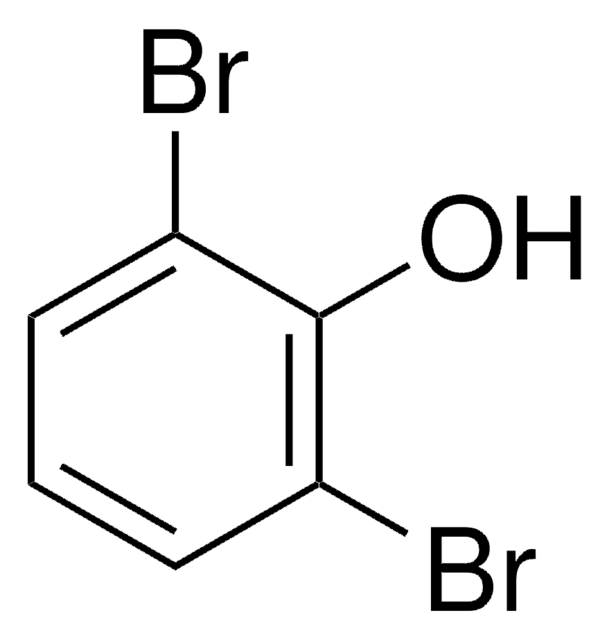
2,6-Dibromophenol

99%

Sign In to View Organizational & Contract Pricing.

Select a Size

1 G

$36.00

10 G

$156.00

$36.00


Available to ship TODAYDetails


Request a Bulk Order
Ships Every 4 weeks

About This Item

Linear Formula:
Br2C6H3OH
CAS Number:
Molecular Weight:
251.90
UNSPSC Code:
12352100
NACRES:
NA.22
PubChem Substance ID:
EC Number:
210-161-0
Beilstein/REAXYS Number:
2043614
MDL number:
Assay:
99%
Form:
solid

Skip To

Technical Service
Need help? Our team of experienced scientists is here for you.
Let Us Assist

Quality Level

assay

99%

form

solid

bp

255-256 °C/740 mmHg (lit.)

mp

53-56 °C (lit.)

functional group

bromo

SMILES string

Oc1c(Br)cccc1Br

InChI

1S/C6H4Br2O/c7-4-2-1-3-5(8)6(4)9/h1-3,9H

InChI key

SSIZLKDLDKIHEV-UHFFFAOYSA-N

Gene Information

Looking for similar products? Visit Product Comparison Guide

Compare Similar Items

View Full Comparison

Show Differences

1 of 4

This Item
258164137715233277
assay

99%

assay

95%

assay

99%

assay

99%

Quality Level

100

Quality Level

100

Quality Level

100

Quality Level

100

bp

255-256 °C/740 mmHg (lit.)

bp

154 °C/11 mmHg (lit.)

bp

282-290 °C/746 mmHg (lit.)

bp

124.5 °C/743 mmHg (lit.)

form

solid

form

solid

form

-

form

liquid

mp

53-56 °C (lit.)

mp

35-38 °C (lit.)

mp

90-94 °C (lit.)

mp

-

functional group

bromo

functional group

bromo

functional group

bromo

functional group

fluoro

General description

2,6-Dibromophenol has been isolated from a luminous marine enteropneust, Balanoglossus biminiensis and is responsible for the characteristic ″iodoform-like″ odor of these animals[1].

Application

2,6-Dibromophenol has been used in the preparation of 2-(2,6-dibromophenoxy)ethylbromide.

pictograms

Exclamation mark

signalword

Warning

Hazard Classifications

Acute Tox. 4 Dermal - Acute Tox. 4 Inhalation - Acute Tox. 4 Oral

Storage Class

11 - Combustible Solids

wgk

WGK 3

flash_point_f

Not applicable

flash_point_c

Not applicable

ppe

dust mask type N95 (US), Eyeshields, Gloves


Choose from one of the most recent versions:

Certificates of Analysis (COA)

Lot/Batch Number

Don't see the Right Version?

If you require a particular version, you can look up a specific certificate by the Lot or Batch number.

Already Own This Product?

Find documentation for the products that you have recently purchased in the Document Library.

Visit the Document Library

R B Ashworth et al.
Science (New York, N.Y.), 155(3769), 1558-1559 (1967-03-24)
2,6-Dibromophenol has been isolated from a luminous marine enteropneust, Balanoglossus biminiensis, found on intertidal beach areas at Sapelo Island, Georgia. This compound, responsible for the characteristic "iodoform-like" odor of these animals, is present in relatively large amounts; the estimated quantity
Synthesis of arylpiperazines via palladium-catalysed aromatic amination reactions of bromoarenes with N- tert-butoxycarbonylpiperazine.
Kerrigan F, et al.
Tetrahedron Letters, 39(15), 2219-2222 (1998)
I Caroline Vaaland et al.
Chemosphere, 256, 126928-126928 (2020-05-23)
Phenols and trans-1,2-dihydro-1,2-diols are metabolites commonly formed in vivo in fish upon exposure to polycyclic aromatic hydrocarbons (PAHs). These metabolites are excreted via the bile and gas chromatography-mass spectrometry (GC-MS) analysis of bile is becoming more frequently used for evaluating PAH
M Schroeder et al.
Journal of agricultural and food chemistry, 56(7), 2485-2489 (2008-03-06)
Contaminating microorganisms such as Actinomycetes, Alicyclobacillus, and Chlostridium can generate off-flavors in apple juices. Such bacterial metabolites represent, besides phenol types such as guaiacol and 2,6-dibromophenol, a broad range of other chemicals, for example, geosmin, 2-methylisoborneol, or alpha-terpineol. A laccase
Noel Ferro et al.
Phytochemistry, 68(2), 237-250 (2006-11-28)
An computational-biostatistical approach, supported by ab initio optimizations of auxin-like molecules, was used to find biologically meaningful relationships between quantum chemical variables and fresh bioassay's data. It is proven that the auxin-like recognition requires different molecular assembling states. We suggest

Global Trade Item Number

SKUGTIN
252018-10G04061825938103
252018-1G04061825938110

Questions

Reviews

No rating value

Active Filters

Our team of scientists has experience in all areas of research including Life Science, Material Science, Chemical Synthesis, Chromatography, Analytical and many others.

Contact Technical Service