Skip to Content
Merck

Skip To

A7154

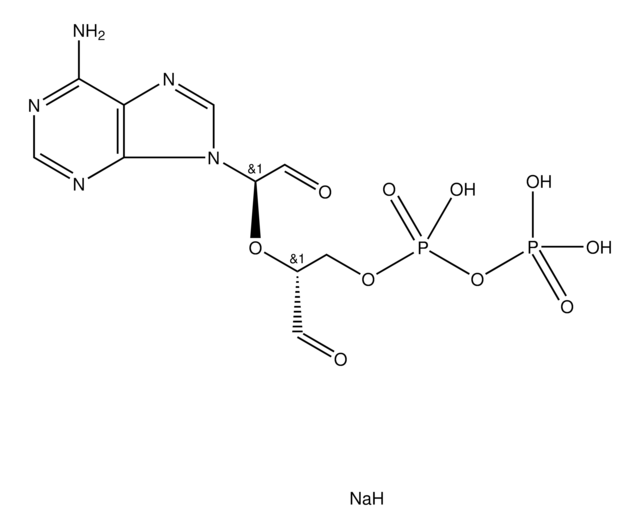
Adenosine, periodate oxidized

≥93%, synthetic, Powder

Synonym(s):

ADOX, Adenosine-2′,3′-dialdehyde

Sign In to View Organizational & Contract Pricing.

Select a Size

Change View
Pack SizeSKUAvailabilityPrice

About This Item

Empirical Formula (Hill Notation):
C10H11N5O4
CAS Number:
Molecular Weight:
265.23
UNSPSC Code:
41106305
PubChem Substance ID:
NACRES:
NA.51
MDL number:
Assay:
≥93%
Biological source:
synthetic (organic)
Form:
powder
Solubility:
0.2 M HCl: 50 mg/mL, clear, colorless to faintly yellow
Storage temp.:
−20°C
Pricing and availability is not currently available.
Technical Service
Need help? Our team of experienced scientists is here for you.
Let Us Assist


Product Name

Adenosine, periodate oxidized, ≥93%

biological source

synthetic (organic)

Quality Level

assay

≥93%

form

powder

solubility

0.2 M HCl: 50 mg/mL, clear, colorless to faintly yellow

storage temp.

−20°C

SMILES string

Nc1ncnc2n(cnc12)C(OC(CO)C=O)C=O

InChI

1S/C10H11N5O4/c11-9-8-10(13-4-12-9)15(5-14-8)7(3-18)19-6(1-16)2-17/h1,3-7,17H,2H2,(H2,11,12,13)

InChI key

ILMNSCQOSGKTNZ-UHFFFAOYSA-N

Application

Adenosine, periodate oxidized has been used:
  • as a methylarginine transferase inhibitor in the human embryonic kidney (HEK)-293 T cells[1]
  • as a methylase inhibitor in H4 neuroglioma[2]
  • as a broad inhibitor of S-adenosylmethionine (AdoMet)-dependent methyltransferases in mouse embryo fibroblast NIH3T3 cells[3]

Biochem/physiol Actions

Adenosine, periodate oxidized (Adox) is a protein arginine methyltransferases (PRMTs) inhibitor.[4] It also inhibits the enzyme S-adenosylhomocysteine hydrolase and induces apoptosis.[5] Its inhibitory effect on histone methyltransferases prevents histone methylation.[6] Adox also elicits intrinsic cytotoxic properties.[1]

Compare Similar Items

View Full Comparison

Show Differences

1 of 1

This Item
A6779A9376A6904
biological source

synthetic (organic)

biological source

bacterial (corynebacterium sp)

biological source

synthetic (organic)

biological source

-

Quality Level

200

Quality Level

200

Quality Level

200

Quality Level

200

form

powder

form

powder

form

powder

form

solid

assay

≥93%

assay

≥97%

assay

≥93%

assay

90-95%

solubility

0.2 M HCl: 50 mg/mL, clear, colorless to faintly yellow

solubility

-

solubility

water: 50 mg/mL, clear, colorless

solubility

-

storage temp.

−20°C

storage temp.

−20°C

storage temp.

−20°C

storage temp.

−20°C


Storage Class

11 - Combustible Solids

wgk

WGK 3

flash_point_f

Not applicable

flash_point_c

Not applicable

ppe

Eyeshields, Faceshields, Gloves, type N95 (US)


Choose from one of the most recent versions:

Certificates of Analysis (COA)

Lot/Batch Number

Don't see the Right Version?

If you require a particular version, you can look up a specific certificate by the Lot or Batch number.

Already Own This Product?

Find documentation for the products that you have recently purchased in the Document Library.

Visit the Document Library


Malin Hultberg et al.
Clinical biochemistry, 39(2), 160-163 (2005-12-07)
The metabolism of homocysteine is influenced by several dietary factors, including folate, cobalamin and possibly also the intake of polyhydroxylated phenolic compounds (polyphenols), which were shown to increase plasma homocysteine (tHcy) concentration. In order to reveal the cause of the
Ivon J M van der Linden et al.
Birth defects research. Part A, Clinical and molecular teratology, 82(10), 676-683 (2008-10-22)
An impaired DNA methylation has been suggested to underlie the complex etiology of neural tube defects (NTDs). Previously, we have demonstrated that inhibition of methylation by periodate oxidized adenosine (Adox) results in a widening of the anterior neuropore (ANP) in
Rita Castro et al.
Journal of molecular medicine (Berlin, Germany), 83(10), 831-836 (2005-06-25)
Hyperhomocysteinemia is a risk factor for atherosclerosis and vascular disease; however, the mechanism underlying this association remains poorly understood. Increased levels of intracellular S-adenosylhomocysteine (AdoHcy), secondary to homocysteine-mediated reversal of the AdoHcy hydrolase reaction, have been associated with reduced DNA


Questions

Reviews

No rating value

Active Filters