
07028

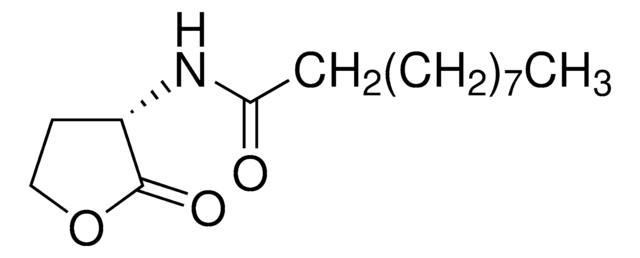
N-Decanoyl-L-homoserine lactone
≥96% (HPLC)
Synonym(s):
N-[(3S)-Tetrahydro-2-oxo-3-furanyl]decanamide, C10-HSL
Sign In to View Organizational & Contract Pricing.
Select a Size
Change View
| Pack Size | SKU | Availability | Price |
|---|
About This Item
Empirical Formula (Hill Notation):
C14H25NO3
CAS Number:
Molecular Weight:
255.35
UNSPSC Code:
12352211
PubChem Substance ID:
NACRES:
NA.85
MDL number:
Pricing and availability is not currently available.
Quality Level
assay
≥96% (HPLC)
form
powder or crystals
optical activity
[α]/D -24±3°, c = 0.2 in methanol
color
white to off-white
suitability
conforms to structure for Proton NMR spectrum
application(s)
cell analysis
storage temp.
−20°C
SMILES string
O=C1OCC[C@@H]1NC(CCCCCCCCC)=O
InChI
1S/C14H25NO3/c1-2-3-4-5-6-7-8-9-13(16)15-12-10-11-18-14(12)17/h12H,2-11H2,1H3,(H,15,16)/t12-/m0/s1
InChI key
TZWZKDULKILUPV-LBPRGKRZSA-N
Biochem/physiol Actions
N-Decanoyl-L-homoserine lactone is a member of N-acyl-homoserine lactone family. N-Acylhomoserine lactones (AHL) regulate gene expression in gram-negative bacteria, such as Echerichia and Salmonella, and are involved in quorum sensing, cell to cell communication among bacteria; for reviews see[1][2][3][4][5]. Bacterial intercellular communication has become a target for the development of new anti-virulence drugs[3], and a research focus for the prevention of biofilm formation[6][7][8].
Quorum-sensing signal generation[9]
1 of 1
This Item | |||
|---|---|---|---|
| form powder or crystals | form - | form powder | form - |
| assay ≥96% (HPLC) | assay ≥97% (HPLC) | assay - | assay ≥96% (HPLC) |
| storage temp. −20°C | storage temp. −20°C | storage temp. −20°C | storage temp. −20°C |
| optical activity [α]/D -24±3°, c = 0.2 in methanol | optical activity - | optical activity - | optical activity - |
| Quality Level 100 | Quality Level 100 | Quality Level 100 | Quality Level 100 |
| color white to off-white | color - | color - | color - |

Storage Class
11 - Combustible Solids
wgk
WGK 3
flash_point_f
Not applicable
flash_point_c
Not applicable
Choose from one of the most recent versions:
Already Own This Product?
Find documentation for the products that you have recently purchased in the Document Library.
M R Parsek et al.
Proceedings of the National Academy of Sciences of the United States of America, 97(16), 8789-8793 (2000-08-02)
Recent advances in studies of bacterial gene expression have brought the realization that cell-to-cell communication and community behavior are critical for successful interactions with higher organisms. Species-specific cell-to-cell communication is involved in successful pathogenic or symbiotic interactions of a variety
Wen-Zhao Wang et al.
Applied and environmental microbiology, 78(22), 7985-7992 (2012-09-04)
N-acylhomoserine lactones (AHLs) are used as quorum-sensing (QS) signal molecules by many gram-negative bacteria. We have reported that Chryseobacterium sp. strain StRB126, which was isolated from the root surface of potato, has AHL-degrading activity. In this study, we cloned and
Jian Woon Chen et al.
Sensors (Basel, Switzerland), 13(10), 13217-13227 (2013-10-03)
In the bacteria kingdom, quorum sensing (QS) is a cell-to-cell communication that relies on the production of and response to specific signaling molecules. In proteobacteria, N-acylhomoserine lactones (AHLs) are the well-studied signaling molecules. The present study aimed to characterize the