Przejdź do zawartości
Merck

S5446

Anti-SUMO-1 (C-terminal) antibody produced in rabbit

affinity isolated antibody, buffered aqueous solution

Synonim(y):

Anti-GMP1, Anti-PIC1, Anti-SMT3C, Anti-SMT3H3, Anti-Sentrin-1, Anti-Small Ubiquitin-related modifier-1, Anti-UBL1

Zaloguj się, aby wyświetlić ceny organizacyjne i kontraktowe.

Informacje o tej pozycji

UNSPSC Code:
12352203
NACRES:
NA.41
MDL number:
Conjugate:
unconjugated
Clone:
polyclonal
Application:
ARR, WB
Citations:
6

Przejdź do

Pomoc techniczna
Potrzebujesz pomocy? Nasz zespół doświadczonych naukowców chętnie Ci pomoże.
Pozwól nam pomóc

biological source

rabbit

Quality Level

conjugate

unconjugated

antibody form

affinity isolated antibody

antibody product type

primary antibodies

clone

polyclonal

form

buffered aqueous solution

mol wt

antigen 14 kDa

species reactivity

human

technique(s)

microarray: suitable, western blot: 1-2 μg/mL using nuclear extract of the human epitheloid carcinoma HeLa cell line

UniProt accession no.

shipped in

dry ice

storage temp.

−20°C

target post-translational modification

unmodified

Gene Information

cow ... SUMO1(614967)
human ... SUMO1(7341)
mouse ... Sumo1(22218)
rat ... Sumo1(301442)

Porównaj podobne pozycje

Wyświetl pełne porównanie

Pokaż różnice

1 of 4

Ta pozycja
SAB3500488SAB1402954SAB4503055
Quality Level

200

Quality Level

100

Quality Level

100

Quality Level

100

conjugate

unconjugated

conjugate

unconjugated

conjugate

unconjugated

conjugate

unconjugated

antibody form

affinity isolated antibody

antibody form

affinity isolated antibody

antibody form

purified immunoglobulin

antibody form

affinity isolated antibody

biological source

rabbit

biological source

rabbit

biological source

mouse

biological source

rabbit

technique(s)

microarray: suitable, western blot: 1-2 μg/mL using nuclear extract of the human epitheloid carcinoma HeLa cell line

technique(s)

immunofluorescence: suitable, immunohistochemistry: suitable, indirect ELISA: suitable, western blot: suitable

technique(s)

capture ELISA: suitable, immunofluorescence: suitable, indirect ELISA: suitable, western blot: 1-5 μg/mL

technique(s)

ELISA: 1:20000, immunofluorescence: 1:100-1:500, immunohistochemistry: 1:50-1:100, western blot: 1:500-1:1000

form

buffered aqueous solution

form

buffered aqueous solution

form

buffered aqueous solution

form

buffered aqueous solution

General description

Small ubiquitin-related modifier 1 (SUMO-1) is a highly conserved small ubiquitin-related modifier, also known as sentrin. SUMO-1 gene is mapped to human chromosome 2q33.1.

Immunogen

synthetic peptide corresponding to amino acids 86-97 located at the C-terminus of human SUMO-1, conjugated to KLH. This sequence is identical in many species including rat, mouse, bovine, chicken, and Xenopus, and highly conserved (single amino acid substitution) in C. elegans SMT3. The sequence has only 66% homology to human SUMO-2 and SUMO-3.

Application

Anti-SUMO-1 (C-terminal) antibody produced in rabbit has been used in immunoblotting.[1][2]

Biochem/physiol Actions

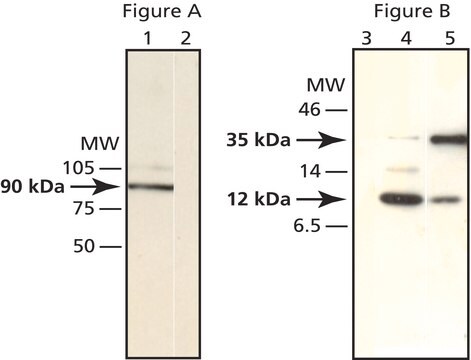
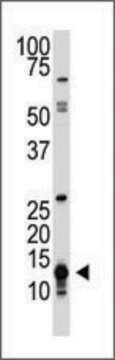
Anti-SUMO-1 (C-terminal) recognizes unconjugated SUMO-1 (14 kDa), SUMO-1-fusion protein, as well as proteins covalently conjugated to SUMO-1, eg. RanGAP1, 90kDa
Small ubiquitin-related modifier 1 (SUMO-1) is covalently conjugated to the lysine side in proteins through its C-terminal glycine residue by an isopeptide bond. Their conjugation with cellular proteins has been correlated wide variety of biological processes including inflammation, oncogenesis nuclear transport, cell cycle control and viral infection response. SUMO-1 serves as a substrate for Ran GTPase-activating protein (RanGAP1). Unmodified RanGAP1 is present in the cytoplasm, suggesting that modification by SUMO-1 may target RanGAP1 to the nuclear pore complex (NPC). Haploinsufficiency in the SUMO-1 gene is implicated in the Cleft Lip and Palate.

Physical form

Solution in 0.01 M phosphate buffered saline, pH 7.4, containing 1% bovine serum albumin and 15 mM sodium azide.

Preparation Note

For continuous use, store at 2-8 °C for up to one month. For extended storage, freeze in working aliquots. Repeated freezing and thawing, or storage in “frost-free” freezers, is not recommended. If slight turbidity occurs upon prolonged storage, clarify the solution by centrifugation before use. Working dilutions should be discarded if not used within 12 hours.

Disclaimer

Unless otherwise stated in our catalog or other company documentation accompanying the product(s), our products are intended for research use only and are not to be used for any other purpose, which includes but is not limited to, unauthorized commercial uses, in vitro diagnostic uses, ex vivo or in vivo therapeutic uses or any type of consumption or application to humans or animals.
Ta strona może zawierać tekst przetłumaczony maszynowo.

Nie możesz znaleźć właściwego produktu?  

Wypróbuj nasz Narzędzie selektora produktów.


Wybierz jedną z najnowszych wersji:

Certyfikaty analizy (CoA)

Lot/Batch Number

Nie widzisz odpowiedniej wersji?

Jeśli potrzebujesz konkretnej wersji, możesz wyszukać konkretny certyfikat według numeru partii lub serii.

Masz już ten produkt?

Dokumenty związane z niedawno zakupionymi produktami zostały zamieszczone w Bibliotece dokumentów.

Odwiedź Bibliotekę dokumentów

Soraya Beiraghi et al.
American journal of human genetics, 81(1), 180-188 (2007-06-15)
Nonsyndromic cleft lip with or without cleft palate (NSCL/P) is one of the most common congenital facial defects, with an incidence of 1 in 700-1,000 live births among individuals of European descent. Several linkage and association studies of NSCL/P have
Aleksandra Fergin et al.
PLoS genetics, 18(6), e1009978-e1009978 (2022-06-07)
The sumoylation (SUMO) pathway is involved in a variety of processes during C. elegans development, such as gonadal and vulval fate specification, cell cycle progression and maintenance of chromosome structure. The ubiquitous expression and pleiotropic effects have made it difficult
Fowzan S Alkuraya et al.
Science (New York, N.Y.), 313(5794), 1751-1751 (2006-09-23)
The posttranslational modification sumoylation can have multiple effects on its substrate proteins. We studied a patient with isolated cleft lip and palate and a balanced chromosomal translocation that disrupts the SUMO1 (small ubiquitin-related modifier) gene, resulting in haploinsufficiency. In mouse
H Saitoh et al.
The Journal of biological chemistry, 275(9), 6252-6258 (2000-02-29)
Post-translational modification marked by the covalent attachment of the ubiquitin-like protein SUMO-1/SMT3C has been implicated in a wide variety of cellular processes. Recently, two cDNAs encoding proteins related to SUMO-1 have been identified in human and mouse. The functions and
Xiuling Li et al.
Development (Cambridge, England), 139(23), 4321-4329 (2012-11-08)
In vertebrates, establishment of the hematopoietic stem/progenitor cell (HSPC) pool involves mobilization of these cells in successive developmental hematopoietic niches. In zebrafish, HSPCs originate from the ventral wall of the dorsal aorta (VDA), the equivalent of the mammalian aorta-gonad-mesonephros (AGM).

Powiązane treści

Instructions

Numer pozycji handlu globalnego

SKUNUMER GTIN
S5446-200UL04061837897719

Questions

Reviews

No rating value

Active Filters

Nasz zespół naukowców ma doświadczenie we wszystkich obszarach badań, w tym w naukach przyrodniczych, materiałoznawstwie, syntezie chemicznej, chromatografii, analityce i wielu innych dziedzinach.

Skontaktuj się z zespołem ds. pomocy technicznej