Przejdź do zawartości
Merck

G6142

Glycerokinase from Cellulomonas sp.

lyophilized powder, 25-75 units/mg protein

Synonim(y):

glpK, ATP:glycerol 3-phosphotransferase, Glycerol Kinase

Zaloguj się, aby wyświetlić ceny organizacyjne i kontraktowe.

Wybierz wielkość

1000 UNITS

1370,00 zł

1370,00 zł


Skontaktuj się z Obsługą Klienta, aby uzyskać informacje na temat dostępności

Zamów zamówienie zbiorcze

Informacje o tej pozycji

Numer CAS:
UNSPSC Code:
12352204
NACRES:
NA.54
EC Number:
232-862-0
MDL number:
Specific activity:
25-75 units/mg protein

Przejdź do

Pomoc techniczna
Potrzebujesz pomocy? Nasz zespół doświadczonych naukowców chętnie Ci pomoże.
Pozwól nam pomóc

form

lyophilized powder

specific activity

25-75 units/mg protein

mol wt

~128 kDa (by gel filtration)

composition

Protein, ≥60% biuret

storage temp.

−20°C

Quality Level

Porównaj podobne pozycje

Wyświetl pełne porównanie

Pokaż różnice

1 of 4

Ta pozycja
G4509G0774G9637
specific activity

25-75 units/mg protein

specific activity

40-100 units/mg protein

specific activity

≥75 units/mg protein (biuret)

specific activity

40-80 units/mg solid, pH 8.1

form

lyophilized powder

form

lyophilized powder

form

buffered aqueous solution

form

lyophilized powder

mol wt

~128 kDa (by gel filtration)

mol wt

-

mol wt

-

mol wt

~76 kDa (gel filtration)

storage temp.

−20°C

storage temp.

−20°C

storage temp.

2-8°C

storage temp.

2-8°C

Quality Level

200

Quality Level

200

Quality Level

200

Quality Level

200

composition

Protein, ≥60% biuret

composition

Protein, ≥50% biuret

composition

-

composition

-

General description

Research area: Cell Signaling

Glycerol kinase (GK) is part of the FGGY carbohydrate kinase family.[1]
Isoelectric point : 4.2
Michaelis constants : 4.4 x 10⁻⁵M (Glycerol), 4.3 x 10⁻⁴M (ATP)
Inhibitors : p-Chloromercuribenzoate, heavy metal ions (Pb++, Fe++, Hg++, Ag+)
Optimum pH : 9.8 (G-3-PDH system), 7.8 (G-3-P oxidase system) Optimum temperature : 500C
pH Stability : pH 5.5 x 10.0 (25oC, 20hr)
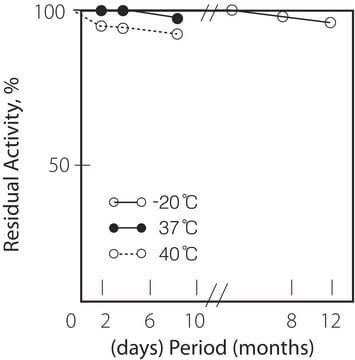
Thermal stability : below 40oC (pH 7.5, 15min)
Substrate specificity : This enzyme catalyzes the stereospecific transfer of the terminal
phosphoryl moiety of ATP to one of the primary hydroxyl group of
glycerol, forming sn-glycerol-3-P. The enzyme has the highest
specificity for glycerol, and also phosphorylates dihydroxyacetone
and glyceraldehyde (Table 1,2). Mg++ is essentially required for the
reaction.

Application

Glycerokinase from Cellulomonas sp. has been used:
  • for determining the kinetic characteristics of human and trypanosomatid phosphofructokinases using an enzyme-linked kinetic assay.[2]
  • to study the effect of sugar in fluorescence emission.[3]
  • in 2-Arachidonoylglycerol-based fluorescence assay for DH-463, a fluorescent activity-based probe for monoacylglycerol lipase.[4]

Biochem/physiol Actions

Glycerol kinase catalyzes the MgATP-dependent phosphorylation of glycerol to produce sn-glycerol-3-phosphate and is the rate limiting enzyme in the utilization of glycerol.[5][6] It is also subject to feedback regulation by fructose-1,6-bisphosphate.[7]Mutations in this gene are associated with Glycerol Kinase Deficiency (GKD), a condition characterized primarily by hypertriglyceridemia and hypoglycemia.[1] This enzyme is useful for enzymatic determination of glycerol and triglyceride when coupled with glycerol-3-phosphate dehydrogenase (=G-3-P DH, G3D-301), glycerol-3-phosphate oxidase (=G-3-P oxidase, G3O-301, G3O-311, G3O-321) or pyruvate kinase (PYK-301) and lactate dehydrogenase (LCD-209, LCD-211), lipoprotein lipase (LPL-311, LPL-314) in clinical analysis

Physical form

Lyophilized powder containing phosphate buffer salts and sodium gluconate

Other Notes

One unit will convert 1.0 μmole of glycerol and ATP to L-α-glycerophosphate and ADP per min at pH 9.8 at 25 °C in a coupled system with PK/LDH.
Ta strona może zawierać tekst przetłumaczony maszynowo.

pictograms

Health hazard

signalword

Danger

hcodes

Hazard Classifications

Resp. Sens. 1

Klasa składowania

11 - Combustible Solids

wgk

WGK 3

flash_point_f

Not applicable

flash_point_c

Not applicable

ppe

Eyeshields, Gloves, type N95 (US)


Wybierz jedną z najnowszych wersji:

Certyfikaty analizy (CoA)

Lot/Batch Number

Nie widzisz odpowiedniej wersji?

Jeśli potrzebujesz konkretnej wersji, możesz wyszukać konkretny certyfikat według numeru partii lub serii.

Masz już ten produkt?

Dokumenty związane z niedawno zakupionymi produktami zostały zamieszczone w Bibliotece dokumentów.

Odwiedź Bibliotekę dokumentów

Peter M Fernandes et al.
The Biochemical journal, 476(2), 179-191 (2018-11-09)
Eukaryotic ATP-dependent phosphofructokinases (PFKs) are often considered unidirectional enzymes catalysing the transfer of a phospho moiety from ATP to fructose 6-phosphate to produce ADP and fructose 1,6-bisphosphate. The reverse reaction is not generally considered to occur under normal conditions and
Fei Ying et al.
Scientific reports, 14(1), 3922-3922 (2024-02-17)
The influence of lipid metabolism on tumorigenesis and progression has garnered significant attention. However, the role of Glycerol Kinase (GK), a key enzyme in glycerol metabolism, in Esophageal Carcinoma (ESCA) remains unclear. To further elucidate the relationship between GK and
Susanne Prokop et al.
Nature communications, 12(1), 6505-6505 (2021-11-13)
Immunolabeling and autoradiography have traditionally been applied as the methods-of-choice to visualize and collect molecular information about physiological and pathological processes. Here, we introduce PharmacoSTORM super-resolution imaging that combines the complementary advantages of these approaches and enables cell-type- and compartment-specific
Zhongya Qin et al.
Biomedical optics express, 9(7), 3373-3390 (2018-07-10)
The femtosecond laser ablation in biological tissue produces highly fluorescent compounds that are of great significance for intrinsically labelling ablated tissue in vivo and achieving imaging-guided laser microsurgery. In this study, we analyzed the molecular structures of femtosecond laser-ablated tissues
Purification and properties of glycerol kinase from Escherichia coli.
S I Hayashi et al.
The Journal of biological chemistry, 242(5), 1030-1035 (1967-03-10)

Powiązane treści

Questions

Reviews

No rating value

Active Filters

Nasz zespół naukowców ma doświadczenie we wszystkich obszarach badań, w tym w naukach przyrodniczych, materiałoznawstwie, syntezie chemicznej, chromatografii, analityce i wielu innych dziedzinach.

Skontaktuj się z zespołem ds. pomocy technicznej