Przejdź do zawartości
Merck

C265

Monoclonal Anti-CaM Kinase IIα (CaMKIIα) antibody produced in mouse

clone 6G9, purified immunoglobulin, buffered aqueous solution

Synonim(y):

Anti-CAMKA, Anti-CaMKIINalpha, Anti-CaMKIIalpha, Anti-MRD53, Anti-MRT63

Zaloguj się, aby wyświetlić ceny organizacyjne i kontraktowe.

Wybierz wielkość

100 μL

2870,00 zł

2870,00 zł


Skontaktuj się z Obsługą Klienta, aby uzyskać informacje na temat dostępności


Informacje o tej pozycji

UNSPSC Code:
12352203
NACRES:
NA.44
MDL number:

Przejdź do

Pomoc techniczna
Potrzebujesz pomocy? Nasz zespół doświadczonych naukowców chętnie Ci pomoże.
Pozwól nam pomóc

Nazwa produktu

Monoclonal Anti-CaM Kinase IIα (CaMKIIα) antibody produced in mouse, clone 6G9, purified immunoglobulin, buffered aqueous solution

biological source

mouse

conjugate

unconjugated

antibody form

purified immunoglobulin

antibody product type

primary antibodies

clone

6G9, monoclonal

form

buffered aqueous solution

mol wt

antigen ~50 kDa

species reactivity

rat, mouse

technique(s)

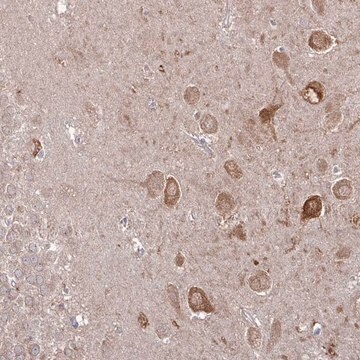
indirect immunofluorescence: suitable using rat hippocampus
western blot: 0.5-1.0 μg/mL

isotype

IgG1

UniProt accession no.

shipped in

dry ice

storage temp.

−20°C

target post-translational modification

unmodified

Quality Level

Gene Information

rat ... Camk2a(25400)

Porównaj podobne pozycje

Wyświetl pełne porównanie

Pokaż różnice

1 of 4

Ta pozycja
WH0010645M1WH0008536M1HPA051785
biological source

mouse

biological source

mouse

biological source

mouse

biological source

rabbit

conjugate

unconjugated

conjugate

unconjugated

conjugate

unconjugated

conjugate

unconjugated

Gene Information

rat ... Camk2a(25400)

Gene Information

human ... CAMKK2(10645)

Gene Information

human ... CAMK1(8536)

Gene Information

human ... CAMK2A(817)

antibody form

purified immunoglobulin

antibody form

purified immunoglobulin

antibody form

purified immunoglobulin

antibody form

affinity isolated antibody

species reactivity

rat, mouse

species reactivity

human

species reactivity

human

species reactivity

human

clone

6G9, monoclonal

clone

1A11, monoclonal

clone

3G1, monoclonal

clone

polyclonal

Application

Monoclonal Anti-CaM Kinase IIα (CaMKIIα) antibody produced in mouse has been used in immunohistochemistry[1] and western blotting.

Disclaimer

Unless otherwise stated in our catalog or other company documentation accompanying the product(s), our products are intended for research use only and are not to be used for any other purpose, which includes but is not limited to, unauthorized commercial uses, in vitro diagnostic uses, ex vivo or in vivo therapeutic uses or any type of consumption or application to humans or animals.

General description

CaM Kinase II α is a Ca2+/calmodulin-dependent kinase that belongs to the serine/threonine protein kinases family. It facilitates the regulation of NMDAR-dependent AMPA receptor trafficking to the synapses. Mouse anti-CaM kinase II α antibody reacts specifically with phosphorylated and non-phosphorylated forms of native and recombinant CaM (Ca2+/calmodulin-dependent) kinase II α subunit in rats. The product has shown no reactivity for phosphorylated or non-phosphorylated β subunit (60kD).

Immunogen

partially purified rat CaM kinase II.

Physical form

Solution in phosphate buffered saline containing 0.05% sodium azide
Ta strona może zawierać tekst przetłumaczony maszynowo.

Nie możesz znaleźć właściwego produktu?  

Wypróbuj nasz Narzędzie selektora produktów.

Klasa składowania

10 - Combustible liquids

wgk

nwg

flash_point_f

Not applicable

flash_point_c

Not applicable

ppe

Eyeshields, Gloves, multi-purpose combination respirator cartridge (US)


Wybierz jedną z najnowszych wersji:

Certyfikaty analizy (CoA)

Lot/Batch Number

Nie widzisz odpowiedniej wersji?

Jeśli potrzebujesz konkretnej wersji, możesz wyszukać konkretny certyfikat według numeru partii lub serii.

Masz już ten produkt?

Dokumenty związane z niedawno zakupionymi produktami zostały zamieszczone w Bibliotece dokumentów.

Odwiedź Bibliotekę dokumentów

Ke-Hui Hu et al.
Behavioural brain research, 359, 81-88 (2018-10-27)
Ischemic stroke is a major cause of disability and mortality worldwide, while no unequivocally efficacious drug is currently available to treat post-stroke functional impairments. Animal and clinical investigations suggest that the motor cortex stimulation constitutes a particularly promising approach for
Metabotropic signal transduction for bradykinin in submucosal neurons of guinea pig small intestine
Hu HZ, et al.
Journal of Pharmacology and Experimental Therapeutics, 309(1), 310-319 (2004)
Naohiro Kon et al.
Genes & development, 28(10), 1101-1110 (2014-05-17)
Daily behavioral rhythms in mammals are governed by the central circadian clock, located in the suprachiasmatic nucleus (SCN). The behavioral rhythms persist even in constant darkness, with a stable activity time due to coupling between two oscillators that determine the
Jay F Muller et al.
The Journal of comparative neurology, 519(4), 790-805 (2011-01-20)
The basolateral nucleus of the amygdala receives an extremely dense cholinergic innervation from the basal forebrain that is critical for memory consolidation. Although previous electron microscopic studies determined some of the postsynaptic targets of cholinergic afferents, the majority of postsynaptic
Wen Fong Ooi et al.
PLoS genetics, 9(9), e1003795-e1003795 (2013-09-27)
Burkholderia pseudomallei (Bp), the causative agent of the often-deadly infectious disease melioidosis, contains one of the largest prokaryotic genomes sequenced to date, at 7.2 Mb with two large circular chromosomes (1 and 2). To comprehensively delineate the Bp transcriptome, we

Questions

Reviews

No rating value

Active Filters

Nasz zespół naukowców ma doświadczenie we wszystkich obszarach badań, w tym w naukach przyrodniczych, materiałoznawstwie, syntezie chemicznej, chromatografii, analityce i wielu innych dziedzinach.

Skontaktuj się z zespołem ds. pomocy technicznej