Przejdź do zawartości
Merck

A4480

Anti-ASPP2 antibody, Mouse monoclonal

~1.5 mg/mL, clone DX 54.10, purified from hybridoma cell culture

Synonim(y):

Anti-53BP2 apoptosis-stimulating protein of p53 2, Anti-TP53BP2, Anti-tumor protein p53-binding protein 2

Zaloguj się, aby wyświetlić ceny organizacyjne i kontraktowe.

Wybierz wielkość

200 μL

2900,00 zł

2900,00 zł


Skontaktuj się z Obsługą Klienta, aby uzyskać informacje na temat dostępności


Informacje o tej pozycji

UNSPSC Code:
12352203
NACRES:
NA.41
MDL number:

Przejdź do

Pomoc techniczna
Potrzebujesz pomocy? Nasz zespół doświadczonych naukowców chętnie Ci pomoże.
Pozwól nam pomóc

Nazwa produktu

Anti-ASPP2 antibody, Mouse monoclonal, ~1.5 mg/mL, clone DX 54.10, purified from hybridoma cell culture

biological source

mouse

conjugate

unconjugated

antibody form

purified from hybridoma cell culture

antibody product type

primary antibodies

clone

DX 54.10, monoclonal

form

buffered aqueous solution

mol wt

antigen ~175 kDa

species reactivity

human, mouse

concentration

~1.5 mg/mL

technique(s)

immunocytochemistry: suitable
immunoprecipitation (IP): suitable
microarray: suitable
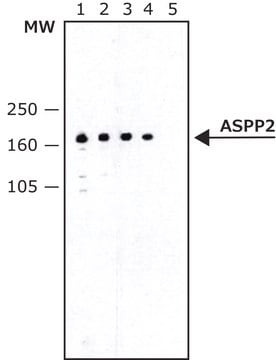
western blot: 0.5-1 μg/mL using total cell extract of human osteogenic sarcoma

isotype

IgG1

UniProt accession no.

shipped in

dry ice

storage temp.

−20°C

target post-translational modification

unmodified

Quality Level

Gene Information

human ... TP53BP2(7159)
mouse ... Trp53bp2(209456)

Porównaj podobne pozycje

Wyświetl pełne porównanie

Pokaż różnice

1 of 4

Ta pozycja
A4355A4605P6874
clone

DX 54.10, monoclonal

clone

LXO54.2, monoclonal

clone

LXO49.3, monoclonal

clone

DO-1, monoclonal

conjugate

unconjugated

conjugate

unconjugated

conjugate

unconjugated

conjugate

unconjugated

biological source

mouse

biological source

mouse

biological source

mouse

biological source

mouse

Gene Information

human ... TP53BP2(7159)
mouse ... Trp53bp2(209456)

Gene Information

human ... PPP1R13B(23368)
mouse ... Ppp1r13b(21981)

Gene Information

human ... PPP1R13L(10848)
mouse ... Ppp1r13l(333654)

Gene Information

human ... TP53(7157)

antibody form

purified from hybridoma cell culture

antibody form

purified immunoglobulin

antibody form

purified immunoglobulin

antibody form

purified immunoglobulin

species reactivity

human, mouse

species reactivity

mouse, human

species reactivity

mouse, human

species reactivity

human

Application

Mouse Monoclonal Anti-ASPP2 has been used for immunofluorescence analysis. The antibody can also be used for immunocytochemistry, immunoprecipitation and microarray applications.
Western blot analysis of Hek293 or 3T3-L1 adipocyte cell lysates was performed using monoclonal mouse anti-ASPP2 as the primary.

Biochem/physiol Actions

ASPP2 is a tumor suppressor that activates p53. ASPP2 also regulates Par-3 which subsequently modulates the proliferation and polarity of neural progenitor cells during CNS development. Furthermore, ASPP2 interacts with active Ras to induce p53 mediated cell death. ASPP2 is known to function as a biomarker for invasive pituitary adenomas.
Apoptosis-stimulating protein of p53 (ASPP2) enhances the ability of p53 to induce apoptosis ASPP1 and ASPP2 stimulates the transactivation function of p63 and p73 on promoters of different genes such as BCL2 associated X, apoptosis regulator (Bax), p53-inducible gene 3 (PIG3) and p53 upregulated modulator of apoptosis (PUMA), but not mouse double minute 2 homolog (Mdm2) or p21WAF-1/CIP1.
Monoclonal Anti-ASPP2 recognizes human and mouse ASPP2. The epitope recognized by the antibody resides within amino acids 691-1128 of human ASPP2.

Disclaimer

Unless otherwise stated in our catalog or other company documentation accompanying the product(s), our products are intended for research use only and are not to be used for any other purpose, which includes but is not limited to, unauthorized commercial uses, in vitro diagnostic uses, ex vivo or in vivo therapeutic uses or any type of consumption or application to humans or animals.

General description

Monoclonal Anti-ASPP2 (mouse IgG1 isotype) is derived from the hybridoma DX 54.10 produced by the fusion of mouse myeloma cells (SP2/0 cells) and splenocytes from BALB/c mice. Apoptosis-stimulating protein of p53 (ASPP) family of proteins contains three members, ASPP1, ASPP2 and iASPP, which interact via their C-terminal region with p53 and modulate its activity.

Immunogen

fragment of human ASPP2 (amino acids 691-1128).

Physical form

Solution in 0.01 M phosphate buffered saline, pH 7.4, containing 15 mM sodium azide.
Ta strona może zawierać tekst przetłumaczony maszynowo.

Nie możesz znaleźć właściwego produktu?  

Wypróbuj nasz Narzędzie selektora produktów.

Klasa składowania

10 - Combustible liquids

wgk

WGK 3

flash_point_f

Not applicable

flash_point_c

Not applicable

ppe

Eyeshields, Gloves, multi-purpose combination respirator cartridge (US)


Wybierz jedną z najnowszych wersji:

Certyfikaty analizy (CoA)

Lot/Batch Number

Nie widzisz odpowiedniej wersji?

Jeśli potrzebujesz konkretnej wersji, możesz wyszukać konkretny certyfikat według numeru partii lub serii.

Masz już ten produkt?

Dokumenty związane z niedawno zakupionymi produktami zostały zamieszczone w Bibliotece dokumentów.

Odwiedź Bibliotekę dokumentów

Lin Ma et al.
Oncology letters, 6(5), 1313-1318 (2013-11-02)
Nucleostemin is a GTP-conjugated protein located in the nucleoli of stem cells and certain cancer cells, and maintains cellular self-renewal. The present study aimed to evaluate nucleostemin as a potential target for pituitary adenoma gene therapy by investigating nucleostemin and
Y Wang et al.
Cell death and differentiation, 20(4), 525-534 (2013-02-09)
RAS mutations occur frequently in human cancer and activated RAS signalling contributes to tumour development and progression. Apart from its oncogenic effects on cell growth, active RAS has tumour-suppressive functions via its ability to induce cellular senescence and apoptosis. RAS
ASPP1 and ASPP2 are new transcriptional targets of E2F
Fogal V, et al.
Cell Death and Differentiation, 12(4), 369-369 (2005)
ASPP proteins specifically stimulate the apoptotic function of p53
Samuels-Lev Y, et al.
Molecular Cell, 8(4), 781-794 (2001)
Roberta Sottocornola et al.
Developmental cell, 19(1), 126-137 (2010-07-14)
Cell polarity plays a key role in the development of the central nervous system (CNS). Interestingly, disruption of cell polarity is seen in many cancers. ASPP2 is a haplo-insufficient tumor suppressor and an activator of the p53 family. In this

Questions

Reviews

No rating value

Active Filters

Nasz zespół naukowców ma doświadczenie we wszystkich obszarach badań, w tym w naukach przyrodniczych, materiałoznawstwie, syntezie chemicznej, chromatografii, analityce i wielu innych dziedzinach.

Skontaktuj się z zespołem ds. pomocy technicznej