Przejdź do zawartości
Merck

A4355

Monoclonal Anti-ASPP1 antibody produced in mouse

~2 mg/mL, clone LXO54.2, purified immunoglobulin, buffered aqueous solution

Synonim(y):

Anti-Apoptosis-stimulating protein of p53, 1, Anti-PPP1R13B, Anti-protein phosphatase 1 regulatory subunit 13B

Zaloguj się, aby wyświetlić ceny organizacyjne i kontraktowe.

Informacje o tej pozycji

UNSPSC Code:
12352203
NACRES:
NA.41
MDL number:

Przejdź do

Pomoc techniczna
Potrzebujesz pomocy? Nasz zespół doświadczonych naukowców chętnie Ci pomoże.
Pozwól nam pomóc

Nazwa produktu

Monoclonal Anti-ASPP1 antibody produced in mouse, ~2 mg/mL, clone LXO54.2, purified immunoglobulin, buffered aqueous solution

biological source

mouse

conjugate

unconjugated

antibody form

purified immunoglobulin

antibody product type

primary antibodies

clone

LXO54.2, monoclonal

form

buffered aqueous solution

mol wt

antigen ~175 kDa

species reactivity

mouse, human

concentration

~2 mg/mL

technique(s)

immunoprecipitation (IP): suitable
microarray: suitable
western blot: 1-2 μg/mL using total cell extract of human osteogenic sarcoma, U-2-OS

isotype

IgG1

UniProt accession no.

shipped in

dry ice

storage temp.

−20°C

target post-translational modification

unmodified

Gene Information

human ... PPP1R13B(23368)
mouse ... Ppp1r13b(21981)

Porównaj podobne pozycje

Wyświetl pełne porównanie

Pokaż różnice

1 of 4

Ta pozycja
A4480P6874P6749
species reactivity

mouse, human

species reactivity

human, mouse

species reactivity

human

species reactivity

human

biological source

mouse

biological source

mouse

biological source

mouse

biological source

mouse

Gene Information

human ... PPP1R13B(23368)
mouse ... Ppp1r13b(21981)

Gene Information

human ... TP53BP2(7159)
mouse ... Trp53bp2(209456)

Gene Information

human ... TP53(7157)

Gene Information

human ... TP53(7157)

clone

LXO54.2, monoclonal

clone

DX 54.10, monoclonal

clone

DO-1, monoclonal

clone

PAb1801, monoclonal

conjugate

unconjugated

conjugate

unconjugated

conjugate

unconjugated

conjugate

unconjugated

antibody form

purified immunoglobulin

antibody form

purified from hybridoma cell culture

antibody form

purified immunoglobulin

antibody form

purified immunoglobulin

Application

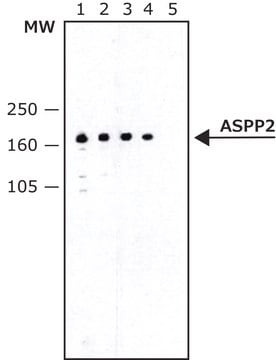
Monoclonal Anti-ASPP1 antibody can be used for western blot at 1-2 μg/mL using total cell extract of human osteogenic sarcoma, U-2-OS. The antibody can also be used for microarray and immunoprecipitation assays.

Biochem/physiol Actions

Apoptosis-stimulating protein of p53, 1 (ASPP1) is known to stimulate RAS signalling which subsequently enhances p53-dependent apoptosis in cancer cells. Furthermore, ASPP1 can also induce p53-independent apoptosis by enhancing the apoptotic functions of p63 and p73. Monoclonal Anti-ASPP1 antibody recognizes human and mouse ASPP1.

Disclaimer

Unless otherwise stated in our catalog or other company documentation accompanying the product(s), our products are intended for research use only and are not to be used for any other purpose, which includes but is not limited to, unauthorized commercial uses, in vitro diagnostic uses, ex vivo or in vivo therapeutic uses or any type of consumption or application to humans or animals.

General description

ASPP1 interacts with p53 to enhance p53-induced apoptosis.
Monoclonal Anti-ASPP1 (mouse IgG1 isotype) is derived from the hybridoma LXO54.2 produced by the fusion of mouse myeloma cells (SP2/0 cells) and splenocytes from BALB/c mice immunized with a recombinant fragment of human ASPP1, amino acids. Apoptosis-stimulating protein of p53, 1 (ASPP1) belongs to the ASPP family of proteins. This protein contains a proline-rich region, four ankyrin repeats, and an SH3 domain in the C-terminal end.

Immunogen

recombinant fragment of human ASPP1 (amino acids 1-308).

Physical form

Solution in 0.01 M phosphate buffered saline, pH 7.4, containing 15 mM sodium azide.
Ta strona może zawierać tekst przetłumaczony maszynowo.

Nie możesz znaleźć właściwego produktu?  

Wypróbuj nasz Narzędzie selektora produktów.

Klasa składowania

10 - Combustible liquids

wgk

WGK 3

flash_point_f

Not applicable

flash_point_c

Not applicable

ppe

Eyeshields, Gloves, multi-purpose combination respirator cartridge (US)


Wybierz jedną z najnowszych wersji:

Certyfikaty analizy (CoA)

Lot/Batch Number

Nie widzisz odpowiedniej wersji?

Jeśli potrzebujesz konkretnej wersji, możesz wyszukać konkretny certyfikat według numeru partii lub serii.

Masz już ten produkt?

Dokumenty związane z niedawno zakupionymi produktami zostały zamieszczone w Bibliotece dokumentów.

Odwiedź Bibliotekę dokumentów

Xingwen Wang et al.
International journal of cancer, 141(7), 1422-1433 (2017-06-29)
Inactivation of p53 has been shown to correlate with drug resistance in tumors. However, in clear cell renal cell carcinoma (ccRCC), p53 is rarely mutated, yet the tumors remain highly insensitive to the conventional chemotherapeutic drugs. The underlying mechanisms responsible
Marcus M Schittenhelm et al.
Cell death & disease, 15(1), 25-25 (2024-01-10)
ASPP1 (PPP1R13B) belongs to a family of p53-binding proteins and enhances apoptosis by stimulation of p53-transactivation of selected proapoptotic target genes. It is preferentially expressed in hematopoietic stem cells (HSC) and together with p53 preserves the genomic integrity of the
Y Wang et al.
Cell death and differentiation, 20(4), 525-534 (2013-02-09)
RAS mutations occur frequently in human cancer and activated RAS signalling contributes to tumour development and progression. Apart from its oncogenic effects on cell growth, active RAS has tumour-suppressive functions via its ability to induce cellular senescence and apoptosis. RAS
ASPP1 and ASPP2 are new transcriptional targets of E2F
Fogal V, et al.
Cell Death and Differentiation, 12(4), 369-369 (2005)
ASPP proteins specifically stimulate the apoptotic function of p53
Samuels-Lev Y, et al.
Molecular Cell, 8(4), 781-794 (2001)

Powiązane treści

Questions

Reviews

No rating value

Active Filters

Nasz zespół naukowców ma doświadczenie we wszystkich obszarach badań, w tym w naukach przyrodniczych, materiałoznawstwie, syntezie chemicznej, chromatografii, analityce i wielu innych dziedzinach.

Skontaktuj się z zespołem ds. pomocy technicznej