Przejdź do zawartości
Merck

Przejdź do

04677

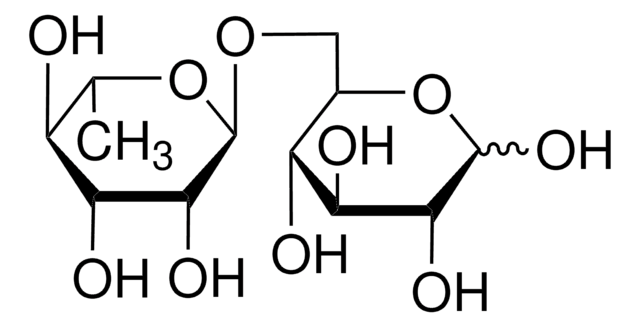
Rutinose

≥98.0% (HPLC)

Synonim(y):

6-O-(α-L-Rhamnopyranosyl)-D-glucose, 6-O-(6-Deoxy-α-L-mannopyranosyl)-D-glucose

Zaloguj się, aby wyświetlić ceny organizacyjne i kontraktowe.

Informacje o tej pozycji

Wzór empiryczny (zapis Hilla):
C12H22O10
Numer CAS:
Masa cząsteczkowa:
326.30
PubChem Substance ID:
UNSPSC Code:
12352201
NACRES:
NA.25
EC Number:
202-014-4
MDL number:

assay

≥98.0% (HPLC)

form

solid

color

white to light beige

storage temp.

room temp

InChI

1S/C12H22O10/c1-4-7(16)10(19)11(20)12(22-4)21-3-6(15)9(18)8(17)5(14)2-13/h2,4-12,14-20H,3H2,1H3/t4-,5-,6+,7-,8+,9+,10+,11+,12+/m0/s1

InChI key

CPYCUQCIDSHOHI-IFLAJBTPSA-N

Application

Rutinose, a rhamnose and glucose containing disaccharide, is used to study the composition and function of flavonoid glycosides (eg. Rutin). Rutinose is also studied as a possible sugar metabolite in plants.

Packaging

Bottomless glass bottle. Contents are inside inserted fused cone.

Other Notes

To gain a comprehensive understanding of our extensive range of disaccharides for your research, we encourage you to visit our Carbohydrates Category page.
Ta strona może zawierać tekst przetłumaczony maszynowo.

Klasa składowania

11 - Combustible Solids

wgk

WGK 3

flash_point_f

Not applicable

flash_point_c

Not applicable

ppe

Eyeshields, Gloves, type N95 (US)


Wybierz jedną z najnowszych wersji:

Certyfikaty analizy (CoA)

Lot/Batch Number

Nie widzisz odpowiedniej wersji?

Jeśli potrzebujesz konkretnej wersji, możesz wyszukać konkretny certyfikat według numeru partii lub serii.

Masz już ten produkt?

Dokumenty związane z niedawno zakupionymi produktami zostały zamieszczone w Bibliotece dokumentów.

Odwiedź Bibliotekę dokumentów

Hui-Yi Lin et al.
Journal of cellular physiology, 202(2), 579-590 (2004-08-19)
Flavonoids including the aglycones, hesperetin (HT; 5,7,3'-trihydroxy-4'-methoxy-flavanone), and naringenin (NE; 5,7,4'-trihydroxy flavanone) and glycones, hesperidin (HD; 5,7,3'-trihydroxy-4'-methoxy-flavanone 7-rhamnoglucoside) and naringin (NI; 5,7,4'-trihydroxy flavanone 7-rhamno glucoside), were used to examine the importance of rutinose at C7 on the inhibitory effects of
Yashwantsinh S Jadeja et al.
Magnetic resonance in chemistry : MRC, 55(6), 589-594 (2016-12-13)
Hesperidin is flavonoid molecule found in citrus fruits (Citrus reticulata), especially difficult to extract, classify and characterize. Present work is to study the unresolved relative configuration of Hesperidin through the dihedral angle, coupling constant and different NMR techniques. The Karplus
Stefan Jenkins et al.
Frontiers in microbiology, 8, 2618-2618 (2018-01-10)
Exometabolomics enables analysis of metabolite utilization of low molecular weight organic substances by soil bacteria. Environmentally-based defined media are needed to examine ecologically relevant patterns of substrate utilization. Here, we describe an approach for the construction of defined media using
Marisol Minig et al.
Biotechnology and applied biochemistry, 62(1), 94-100 (2014-04-05)
The diglycosidase, α-rhamnosyl-β-glucosidase, from Acremonium sp. DSM24697 was immobilized by adsorption and cross-linking onto polyaniline-iron (PI) particles. The immobilization yield and the immobilization efficiency were relatively high, 31.2% and 8.9%, respectively. However, the heterogeneous preparation showed lower stability in comparison
Pavel Bartl et al.
International journal of food sciences and nutrition, 66(5), 514-519 (2015-06-20)
The anthocyanin composition of blue (Triticum aestivum L., cv. Skorpion) and purple wheat (Triticum aethiopicum JAKUBZ cv. Abyssinskaja arrasajta cv. Abyssinskaja arrasajta), cultivated in the Czech Republic, and of the prepared whole blue and purple wheat bread was determined. In

Numer pozycji handlu globalnego

SKUNUMER GTIN
T54801-100G04061837025297
808610010004022536400952
808610001004027269910334
T54801-500G04061837025303
04677-25MG04061838635655

Questions

Reviews

No rating value

Active Filters

Nasz zespół naukowców ma doświadczenie we wszystkich obszarach badań, w tym w naukach przyrodniczych, materiałoznawstwie, syntezie chemicznej, chromatografii, analityce i wielu innych dziedzinach.

Skontaktuj się z zespołem ds. pomocy technicznej