Przejdź do zawartości
Merck

Przejdź do

45484

Fenarimol

PESTANAL®, analytical standard

Zaloguj się, aby wyświetlić ceny organizacyjne i kontraktowe.

Wybierz wielkość

Zmień widok
Gabaryty przesyłkiSKUDostępnośćCena netto
250 mg
Skontaktuj się z Obsługą Klienta, aby uzyskać informacje na temat dostępności
572,00 zł

Informacje o tej pozycji

Wzór empiryczny (zapis Hilla):
C17H12Cl2N2O
Numer CAS:
Masa cząsteczkowa:
331.20
UNSPSC Code:
41116107
NACRES:
NA.24
PubChem Substance ID:
EC Number:
262-095-7
Beilstein/REAXYS Number:
5972869
MDL number:

572,00 zł


Skontaktuj się z Obsługą Klienta, aby uzyskać informacje na temat dostępności

Zamów zamówienie zbiorcze
Pomoc techniczna
Potrzebujesz pomocy? Nasz zespół doświadczonych naukowców chętnie Ci pomoże.
Pozwól nam pomóc

grade

analytical standard

Quality Level

product line

PESTANAL®

shelf life

limited shelf life, expiry date on the label

technique(s)

HPLC: suitable, gas chromatography (GC): suitable

application(s)

agriculture
cleaning products
cosmetics
environmental
food and beverages
personal care

format

neat

SMILES string

OC(c1ccc(Cl)cc1)(c2cncnc2)c3ccccc3Cl

InChI

1S/C17H12Cl2N2O/c18-14-7-5-12(6-8-14)17(22,13-9-20-11-21-10-13)15-3-1-2-4-16(15)19/h1-11,22H

InChI key

NHOWDZOIZKMVAI-UHFFFAOYSA-N

Szukasz podobnych produktów? Odwiedź Przewodnik dotyczący porównywania produktów

Porównaj podobne pozycje

Wyświetl pełne porównanie

Pokaż różnice

1 of 1

Ta pozycja
457534568432057
Fenarimol PESTANAL®, analytical standard

Supelco

45484

Fenarimol

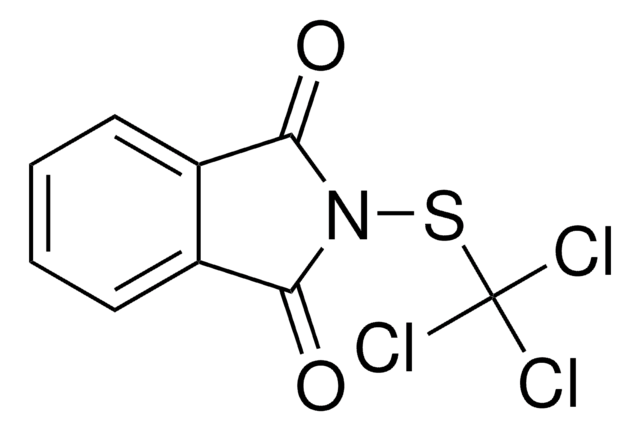
Folpet PESTANAL®, analytical standard

Supelco

32057

Folpet

application(s)

agriculture
cleaning products
cosmetics
environmental
food and beverages
personal care

application(s)

agriculture
cleaning products
cosmetics
environmental
food and beverages
personal care

application(s)

agriculture
cleaning products
cosmetics
environmental
food and beverages
personal care

application(s)

agriculture
cleaning products
cosmetics
environmental
food and beverages
personal care

technique(s)

HPLC: suitable, gas chromatography (GC): suitable

technique(s)

HPLC: suitable, gas chromatography (GC): suitable

technique(s)

HPLC: suitable, gas chromatography (GC): suitable

technique(s)

HPLC: suitable, gas chromatography (GC): suitable

Quality Level

100

Quality Level

100

Quality Level

100

Quality Level

100

grade

analytical standard

grade

analytical standard

grade

analytical standard

grade

analytical standard

shelf life

limited shelf life, expiry date on the label

shelf life

limited shelf life, expiry date on the label

shelf life

limited shelf life, expiry date on the label

shelf life

limited shelf life, expiry date on the label

product line

PESTANAL®

product line

PESTANAL®

product line

PESTANAL®

product line

PESTANAL®

General description

Fenarimol belongs to the pyrimidine class of compounds.

Application

Fenarimol may be used as an analytical reference standard for the determination of fenarimol in:
  • Honeys, honeybees and pollens by QuEChERS extraction followed by analysis using liquid chromatography-electrospray ionization-tandem mass spectrometry (LC-ESI-LC-MS/MS) combined with multiple reaction monitoring (MRM) detection.
  • Grapes by ethyl acetate extraction, dispersive solid phase extraction (d-SPE) clean-up and LC-ESI-MS/MS with MRM detection.
  • Fruit-based baby food samples by programmed temperature vaporizer injection-low pressure gas chromatography coupled with high resolution time-of-flight mass spectrometry (PTV-LP-GC-HR-TOF-MS).[1]
  • Foodstuffs by capillary GC-MS equipped with electron impact (EI) mode of ionization.
  • Soya grain samples by LC-ESI-MS/MS.

Refer to the product′s Certificate of Analysis for more information on a suitable instrument technique. Contact Technical Service for further support.

Legal Information

PESTANAL is a registered trademark of Merck KGaA, Darmstadt, Germany
Ta strona może zawierać tekst przetłumaczony maszynowo.

pictograms

Health hazardEnvironment

signalword

Warning

Hazard Classifications

Aquatic Chronic 2 - Lact. - Repr. 2

Klasa składowania

11 - Combustible Solids

wgk

WGK 2

flash_point_f

212.0 °F - closed cup

flash_point_c

100 °C - closed cup

ppe

Eyeshields, Gloves, type P3 (EN 143) respirator cartridges


Wybierz jedną z najnowszych wersji:

Certyfikaty analizy (CoA)

Lot/Batch Number

Nie widzisz odpowiedniej wersji?

Jeśli potrzebujesz konkretnej wersji, możesz wyszukać konkretny certyfikat według numeru partii lub serii.

Masz już ten produkt?

Dokumenty związane z niedawno zakupionymi produktami zostały zamieszczone w Bibliotece dokumentów.

Odwiedź Bibliotekę dokumentów

Jin-Cheol Kim et al.
Pest management science, 60(8), 803-808 (2004-08-17)
Methanol extracts of fresh materials of 183 plants were screened for in vivo antifungal activity against Magnaporthe grisea, Corticium sasaki, Botrytis cinerea, Phytophthora infestans, Puccinia recondita and Erysiphe graminis f sp hordei. Among them, 33 plant extracts showed disease-control efficacy
G Janer et al.
Aquatic toxicology (Amsterdam, Netherlands), 71(3), 273-282 (2005-01-27)
Testosterone conjugation activities, microsomal acyltransferases and cytosolic sulfotransferases, were investigated in three invertebrate species, the gastropod Marisa cornuarietis, the amphipod Hyalella azteca, and the echinoderm Paracentrotus lividus. The goals of the study were to characterize steroid conjugation pathways in different
Michela Sugni et al.
Ecotoxicology (London, England), 19(3), 538-554 (2009-11-26)
Two echinoderm species, the sea urchin Paracentrotus lividus and the feather star Antedon mediterranea, were exposed for 28 days to several EDCs: three putative androgenic compounds, triphenyltin (TPT), fenarimol (FEN), methyltestosterone (MET), and two putative antiandrogenic compounds, p,p'-DDE (DDE) and
Helle Raun Andersen et al.
Toxicology letters, 163(2), 142-152 (2005-12-06)
The fungicide fenarimol has the potential to induce endocrine disrupting effects via several mechanisms since it possesses both estrogenic and antiandrogenic activity and inhibits aromatase activity in cell culture studies. Hence, the integrated response of fenarimol in vivo is not
Karen L Thorpe et al.
Aquatic toxicology (Amsterdam, Netherlands), 85(3), 176-183 (2007-10-19)
Mechanism specific biomarkers are used in ecotoxicology to identify classes of chemicals and to inform on their presence in the environment, but their use in signalling for adverse effects has been limited by a poor understanding of their associated links

Numer pozycji handlu globalnego

SKUNUMER GTIN
45484-250MG04061832340715

Questions

Reviews

No rating value

Active Filters

Nasz zespół naukowców ma doświadczenie we wszystkich obszarach badań, w tym w naukach przyrodniczych, materiałoznawstwie, syntezie chemicznej, chromatografii, analityce i wielu innych dziedzinach.

Skontaktuj się z zespołem ds. pomocy technicznej