
MAB3418

Anti-MAP2 Antibody
CHEMICON®, mouse monoclonal, AP20
Synonim(y):
Microtubule Associated Protein, MAP2A and 2B
Wybierz wielkość
773,00 zł
2720,00 zł
773,00 zł
Dostępne do wysyłki DZISIAJSzczegóły
Informacje o tej pozycji
Przejdź do
Nazwa produktu
Anti-MAP2 Antibody, clone AP20, clone AP20, Chemicon®, from mouse
biological source
mouse
antibody form
purified immunoglobulin
antibody product type
primary antibodies
clone
AP20, monoclonal
species reactivity
bovine, mouse, rat, chicken, quail, Xenopus, human
packaging
antibody small pack of 25 μg
manufacturer/tradename
Chemicon®
technique(s)
immunohistochemistry: suitable, western blot: suitable
isotype
IgG
NCBI accession no.
UniProt accession no.
shipped in
ambient
storage temp.
2-8°C
target post-translational modification
unmodified
Quality Level
Gene Information
chicken ... Map2(424001)
frog ... Map2(780043)
human ... MAP2(4133)
mouse ... Map2(17756), Map2(281294)
rat ... Map2(25595)
Szukasz podobnych produktów? Odwiedź Przewodnik dotyczący porównywania produktów
1 of 4
Ta pozycja | |||
|---|---|---|---|
| antibody form purified immunoglobulin | antibody form affinity purified immunoglobulin | antibody form purified from hybridoma cell culture | antibody form purified immunoglobulin |
| species reactivity bovine, mouse, rat, chicken, quail, Xenopus, human | species reactivity rat, Xenopus, bovine, chicken, human, quail, mouse | species reactivity Xenopus, mouse, quail, human, bovine, rat, aquatic salamander | species reactivity rat, chicken, human, mouse, bovine, quail |
| biological source mouse | biological source mouse | biological source mouse | biological source mouse |
| clone AP20, monoclonal | clone AP20, monoclonal | clone AP-20, monoclonal | clone HM-2, monoclonal |
| Gene Information chicken ... Map2(424001) | Gene Information chicken ... Map2(424001) | Gene Information human ... MAP2(4133) | Gene Information human ... MAP2(4133) |
| isotype IgG | isotype IgG | isotype IgG1 | isotype IgG1 |


General description
Immunogen
Application
Neuroscience
Neuronal & Glial Markers
60 ng/mL. In SDS-PAGE, MAP-2 from adult rat migrates as a closely associated doublet having a molecular weight of approximately 280-300 kD representing the MAP-2A and -2B isoforms but not the 70 kDa MAP-2C isoform. However, early in brain development (postnatal day 10 in rats), MAP-2 migrates as a single band that is identical to the lower molecular weight band of the adult MAP-2 doublet (MAP-2b). Later in development (postnatal days 17-18), the mobility of MAP-2 changes to the adult doublet form. (In the spinal cord, conversion to the adult form occurs earlier). Users should run 4%-20% SDS-PAGE gradient gels.
Immunohistochemistry:
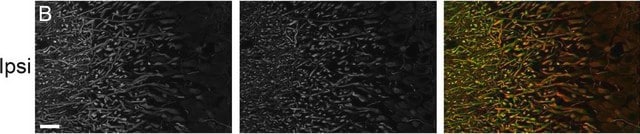
5 µg/mL (4% PFA fixed frozen sections).
Immunohistochemistry:
5 µg/mL of a previous lot was used. Anti-MAP-2 can be used to stain tissue (brain or spinal cord) fixed with paraformaldehyde.
Optimal working concentrations must be determined by the end user.
Biochem/physiol Actions
Physical form
Preparation Note
During shipment, small volumes of product will occasionally become entrapped in the seal of the product vial. For products with volumes of 200 µL or less, we recommend gently tapping the vial on a hard surface or briefly centrifuging the vial in a tabletop centrifuge to dislodge any liquid in the container’s cap.
Analysis Note
Brain, Neuronal culture, Human glioblastoma T98G cells.
Western Blot Analysis:
1:1000 dilution of this lot detected MAP2 on 10 μg of Rat Brain lysate.
Other Notes
Legal Information
Disclaimer
Nie możesz znaleźć właściwego produktu?
Wypróbuj nasz Narzędzie selektora produktów.
related product
Klasa składowania
12 - Non Combustible Liquids
wgk
WGK 1
flash_point_f
Not applicable
flash_point_c
Not applicable
Certyfikaty analizy (CoA)
Poszukaj Certyfikaty analizy (CoA), wpisując numer partii/serii produktów. Numery serii i partii można znaleźć na etykiecie produktu po słowach „seria” lub „partia”.
Masz już ten produkt?
Dokumenty związane z niedawno zakupionymi produktami zostały zamieszczone w Bibliotece dokumentów.
Produkty
Podłoża do różnicowania neuronalnego ludzkich iPSC i protokoły stosowane do generowania neuronalnych komórek macierzystych, neuronów i komórek glejowych.
Human iPSC neural differentiation media and protocols used to generate neural stem cells, neurons and glial cell types.
Powiązane treści
Active Filters
Nasz zespół naukowców ma doświadczenie we wszystkich obszarach badań, w tym w naukach przyrodniczych, materiałoznawstwie, syntezie chemicznej, chromatografii, analityce i wielu innych dziedzinach.
Skontaktuj się z zespołem ds. pomocy technicznej