Przejdź do zawartości
Merck

ABE285

Anti-Tristetraprolin Antibody

from rabbit, purified by affinity chromatography

Synonim(y):

Tristetraprolin, TTP, G0/G1 switch regulatory protein 24, Growth factor-inducible nuclear protein NUP475, Protein TIS11A, TIS11, Zinc finger protein 36 homolog, Zfp-36

Zaloguj się, aby wyświetlić ceny organizacyjne i kontraktowe.

Wybierz wielkość

100 μG

1900,00 zł

1900,00 zł


Przewidywany termin wysyłki07 stycznia 2026Szczegóły


Zamów zamówienie zbiorcze

Informacje o tej pozycji

UNSPSC Code:
12352203
NACRES:
NA.41
eCl@ss:
32160702

Przejdź do

Pomoc techniczna
Potrzebujesz pomocy? Nasz zespół doświadczonych naukowców chętnie Ci pomoże.
Pozwól nam pomóc

Nazwa produktu

Anti-Tristetraprolin Antibody, from rabbit, purified by affinity chromatography

biological source

rabbit

conjugate

unconjugated

antibody form

affinity isolated antibody

antibody product type

primary antibodies

clone

polyclonal

purified by

affinity chromatography

species reactivity

human, mouse

technique(s)

RIP: suitable
immunocytochemistry: suitable
immunoprecipitation (IP): suitable
western blot: suitable

NCBI accession no.

UniProt accession no.

shipped in

wet ice

target post-translational modification

unmodified

Quality Level

Gene Information

human ... ZFP36(7538)

Porównaj podobne pozycje

Wyświetl pełne porównanie

Pokaż różnice

1 of 4

Ta pozycja
T5327SAB4200565ABE434
Quality Level

100

Quality Level

200

Quality Level

200

Quality Level

100

antibody form

affinity isolated antibody

antibody form

affinity isolated antibody

antibody form

tissue culture supernatant

antibody form

affinity isolated antibody

biological source

rabbit

biological source

rabbit

biological source

mouse

biological source

rabbit

UniProt accession no.

P26651

UniProt accession no.

P26651

UniProt accession no.

P26651

UniProt accession no.

O15164

technique(s)

RIP: suitable, immunoprecipitation (IP): suitable, immunocytochemistry: suitable, western blot: suitable

technique(s)

immunoprecipitation (IP): 5-10 μg/mL using lysates of RAW264 cells induced with 10 ng/mL LPS for two hours, western blot: 0.5-1.0 μg/mL using lysates of RAW264 cells induced with 10 ng/mL LPS for two hours

technique(s)

western blot: 1:4,000-1:8,000 using extracts of HepG2 cells.

technique(s)

immunocytochemistry: suitable, western blot: suitable

shipped in

wet ice

shipped in

dry ice

shipped in

dry ice

shipped in

wet ice

Analysis Note

Control
A431 cell lysate
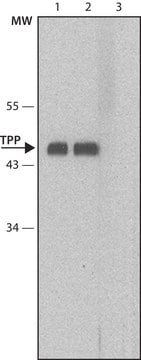
Evaluated by Western Blot in A431 cell lysate.

Western Blot Analysis: 1 µg/mL of this antibody detected Tristetraprolin on 10 µg of A431 cell lysate.

Application

Anti-Tristetraprolin Antibody is an antibody against Tristetraprolin for use in Western Blotting, ICC, Immunoprecipitation, RNA Binding Protein Immunoprecipitation (RIP).
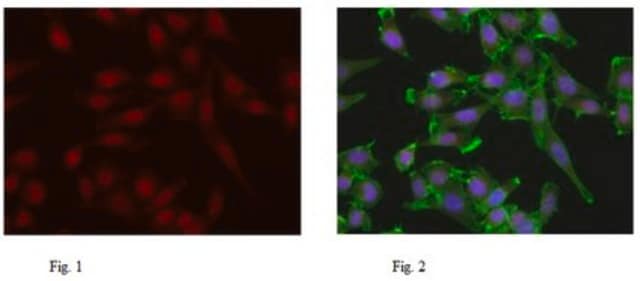
Immunocytochemistry Analysis: A representative lot was used by an independent laboratory to detect Tristetraprolin in human leukocytes. (Brooks, S., et al. (2002). Arthritis and Rheumatism. 46(5):1362–1370.)
Research Category
Epigenetics & Nuclear Function
Research Sub Category
Growth Factors & Receptors

Disclaimer

Unless otherwise stated in our catalog or other company documentation accompanying the product(s), our products are intended for research use only and are not to be used for any other purpose, which includes but is not limited to, unauthorized commercial uses, in vitro diagnostic uses, ex vivo or in vivo therapeutic uses or any type of consumption or application to humans or animals.

General description

Tristetraprolin (TTP, Nup 475, TIS11, G0S24, or ZFP36) is a member of the CCCH tandem zinc finger protein family. It is a nuclear RNA-binding protein that functions as a trans-acting factor. It is involved in post-transcriptional regulation of cytokine genes, most notably Tumor Necrosis Factor alpha (TNF-α). Upon activation by lipopolysaccharides, TTP binds TNF-α mRNA at AU-rich domains in the 3′-untranslated Region (3′-UTR) and induces deadenylation, thereby destabilizing the mRNA and tagging it for degradation. To produce this effect, TTP recruits other trans-acting factors to its C-terminal domain and mRNA-decay enzymes to its N-terminal domain. TTP is deactivated by phosphorylation driven by mitogen-activated protein kinase-activated protein kinase 2 (MK2) and p53. Therefore, TTP/MK2 regulates the biosynthesis of TNF-α and mediates inflammatory responses involving TNF-α. Knockout of TTP in mice produces arthritis, alopecia, dermatitis, among a range of other phenotypes related to overexpression of TNF-α.
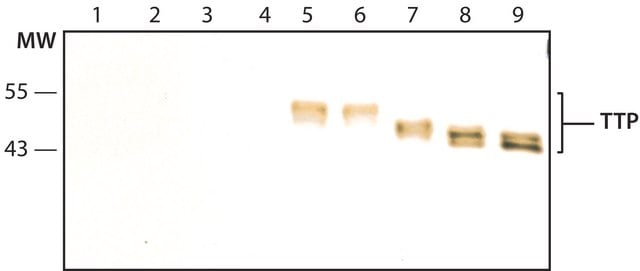
~40 kDa observed. Uniprot gives a calculated molecular weight of 34 kDa An uncharacterized band appears at ~53 kDa in some lysates.

Immunogen

KLH-conjugated linear peptide corresponding to human Tristetraprolin.

Other Notes

Concentration: Please refer to the Certificate of Analysis for the lot-specific concentration.

Physical form

Affinity purified
Purified rabbit polyclonal in buffer containing PBS without 0.05% sodium azide.

Preparation Note

Stable for 1 year at 2-8°C from date of receipt.
Ta strona może zawierać tekst przetłumaczony maszynowo.

Nie możesz znaleźć właściwego produktu?  

Wypróbuj nasz Narzędzie selektora produktów.

Klasa składowania

12 - Non Combustible Liquids

wgk

WGK 2

flash_point_f

Not applicable

flash_point_c

Not applicable


Certyfikaty analizy (CoA)

Poszukaj Certyfikaty analizy (CoA), wpisując numer partii/serii produktów. Numery serii i partii można znaleźć na etykiecie produktu po słowach „seria” lub „partia”.

Masz już ten produkt?

Dokumenty związane z niedawno zakupionymi produktami zostały zamieszczone w Bibliotece dokumentów.

Odwiedź Bibliotekę dokumentów

Tongjia Zhang et al.
Cell death & disease, 14(8), 527-527 (2023-08-17)
Non-small cell lung cancer (NSCLC) is the most common type of lung cancer, with high morbidity and mortality worldwide. Although the dysregulation of BARX1 expression has been shown to be associated with malignant cancers, including NSCLC, the underlying mechanism remains
Comparative phosphoproteomics reveals components of host cell invasion and post-transcriptional regulation during Francisella infection.
Nakayasu, ES; Tempel, R; Cambronne, XA; Petyuk, VA; Jones, MB; Gritsenko, MA; Monroe et al.
Molecular and Cellular Proteomics null
Jan Meier et al.
RNA biology, 10(6), 1018-1029 (2013-05-16)
MicroRNAs (miRNAs) are single-stranded, small, non-coding RNAs, which fine-tune protein expression by degrading and/or translationally inhibiting mRNAs. Manipulation of miRNA expression in animal models frequently results in severe phenotypes indicating their relevance in controlling cellular functions, most likely by interacting
Xiaohui Liu et al.
Oncotarget, 7(33), 53330-53338 (2016-07-28)
Tristetraprolin (TTP), a member of TIS11 family containing CCCH tandem zinc finger, is one of the best characterized RNA-binding proteins. However, to date, the role of TTP in mammalian oocytes remains completely unknown. In the present study, we report the
Matthew A Coelho et al.
Immunity, 47(6), 1083-1099 (2017-12-17)
The immunosuppressive protein PD-L1 is upregulated in many cancers and contributes to evasion of the host immune system. The relative importance of the tumor microenvironment and cancer cell-intrinsic signaling in the regulation of PD-L1 expression remains unclear. We report that

Powiązane treści

New Products: Antibodies, Assays, Small Molecules, Inhibitors, and Proteins

Questions

Reviews

No rating value

Active Filters

Nasz zespół naukowców ma doświadczenie we wszystkich obszarach badań, w tym w naukach przyrodniczych, materiałoznawstwie, syntezie chemicznej, chromatografii, analityce i wielu innych dziedzinach.

Skontaktuj się z zespołem ds. pomocy technicznej