Przejdź do zawartości
Merck

Przejdź do

ABC10

Anti-Megf10 Antibody

from rabbit, purified by affinity chromatography

Synonim(y):

Multiple epidermal growth factor-like domains protein 10, Multiple EGF-like domains protein 10

Zaloguj się, aby wyświetlić ceny organizacyjne i kontraktowe.

Wybierz wielkość

Zmień widok
Gabaryty przesyłkiSKUDostępnośćCena netto
100 μg

Dostępne do wysyłki DZISIAJzKuehne + Nagel Sp. z o.o.

1750,00 zł

Informacje o tej pozycji

UNSPSC Code:
12352203
NACRES:
NA.41
eCl@ss:
32160702
Conjugate:
unconjugated
Clone:
polyclonal
Application:
IF, WB
Citations:
7

1750,00 zł


Dostępne do wysyłki DZISIAJSzczegóły


Zamów zamówienie zbiorcze
Pomoc techniczna
Potrzebujesz pomocy? Nasz zespół doświadczonych naukowców chętnie Ci pomoże.
Pozwól nam pomóc

biological source

rabbit

Quality Level

conjugate

unconjugated

antibody form

affinity isolated antibody

antibody product type

primary antibodies

clone

polyclonal

purified by

affinity chromatography

species reactivity

mouse

technique(s)

immunofluorescence: suitable, western blot: suitable

NCBI accession no.

Porównaj podobne pozycje

Wyświetl pełne porównanie

Pokaż różnice

1 of 1

Ta pozycja
SAB4500710WH0002255M5HPA049248
Quality Level

100

Quality Level

-

Quality Level

100

Quality Level

100

biological source

rabbit

biological source

rabbit

biological source

mouse

biological source

rabbit

antibody form

affinity isolated antibody

antibody form

affinity isolated antibody

antibody form

purified immunoglobulin

antibody form

affinity isolated antibody

conjugate

unconjugated

conjugate

unconjugated

conjugate

unconjugated

conjugate

unconjugated

Gene Information

mouse ... Megf10(70417)

Gene Information

human ... MEGF9(1955)

Gene Information

human ... FGF10(2255)

Gene Information

human ... MEGF8(1954)

species reactivity

mouse

species reactivity

human, mouse, rat

species reactivity

human

species reactivity

human

General description

Multiple epidermal growth factor-like domains protein 10 (Megf10) is a type 1 transmembrane protein with multiple EGF-like extracellular domains. Megf10 is highly expressed in the brain, and plays an important role in phacocytosis of apoptotic cells. This role may be performed through the interaction of Megf10 with the ATP-binding cassette transporter (ABCA1) protein. Previous studies have suggested that Megf10 may be involved in the uptake of amyloid β peptides in the brain. Megf10 may therefore play a role Alzheimer’s disease.
~130 kDa observed

Immunogen

Epitope: Cytoplasmic domain
Histidine-tagged recombinant protein corresponding to the cytoplasmic domain of mouse Megf10.

Application

Detect the Megf10 protein using this Anti-Megf10 validated for use in WB & IF.
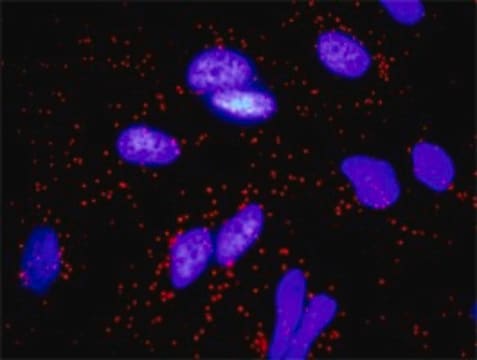
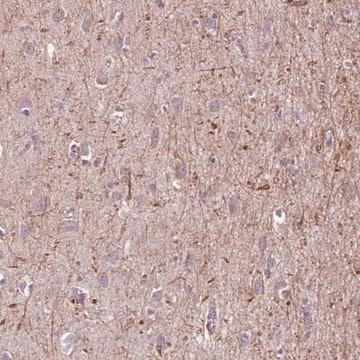
Immunofluorescence Analysis: A representative lot was used to detect Megf10 in P7 caudal brain tissue and retina cells by an independent laboratory. (Image courtesy form the laboratory of Dr. Joshua Sanes, Harvard University).

Note: Actual optimal working dilutions must be determined by end user as specimens, and experimental conditions may vary with the end user
Research Category
Apoptosis & Cancer
Research Sub Category
Apoptosis - Additional

Biochem/physiol Actions

Other homologies: Rat (98% sequence homology) and Human (92% sequence homology).
This antibody recognizes Megf10 at the cytoplasmic domain.

Physical form

Affinity purified
Purified rabbit polyclonal in buffer containing 0.1 M Tris-Glycine (pH 7.4), 150 mM NaCl with 0.05% sodium azide.

Preparation Note

Stable for 1 year at 2-8°C from date of receipt.

Analysis Note

Control
Mouse retina tissue lysate
Evaluated by Western Blotting in Mouse Brain tissue lysate.

Western Blotting Analysis: A 1:500 dilution of this antibody detected Megf10 in Mouse Brain tissue lysate.

Other Notes

Concentration: Please refer to the Certificate of Analysis for the lot-specific concentration.

Disclaimer

Unless otherwise stated in our catalog or other company documentation accompanying the product(s), our products are intended for research use only and are not to be used for any other purpose, which includes but is not limited to, unauthorized commercial uses, in vitro diagnostic uses, ex vivo or in vivo therapeutic uses or any type of consumption or application to humans or animals.
Ta strona może zawierać tekst przetłumaczony maszynowo.

Nie możesz znaleźć właściwego produktu?  

Wypróbuj nasz Narzędzie selektora produktów.

Klasa składowania

12 - Non Combustible Liquids

wgk

WGK 1

flash_point_f

Not applicable

flash_point_c

Not applicable


Certyfikaty analizy (CoA)

Poszukaj Certyfikaty analizy (CoA), wpisując numer partii/serii produktów. Numery serii i partii można znaleźć na etykiecie produktu po słowach „seria” lub „partia”.

Masz już ten produkt?

Dokumenty związane z niedawno zakupionymi produktami zostały zamieszczone w Bibliotece dokumentów.

Odwiedź Bibliotekę dokumentów

Dai Shi et al.
International journal of molecular sciences, 24(2) (2023-01-22)
It has been hypothesised that inhalational anaesthetics such as isoflurane (Iso) may trigger the pathogenesis of Alzheimer's disease (AD), while the gaseous anaesthetic xenon (Xe) exhibits many features of a putative neuroprotective agent. Loss of synapses is regarded as one
Michael Surala et al.
EMBO reports, 25(5), 2348-2374 (2024-04-09)
Microglia sculpt developing neural circuits by eliminating excess synapses in a process called synaptic pruning, by removing apoptotic neurons, and by promoting neuronal survival. To elucidate the role of microglia during embryonic and postnatal brain development, we used a mouse
Hiroyuki Konishi et al.
The EMBO journal, 39(22), e104464-e104464 (2020-09-23)
Microglia are the principal phagocytes that clear cell debris in the central nervous system (CNS). This raises the question, which cells remove cell debris when microglial phagocytic activity is impaired. We addressed this question using Siglechdtr mice, which enable highly
Lingjie Li et al.
International journal of molecular sciences, 25(2) (2024-01-23)
Synapse loss is one of the most critical features in Alzheimer's disease (AD) and correlates with cognitive decline. Astrocytes mediate synapse elimination through multiple EGF-like domains 10 (MEGF10) pathways in the developing and adult brain to build the precise neural
Yin-Peng Chen et al.
Frontiers in molecular neuroscience, 9, 105-105 (2016-11-09)
Cytoplasmic polyadenylation element binding protein 3 (CPEB3) regulates target RNA translation in neurons. Here, we examined CPEB3 distribution and function in the mouse retina. CPEB3 is expressed in retinal neurons, including those located in the inner nuclear layer (INL) and

Powiązane treści

New Products: Antibodies, Assays, Small Molecules, Inhibitors, and Proteins

Numer pozycji handlu globalnego

SKUNUMER GTIN
ABC1004053252550188

Questions

Reviews

No rating value

Active Filters

Nasz zespół naukowców ma doświadczenie we wszystkich obszarach badań, w tym w naukach przyrodniczych, materiałoznawstwie, syntezie chemicznej, chromatografii, analityce i wielu innych dziedzinach.

Skontaktuj się z zespołem ds. pomocy technicznej