Przejdź do zawartości
Merck

Przejdź do

AB2203

Anti-CLOCK Antibody

serum, Chemicon®

Zaloguj się, aby wyświetlić ceny organizacyjne i kontraktowe.

Wybierz wielkość

Zmień widok
Gabaryty przesyłkiSKUDostępnośćCena netto

Informacje o tej pozycji

UNSPSC Code:
12352203
NACRES:
NA.41
eCl@ss:
32160702
Conjugate:
unconjugated
Clone:
polyclonal
Application:
WB
Citations:
5
Informacje o cenach i dostępności nie są obecnie dostępne.
Pomoc techniczna
Potrzebujesz pomocy? Nasz zespół doświadczonych naukowców chętnie Ci pomoże.
Pozwól nam pomóc

biological source

rabbit

Quality Level

conjugate

unconjugated

antibody form

serum

antibody product type

primary antibodies

clone

polyclonal

species reactivity

mouse, human, rat

manufacturer/tradename

Chemicon®

technique(s)

western blot: suitable

GenBank accession no.

Szukasz podobnych produktów? Odwiedź Przewodnik dotyczący porównywania produktów

Porównaj podobne pozycje

Wyświetl pełne porównanie

Pokaż różnice

1 of 1

Ta pozycja
ABE2598MSAB5701638AB5416P
conjugate

unconjugated

conjugate

unconjugated

conjugate

unconjugated

conjugate

unconjugated

antibody form

serum

antibody form

affinity isolated antibody

antibody form

-

antibody form

affinity purified immunoglobulin

Quality Level

100

Quality Level

100

Quality Level

100

Quality Level

100

biological source

rabbit

biological source

guinea pig

biological source

rabbit

biological source

rabbit

shipped in

wet ice

shipped in

-

shipped in

wet ice

shipped in

dry ice

Gene Information

mouse ... Clock(12753)

Gene Information

mouse ... Clock(12753)

Gene Information

human ... CLOCK(9575)

Gene Information

human ... CLOCK(9575)

General description

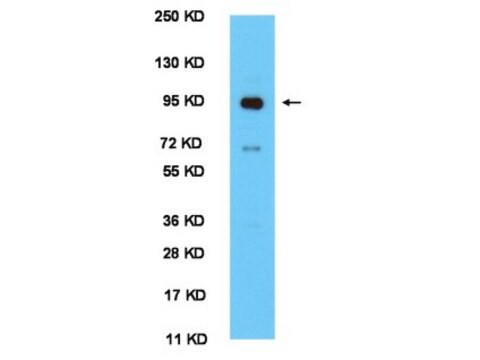
Approx. 95 kDa
Circadian Locomotor Output Cycles Kaput, or Clock is a gene which encodes proteins regulating circadian rhythm. This gene encodes a protein that belongs to the basic helix-loop-helix (bHLH) family of transcription factors. Polymorphisms within the encoded protein have been associated with circadian rhythm sleep disorders. A similar protein in mice is a circadian regulator that acts as a transcription factor and forms a heterodimer with aryl hydrocarbon receptor nuclear translocator-like protein to activate transcription of mouse period 1.

Application

Anti-CLOCK Antibody is an antibody against CLOCK for use in WB.
Western Blot Analysis:
L6 lysate was resolved by electrophoresis, transferred to PVDF membrane and probed with anti-CLOCK (1:500 dilution of this lot).
Proteins were visualized using a Donkey anti-rabbit secondary antibody conjugated to HRP and a chemiluminescence detection system.

Biochem/physiol Actions

Cat. # AB2203 recognizes CLOCK protein
Reactivity with other species has not been tested.

Analysis Note

Control
L6 Cell Lysate.
Routinely evaluated by western blot on L6 tissue lysate.

Other Notes

Concentration: Please refer to the Certificate of Analysis for the lot-specific concentration.

Legal Information

CHEMICON is a registered trademark of Merck KGaA, Darmstadt, Germany
GenBank is a registered trademark of United States Department of Health and Human Services
Ta strona może zawierać tekst przetłumaczony maszynowo.

Nie możesz znaleźć właściwego produktu?  

Wypróbuj nasz Narzędzie selektora produktów.

Klasa składowania

10 - Combustible liquids

wgk

WGK 1


Certyfikaty analizy (CoA)

Poszukaj Certyfikaty analizy (CoA), wpisując numer partii/serii produktów. Numery serii i partii można znaleźć na etykiecie produktu po słowach „seria” lub „partia”.

Masz już ten produkt?

Dokumenty związane z niedawno zakupionymi produktami zostały zamieszczone w Bibliotece dokumentów.

Odwiedź Bibliotekę dokumentów

Antibodies for assessing circadian clock proteins in the rodent suprachiasmatic nucleus.
LeSauter, J; Lambert, CM; Robotham, MR; Model, Z; Silver, R; Weaver, DR
Testing null
Xiaoqin Liu et al.
PloS one, 7(11), e50602-e50602 (2012-11-29)
Circadian rhythms in metabolism, physiology, and behavior originate from cell-autonomous circadian clocks located in many organs and structures throughout the body and that share a common molecular mechanism based on the clock genes and their protein products. In the mammalian
Yohei Kobayashi et al.
Neuron, 86(1), 264-275 (2015-03-25)
Circadian rhythms control a variety of physiological processes, but whether they may also time brain development remains largely unknown. Here, we show that circadian clock genes control the onset of critical period plasticity in the neocortex. Within visual cortex of
Mark A Naven et al.
Theranostics, 12(8), 3963-3976 (2022-06-07)
The circadian clock in murine articular cartilage is a critical temporal regulatory mechanism for tissue homeostasis and osteoarthritis. However, translation of these findings into humans has been hampered by the difficulty in obtaining circadian time series human cartilage tissues. As
Arthur H Cheng et al.
Cell reports, 26(12), 3191-3202 (2019-03-21)
Clock neurons within the mammalian suprachiasmatic nuclei (SCN) encode circadian time using interlocked transcription-translation feedback loops (TTFLs) that drive rhythmic gene expression. However, the contributions of other transcription factors outside of the circadian TTFLs to the functionality of the SCN

Numer pozycji handlu globalnego

SKUNUMER GTIN
AB220304053252278365

Nasz zespół naukowców ma doświadczenie we wszystkich obszarach badań, w tym w naukach przyrodniczych, materiałoznawstwie, syntezie chemicznej, chromatografii, analityce i wielu innych dziedzinach.

Skontaktuj się z zespołem ds. pomocy technicznej