
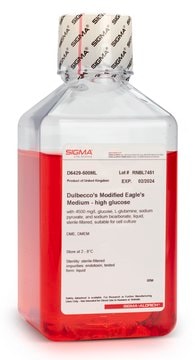


This product is a liquid medium. The density is not reported. The 1L volume weighs approximately 1 kilogram. The total weight of the packaged 1L size is 1.1 kg. The total weight of the packaged 500 mL size is 578 g.
D6429

DMEM - high glucose
With sodium bicarbonate, ʟ-glutamine and sodium pyruvate, liquid, sterile-filtered, suitable for cell culture
Dulbecco’s Modified Eagle’s Medium - high glucose
1 of 5 reviewers received a sample product or took part in a promotion
Sinonimo/i:
DME, DMEM
Autenticati per visualizzare i prezzi organizzativi e contrattuali.
Scegli un formato
Prezzi e disponibilità al momento non sono disponibili
Informazioni su questo articolo
UNSPSC Code:
12352207
NACRES:
NA.71
Vai a
Servizio Tecnico
Hai bisogno di aiuto? Il nostro team di scienziati qualificati è a tua disposizione.
Permettici di aiutartiNome del prodotto
Terreno Eagle modificato di Dulbecco - alto glucosio, With 4500 mg/L glucose, L-glutamine, sodium pyruvate, and sodium bicarbonate, liquid, sterile-filtered, suitable for cell culture
sterility
sterile-filtered
form
liquid
technique(s)
cell culture | mammalian: suitable
impurities
endotoxin, tested
components
HEPES: no
NaHCO3: yes
phenol red: yes
sodium pyruvate: yes
L-glutamine: yes
glucose: high
shipped in
ambient
storage temp.
2-8°C
Quality Level
Cerchi prodotti simili? Visita Guida al confronto tra prodotti
1 of 4
Questo articolo | D6546 | D5796 | D1145 |
|---|---|---|---|
| sterility sterile-filtered | sterility sterile-filtered | sterility sterile-filtered | sterility sterile-filtered |
| technique(s) cell culture | mammalian: suitable | technique(s) cell culture | mammalian: suitable | technique(s) cell culture | mammalian: suitable | technique(s) cell culture | mammalian: suitable |
| form liquid | form liquid | form liquid | form liquid |
| components HEPES: no | components NaHCO3: yes | components NaHCO3: yes | components L-glutamine: no |
| storage temp. 2-8°C | storage temp. 2-8°C | storage temp. 2-8°C | storage temp. 2-8°C |
| shipped in ambient | shipped in ambient | shipped in ambient | shipped in ambient |
General description
Questo terreno di coltura DMEM-Hi ad alto glucosio è un terreno 1x completo arricchito con piruvato di sodio. Si differenzia dalla formulazione DMEM-Hi originale in quanto la contiene piridossina al posto del piridossale. Il piridossale è un componente instabile dei terreni di coltura.
Application
Il terreno Eagle modificato di Dulbecco (DMEM) è una versione modificata del terreno basale Eagle (BME) che contiene concentrazioni quattro volte superiori di amminoacidi e vitamine. La formulazione originale conteneva 1000 mg/L di glucosio ed è stata utilizzata per coltivare cellule embrionali di topo. Da allora, il terreno è stato modificato in diversi modi per favorire le colture primarie di cellule di topo e pollo e di molte altre cellule normali e trasformate. Ognuno di questi terreni offre una diversa combinazione di L-glutammina e piruvato di sodio. Inoltre, i livelli di glucosio sono stati innalzati a 4500 mg/L, motivo per cui il terreno è denominato “DMEM/High”.
Related product
N° Catalogo
Descrizione
Determinazione del prezzo
Classe di stoccaggio
12 - Non Combustible Liquids
flash_point_f
Not applicable
flash_point_c
Not applicable
Scegli una delle versioni più recenti:
Possiedi già questo prodotto?
I documenti relativi ai prodotti acquistati recentemente sono disponibili nell’Archivio dei documenti.
Mouse sphingosine kinase isoforms SPHK1a and SPHK1b differ in enzymatic traits including stability, localization, modification, and oligomerization.
Kihara A, et al.
The Journal of Biological Chemistry, 281(7), 4532-4539 (2006)
Neuraminidase receptor binding variants of human influenza A(H3N2) viruses resulting from substitution of aspartic acid 151 in the catalytic site: a role in virus attachment?
Lin YP, et al.
Journal of Virology, 84(13), 6769-6781 (2010)
Kazuhiro Ikeda et al.
Scientific reports, 7(1), 2850-2850 (2017-06-08)
Human pluripotent stem cells are a potentially powerful cellular resource for application in regenerative medicine. Because such applications require large numbers of human pluripotent stem cell-derived cells, a scalable culture system of human pluripotent stem cell needs to be developed.
Kenta Imai et al.
Journal of cell science, 129(20), 3781-3791 (2016-09-03)
Autophagy is an intracellular degradation pathway conserved in eukaryotes. Among core autophagy-related (Atg) proteins, mammalian Atg9A is the sole multi-spanning transmembrane protein, and both of its N- and C-terminal domains are exposed to the cytoplasm. It is known that Atg9A
Mikiko Fukuda et al.
The Journal of reproduction and development, 62(1), 121-125 (2015-11-26)
Production of knockout mice using targeted embryonic stem cells (ESCs) is a powerful approach for investigating the function of specific genes in vivo. Although the protocol for gene targeting via homologous recombination (HR) in ESCs is already well established, the
Articoli
The field of proteomics is continually looking for new ways to investigate protein dynamics within complex biological samples. Recently, many researchers have begun to use RNA interference (RNAi) as a method of manipulating protein levels within their samples, but the ability to accurately determine these protein amounts remains a challenge. Fortunately, over the past decade, the field of proteomics has witnessed significant advances in the area of mass spectrometry. These advances, both in instrumentation and methodology, are providing researchers with sensitive assays for both identification and quantification of proteins within complex samples. This discussion will highlight some of these methodologies, namely the use of Multiple Reaction Monitoring (MRM) and Protein-AQUA.
Cell culture protocol for passaging and splitting suspension cell lines
Contenuto correlato
Learn how to use our cell culture tested, ready-to-use MilliShot™ single dose antibiotic solutions, conveniently packaged in one-time use vials.
Instructions
-
How much does D6429-1L weigh? Thank you!
1 answer-
Helpful?
-
-
Hi, What is the concentration of endotoxin detected in DMEM high glucose media D6429?
1 answer-
This product has an endotoxin specification of ≤ 1 EU/ml or 0.1 ng/mL. The lot specific values are reported in the Certificate of Analysis. Please see the link below to review a sample or lot specific Certificate:
https://www.sigmaaldrich.com/product/sigma/d6429#product-documentationHelpful?
-
-
What is the concentration of Sodium Bicarbonate and Sodium Pyruvate in it?
1 answer-
This formulation contains 3.7 g/L sodium bicarbonate and 110 mg/L sodium pyruvate. The composition of this product is published on page 3 of the product information sheet. Please see the link below to access this document: https://www.sigmaaldrich.com/deepweb/assets/sigmaaldrich/product/documents/318/256/d6429for.pdf
Helpful?
-
-
After opening a bottle of medium: how long can I use this bottle ?(stored at 4C°)
1 answer-
Provided that the product is handled and stored properly and has not been contaminated, the medium will be stable up to the expiration date. This date is provided on the label and the lot-specific Certificate of Analysis.
Helpful?
-
-
I would like to inquire about the amino acid formulation in DMEM (#6429, #6546). Specifically, could you provide information on the concentration of aspartate and glutamate in these formulations? Thank you very much.
1 answer-
The composition of this product is published on page 3 of the product information sheet. Please see the link below to access this document: https://www.sigmaaldrich.com/deepweb/assets/sigmaaldrich/product/documents/318/256/d6429for.pdf
Helpful?
-
Active Filters
Il team dei nostri ricercatori vanta grande esperienza in tutte le aree della ricerca quali Life Science, scienza dei materiali, sintesi chimica, cromatografia, discipline analitiche, ecc..
Contatta l'Assistenza Tecnica