Direkt zum Inhalt
Merck

F4012

Anti-Dog IgG (whole molecule)–FITC antibody produced in rabbit

IgG fraction of antiserum, buffered aqueous solution

Synonym(e):

Rabbit Anti-Dog IgG (whole molecule)–Fluorescein isothiocyanate

Anmelden zur Ansicht der Organisations- und Vertragspreise.

Größe auswählen

2 ML

CHF 285.00

CHF 285.00


Warenkorb auf Verfügbarkeit prüfen

Großbestellung anfragen

Über diesen Artikel

UNSPSC Code:
12352203
NACRES:
NA.46
MDL number:
Conjugate:
FITC conjugate
Clone:
polyclonal
Application:
IF (d)
Citations:
7

Fortfahren mit

Technischer Dienst
Benötigen Sie Hilfe? Unser Team von erfahrenen Wissenschaftlern ist für Sie da.
Unterstützung erhalten

biological source

rabbit

conjugate

FITC conjugate

antibody form

IgG fraction of antiserum

antibody product type

secondary antibodies

clone

polyclonal

form

buffered aqueous solution

storage condition

protect from light

technique(s)

direct immunofluorescence: 1:32

storage temp.

−20°C

target post-translational modification

unmodified

Quality Level

Suchen Sie nach ähnlichen Produkten? Aufrufen Leitfaden zum Produktvergleich

Ähnliche Artikel vergleichen

Vollständigen Vergleich anzeigen

Unterschiede anzeigen

1 of 4

Dieser Artikel
F4262F7887F6258
conjugate

FITC conjugate

conjugate

FITC conjugate

conjugate

FITC conjugate

conjugate

FITC conjugate

biological source

rabbit

biological source

goat

biological source

rabbit

biological source

goat

antibody form

IgG fraction of antiserum

antibody form

IgG fraction of antiserum

antibody form

affinity isolated antibody

antibody form

affinity isolated antibody

technique(s)

direct immunofluorescence: 1:32

technique(s)

direct immunofluorescence: 1:32

technique(s)

direct immunofluorescence: 1:300, immunohistochemistry: 1:300

technique(s)

direct immunofluorescence: 1:32

form

buffered aqueous solution

form

buffered aqueous solution

form

buffered aqueous solution

form

buffered aqueous solution

storage temp.

−20°C

storage temp.

−20°C

storage temp.

−20°C

storage temp.

2-8°C

General description

IgG is present in large quantities in the human serum and about 10-20% of the plasma proteins. IgG is composed of glycoproteins, out of which it is 82-96% proteins and 4-18% carbohydrates. It consists of four sub-classes i.e IgG1, IgG2, IgG3, and IgG4. IgG is composed of four polypeptide chains-two heavy chains (γ chains) and two light chains (κ or λ chains) which are linked by inter-chain disulfide bonds. The heavy chains consist of a N-terminal variable domain (VH) and three constant domains (CH1, CH2, CH3). A hinge region exists between the CH1 and CH2 region. The light chains have one N-terminal variable domain (VL) and one constant domain (CL). The heavy and the light chains are linked at VH and CH1 domain to form the Fab arm (Fragment antigen binding). The antigen binds to the V regions of the antibody.

Application

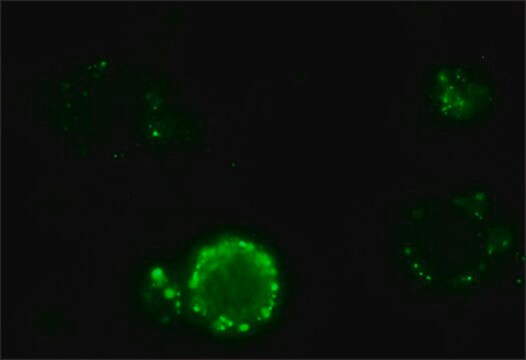
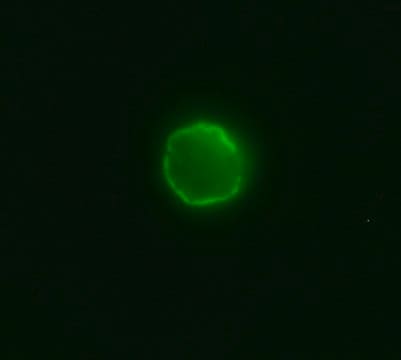
Anti-Dog IgG (whole molecule)-FITC antibody has been used in indirect fluorescent antibody test(IFAT)
Rabbit polyclonal anti-Dog IgG (whole molecule)–FITC antibody may be used as a secondary antibody or to detect the presence of dog IgG via fluorogenic immunochemical or immunohistochemical techniques.

Biochem/physiol Actions

IgG, a monoclonal antibody can be cleaved at the hinge region by nonspecific proteases like papain and pepsin. This can result in univalent Fab fragments or bivalent F(ab′)2 fragments. These two enzymes have a broad substrate specificity resulting in heterogenous fragments. Fluorescein isothiocyanate (FITC) is a fluorescein derivative (fluorochrome) used to tag antibodies, including secondary antibodies, for use in fluorescence-based assays and procedures. FITC excites at 495nm and emits at 521nm.

Physical form

Solution in 0.01 M phosphate buffered saline, pH 7.4, containing 15mM sodium azide.

Disclaimer

Unless otherwise stated in our catalog or other company documentation accompanying the product(s), our products are intended for research use only and are not to be used for any other purpose, which includes but is not limited to, unauthorized commercial uses, in vitro diagnostic uses, ex vivo or in vivo therapeutic uses or any type of consumption or application to humans or animals.

Sie haben nicht das passende Produkt gefunden?  

Probieren Sie unser Produkt-Auswahlhilfe. aus.

Lagerklasse

10 - Combustible liquids

wgk

nwg

flash_point_f

Not applicable

flash_point_c

Not applicable

ppe

Eyeshields, Gloves, multi-purpose combination respirator cartridge (US)


Hier finden Sie alle aktuellen Versionen:

Analysenzertifikate (COA)

Lot/Batch Number

Die passende Version wird nicht angezeigt?

Wenn Sie eine bestimmte Version benötigen, können Sie anhand der Lot- oder Chargennummer nach einem spezifischen Zertifikat suchen.

Besitzen Sie dieses Produkt bereits?

In der Dokumentenbibliothek finden Sie die Dokumentation zu den Produkten, die Sie kürzlich erworben haben.

Die Dokumentenbibliothek aufrufen

Seray Ozensoy Töz et al.
Turkiye parazitolojii dergisi, 37(2), 107-112 (2013-08-21)
In this study, the investigation on the prevalence of canine leishmaniasis (CanL) and sand fly species incriminated as potential vectors of leishmaniasis in the northern part of the Cyprus were aimed. This research was conducted in two periods; 2004 and
Uillians Volkart de Oliveira et al.
Veterinary parasitology, 198(1-2), 209-213 (2013-09-18)
The aim of this study was to characterize the role of quails (Coturnix coturnix japonica) as intermediate hosts for Neospora caninum. Fifty-eight 20-day old quails were individually identified with numbered rings and kept in cages adequate for the species. The
Experimental inoculation of Neospora caninum tachyzoites in eared doves (Zenaida auriculata)
de Barros L D, et al.
Experimental Parasitology, 202(1-2), 1-6 (2019)
L P Aquino et al.
Memorias do Instituto Oswaldo Cruz, 94(2), 255-260 (1999-05-04)
This research investigated the pattern of antibody response by means of enzyme linked immunosorbent assay (Elisa) and indirect fluorescent antibody test (IFAT) through the course of experimental Trypanosoma evansi infection in dogs. Clinical and parasitological features were also studied. The
Alexandre Dias Munhoz et al.
Veterinary parasitology, 206(3-4), 123-128 (2014-12-04)
The aim of this study was to experimentally evaluate infection in Gallus gallus domesticus with Neospora caninum tachyzoites of the NC-1 strain. Experimental infection was conducted in 90-day-old chickens, embryonated eggs and bioassays in dogs. In the first experiment, poults

Verwandter Inhalt

Questions

Reviews

No rating value

Active Filters

Unser Team von Wissenschaftlern verfügt über Erfahrung in allen Forschungsbereichen einschließlich Life Science, Materialwissenschaften, chemischer Synthese, Chromatographie, Analytik und vielen mehr..

Setzen Sie sich mit dem technischen Dienst in Verbindung