Skip to Content
Merck

Skip To

MAC133

Anti-Cas9 Antibody, clone 7A9

clone 7A9, from mouse

Synonym(s):

dCas9

Sign In to View Organizational & Contract Pricing.

Select a Size

Change View
Pack SizeSKUAvailabilityPrice

About This Item

UNSPSC Code:
12352203
NACRES:
NA.41
eCl@ss:
32160702
Clone:
7A9, monoclonal
Technique(s):
immunocytochemistry: suitable, immunoprecipitation (IP): suitable, western blot: suitable
Application:
ICC, IP, WB
Citations:
28
Pricing and availability is not currently available.
Technical Service
Need help? Our team of experienced scientists is here for you.
Let Us Assist


biological source

mouse

Quality Level

antibody form

purified antibody

antibody product type

primary antibodies

clone

7A9, monoclonal

species reactivity (predicted by homology)

all

technique(s)

immunocytochemistry: suitable, immunoprecipitation (IP): suitable, western blot: suitable

isotype

IgG1κ

shipped in

wet ice

target post-translational modification

unmodified

General description

Cas9 is an essential endonuclease in Streptococcus pyogenes serotype M1 that is part of that organism’s innate immunity system, or CRISPR (clustered regularly interspaced short palindromic repeat) adaptive immune system that provides protection against mobile genetic elements (viruses, transposable elements and conjugative plasmids). CRISPR clusters contain spacers, sequences complementary to antecedent mobile elements, and target invading nucleic acids. CRISPR clusters are transcribed and processed into CRISPR RNA (crRNA). In type II CRISPR systems correct processing of pre-crRNA requires a trans-encoded small RNA (tracrRNA), endogenous ribonuclease 3 (rnc) and Cas9. Subsequently Cas9/crRNA/tracrRNA endonucleolytically cleaves linear or circular dsDNA target complementary to the spacer. The target strand not complementary to crRNA is first cut endonucleolytically, and then trimmed by 3′-5′ exonucleolytically. DNA-binding requires protein and both RNA species. Cas9 probably recognizes a short motif in the CRISPR repeat sequences (the PAM or to help distinguish self versus nonself. Researchers hope to exploit the programmability and precise nature of Cas9 cleavage for more effective recombinant DNA technologies.
~160 kDa observed

Immunogen

N-Terminal domain of Cas9.

Application

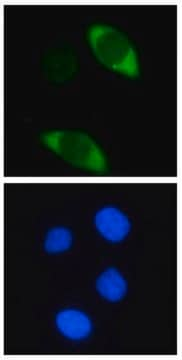
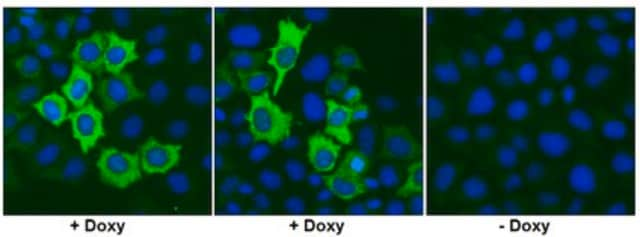
Anti-Cas9 Antibody, clone 7A9 | MAC133 is an antibody against Cas9 Antibody for use in Western Blotting, Immunoprecipitation and Immunocytochemistry.
Research Category
Secondary & Control Antibodies
Research Sub Category
Secondary Antibodies Adsorbed for Dual Labeling
Western Blotting Analysis: 0.5 µg/mL from a representative lot detected Cas9 in 1 µg of Myc-Cas9 expressing HEK293 cell lysate.
Immunoprecipitation Analysis: A representative lot immunoprecipitated Cas9 in Flag-Cas9 and Myc-Cas9 expressing cell lysate (performed by an independent laboratory).

Biochem/physiol Actions

MAC133 recognises both Cas9 and dCas9 (nuclease deficient Cas9)

Physical form

Format: Purified
Protein G Purified
Purified mouse monoclonal IgG1κ in buffer containing 0.1 M Tris-Glycine (pH 7.4), 150 mM NaCl with 0.05% sodium azide.

Preparation Note

Stable for 1 year at 2-8°C from date of receipt.

Analysis Note

Evaluated by Western Blotting in HEK293 expressing Flag-Cas9 cell lysate.

Western Blotting Analysis: 0.5 µg/mL of this antibody detected Cas9 in 1 µg of HEK293 cell lysate expressing Flag-Cas9.

Other Notes

Concentration: Please refer to lot specific datasheet.

Disclaimer

Unless otherwise stated in our catalog or other company documentation accompanying the product(s), our products are intended for research use only and are not to be used for any other purpose, which includes but is not limited to, unauthorized commercial uses, in vitro diagnostic uses, ex vivo or in vivo therapeutic uses or any type of consumption or application to humans or animals.

Compare Similar Items

View Full Comparison

Show Differences

1 of 1

This Item
SAB4200701MABS1291MAC142
antibody form

purified antibody

antibody form

purified from hybridoma cell culture

antibody form

purified antibody

antibody form

purified immunoglobulin

clone

7A9, monoclonal

clone

7A9-3A3, monoclonal

clone

10C11-A12, monoclonal

clone

6H4, monoclonal

biological source

mouse

biological source

mouse

biological source

mouse

biological source

mouse

shipped in

wet ice

shipped in

dry ice

shipped in

wet ice

shipped in

ambient

isotype

IgG1κ

isotype

IgG1

isotype

IgG1κ

isotype

IgG2bκ

technique(s)

immunocytochemistry: suitable, western blot: suitable, immunoprecipitation (IP): suitable

technique(s)

immunoblotting: 1-2 μg/mL using whole extracts of human HEK-293T cells over-expressing CAS9 protein, immunofluorescence: 1-2 μg/mL using human HEK-293T cells over-expressing CAS9 protein., immunoprecipitation (IP): 5-10 μg using whole extract of human HEK-293T cells over-expressing CAS9 protein

technique(s)

immunocytochemistry: suitable, immunoprecipitation (IP): suitable, western blot: suitable

technique(s)

immunofluorescence: suitable, immunoprecipitation (IP): suitable, western blot: suitable


Still not finding the right product?

Try our Product Selector Tool to narrow your options


Storage Class

12 - Non Combustible Liquids

wgk

WGK 1

flash_point_f

Not applicable

flash_point_c

Not applicable


Certificates of Analysis (COA)

Search for Certificates of Analysis (COA) by entering the products Lot/Batch Number. Lot and Batch Numbers can be found on a product’s label following the words ‘Lot’ or ‘Batch’.

Already Own This Product?

Find documentation for the products that you have recently purchased in the Document Library.

Visit the Document Library


Guo-Xiang Ruan et al.
Molecular therapy : the journal of the American Society of Gene Therapy, 25(2), 331-341 (2017-01-23)
As the most common subtype of Leber congenital amaurosis (LCA), LCA10 is a severe retinal dystrophy caused by mutations in the CEP290 gene. The most frequent mutation found in patients with LCA10 is a deep intronic mutation in CEP290 that
Thomas Del'Guidice et al.
PloS one, 13(4), e0195558-e0195558 (2018-04-05)
Delivery of recombinant proteins to therapeutic cells is limited by a lack of efficient methods. This hinders the use of transcription factors or Clustered Regularly Interspaced Short Palindromic Repeats (CRISPR) ribonucleoproteins to develop cell therapies. Here, we report a soluble
Brice Lagrange et al.
Nature communications, 9(1), 242-242 (2018-01-18)
Caspase-4/5 in humans and caspase-11 in mice bind hexa-acylated lipid A, the lipid moeity of lipopolysaccharide (LPS), to induce the activation of non-canonical inflammasome. Pathogens such as Francisella novicida express an under-acylated lipid A and escape caspase-11 recognition in mice.


Global Trade Item Number

SKUGTIN
MAC13304055977127034

Questions

Reviews

No rating value

Active Filters