

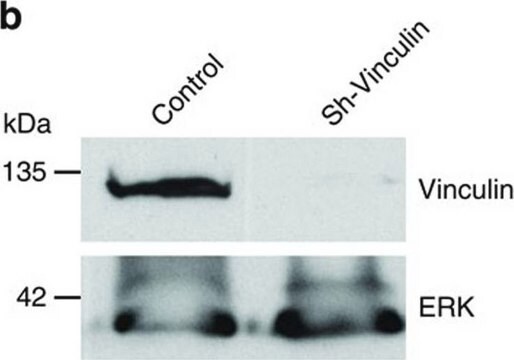


It is recommended to use 0.5% non-fat dry milk in PBS-T as a dilution buffer for this primary antibody.
Fortfahren mit
V9131

Anti-Vinculin Antibody

Verbesserte Validierung
mouse monoclonal, hVIN-1
Monoclonal Anti-Vinculin antibody produced in mouse
1 of 1 reviewers received a sample product or took part in a promotion
Synonym(e):
Anti Vinculin, Vinculin Antibody, Vinculin Antibody - Monoclonal Anti-Vinculin antibody produced in mouse
Anmelden zur Ansicht der Organisations- und Vertragspreise.
Größe auswählen
Ansicht ändern
| Ihnen/SKU | Verfügbarkeit | Preis |
|---|---|---|
100 μL | Warenkorb auf Verfügbarkeit prüfen | € 554,00 |
0.2 mL | Warenkorb auf Verfügbarkeit prüfen | € 718,00 |
Über diesen Artikel
Conjugate:
unconjugated
Clone:
hVIN-1, monoclonal
Application:
IF, IHC (f), WB
Citations:
2013
Technischer Dienst
Benötigen Sie Hilfe? Unser Team von erfahrenen Wissenschaftlern ist für Sie da.
Unterstützung erhaltenProduktname
Monoklonaler Anti-Vinculin-Antikörper in Maus hergestellte Antikörper, clone hVIN-1, ascites fluid
biological source
mouse
Quality Segment
conjugate
unconjugated
antibody form
ascites fluid
antibody product type
primary antibodies
clone
hVIN-1, monoclonal
mol wt
antigen 116 kDa
contains
15 mM sodium azide
species reactivity
frog, chicken, mouse, canine, human, bovine, rat, turkey
enhanced validation
independent
Learn more about Antibody Enhanced Validation
technique(s)
immunohistochemistry (frozen sections): suitable, indirect immunofluorescence: 1:400 using cultured human fibroblasts, western blot: 1:200 using extract of human fibroblasts
isotype
IgG1
UniProt accession no.
application(s)
research pathology
shipped in
dry ice
storage temp.
−20°C
target post-translational modification
unmodified
Gene Information
human ... VCL(7414)
mouse ... Vcl(22330)
rat ... Vcl(305679)
General description
Der monoklonale Anti-Vinculin-Antikörper (Maus-IgG1-Isotyp) ist vom hVIN-1-Hybridom abgeleitet, das durch Fusion von Maus-Myelomzellen und Splenozyten von immunisierten BALB/c-Mäusen hergestellt wird. Vinculin ist im Streifendesmosom von Glanzstreifen (Herzmuskel), in den Muskel-Sehnen-Übergängen (Skelettmuskeln), in neuromuskulären Endplatten und in den membranassoziierten Verdichtungszonen glatter Muskeln lokalisiert. Bei vielen Zelltypen, die eine virale Transformation durchlaufen, wird Vinculin zu Rosetten oder Podosomen umverteilt.
Immunogen
Aufgereinigtes humanes Vinculin aus dem Uterus.
Application
Der monoklonale Anti-Vinculin-Antikörper der Maus wird in folgenden Anwendungen eingesetzt:
- Western Blotting
- Immunfluoreszenzfärbung
- Immunhistochemie
Biochem/physiol Actions
Markiert spezifisch Vinculin an Zell-Zell- und Zell-Substrat-Kontakten. Reagiert stark mit humanem Vinculin. Zeigt Kreuzreaktivität mit Glattmuskel-Metavinculin.
Monoklonale Antikörper gegen Vinculin färben Vinculin spezifisch an Zell-Zell- und Zell-Substrat-Kontakten in Gewebe und kultivierten Zellen durch indirekte Immunfluoreszenzmarkierung. Dieser Antikörper reagiert mit der 116-kDa-Vinculin-Bande im Immunoblot. Das Produkt reagiert mit Vinculin zahlreicher Spezies. Eine gute Reaktivität wird mit den Spezies Mensch, Rind, Huhn, Hund, Ratte, Maus, Truthahn und Xenopus erzielt. Der Antikörper zeigt Kreuzreaktivität mit Glattmuskel-Metavinculin.
Vinculin ist ein Zytoskelett-Protein, das mit der zytoplasmatischen Seite von Adhärenz-Verbindungen (sowohl Zell-Zell-Verbindungen als auch Zell-Extrazellulärmatrix-Kontakten) assoziiert wird. Es fungiert als eines mehrerer interagierender Proteine, die an der Bindung von F-Aktin an die Membran beteiligt sind. Eine Sequenz von molekularen Interaktionen ist möglicherweise an der Transmembranmontage von Adhäsionsplaques beteiligt. Bei der Bildung von Adhäsionsplaques bindet die β-Untereinheit von Integrin an Talin. Talin bindet an Vinculin, das mit α-Aktinin und möglicherweise mit sich selbst interagiert. Da α-Aktinin an Aktinfilamente bindet und diese vernetzt, stellt Vinculin ein wichtiges Element bei der Transmembranverbindung zwischen extrazellulärer Matrix und dem zytoplasmatischen Mikrofilamentsystem dar.
Disclaimer
Sofern in unserem Katalog oder anderen Begleitdokumenten unserer Produkte nicht anders angegeben, sind unsere Produkte nur für Forschungszwecke vorgesehen und nicht für andere Zwecke zu verwenden, einschließlich, jedoch nicht beschränkt auf unautorisierte kommerzielle Verwendung, zur In-vitro-Diagnostik, für Ex-vivo- oder In-vivo-Therapiezwecke oder jegliche Art der Einnahme oder Anwendung bei Menschen oder Tieren.
1 of 1
Dieser Artikel | |||
|---|---|---|---|
| description clone hVIN-1, ascites fluid | description clone VIN-11-5, ascites fluid | description clone hVIN-1, purified from hybridoma cell culture | description clone hVIN-1, purified from hybridoma cell culture |
| antibody form ascites fluid | antibody form ascites fluid | antibody form purified immunoglobulin | antibody form purified immunoglobulin |
| conjugate unconjugated | conjugate unconjugated | conjugate FITC conjugate | conjugate unconjugated |
| clone hVIN-1, monoclonal | clone VIN-11-5, monoclonal | clone hVIN-1, monoclonal | clone hVIN-1, monoclonal |
| species reactivity frog, chicken, mouse, canine, human, bovine, rat, turkey | species reactivity bovine, human, chicken, mouse | species reactivity frog, chicken, mouse, canine, human, bovine, rat, turkey | species reactivity frog, chicken, mouse, canine, human, bovine, rat, turkey |
| biological source mouse | biological source mouse | biological source mouse | biological source mouse |
| Gene Information human ... VCL(7414) | Gene Information human ... VCL(7414) | Gene Information human ... VCL(7414) | Gene Information human ... VCL(7414) |
Still not finding the right product?
Explore all of our products under Monoklonaler Anti-Vinculin-Antikörper in Maus hergestellte Antikörper
— oder —
Probieren Sie unser Produkt-Auswahlhilfe, um Ihre Auswahl einzugrenzen
Lagerklasse
10 - Combustible liquids
wgk
WGK 3
flash_point_f
Not applicable
flash_point_c
Not applicable
Hier finden Sie alle aktuellen Versionen:
Besitzen Sie dieses Produkt bereits?
In der Dokumentenbibliothek finden Sie die Dokumentation zu den Produkten, die Sie kürzlich erworben haben.
-
What is the recommended diluent for when using in western blot? E.g. 5% milk TBST, 3% BSA in PBST?
1 answer-
Helpful?
-
-
How is V9131-.02ML packaged? Is it in a small glass container or a small plastic tube?
1 answer-
The product V9131-.02ML is packaged into a 0.5 ml polypropylene tube (PP) with a skirted base, knurls, and an assembled cap (PP).
Helpful?
-
-
Good afternoon, regarding Vinculin antibody V9131, clone hVIN-1, I wonder if it is possible to know the epitope sequence that this Ab recognizes, as I was not able to found it. Thanks for your attention, Sincerely
1 answer-
The immunogen used to produce this antibody was purified native human vinculin. Unfortunately, the epitope sequence has not been determined.
Helpful?
-