Direkt zum Inhalt
Merck

SML0149

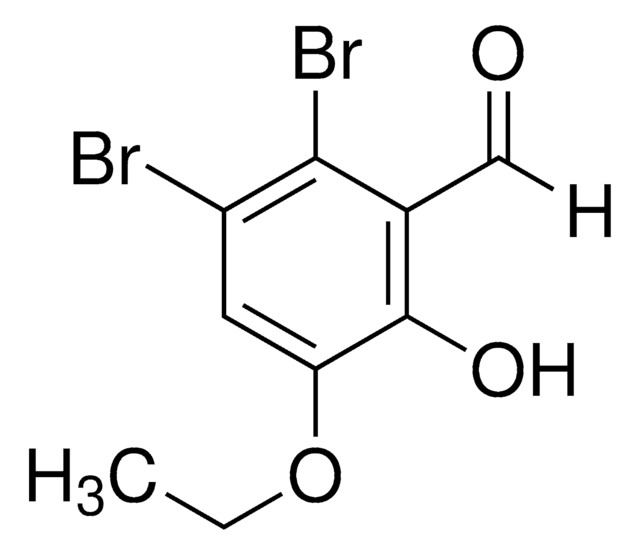
3-Ethoxy-5,6-dibromosalicylaldehyde

≥95% (HPLC)

Synonym(e):

2,3-Dibromo-5-ethoxy-6-hydroxy-benzaldehyde, 5,6-Dibromo-o-bourbonal

Anmelden zur Ansicht der Organisations- und Vertragspreise.

Über diesen Artikel

Empirische Formel (Hill-System):
C9H8Br2O3
CAS-Nummer:
Molekulargewicht:
323.97
NACRES:
NA.77
PubChem Substance ID:
UNSPSC Code:
12352200
MDL number:
Assay:
≥95% (HPLC)
Form:
powder
Quality level:
Storage condition:
desiccated

Fortfahren mit

Technischer Dienst
Benötigen Sie Hilfe? Unser Team von erfahrenen Wissenschaftlern ist für Sie da.
Unterstützung erhalten

InChI

1S/C9H8Br2O3/c1-2-14-7-3-6(10)8(11)5(4-12)9(7)13/h3-4,13H,2H2,1H3

SMILES string

CCOc1cc(Br)c(Br)c(C=O)c1O

InChI key

MZAISYPWQNBWED-UHFFFAOYSA-N

assay

≥95% (HPLC)

form

powder

storage condition

desiccated

color

yellow

solubility

DMSO: ≥15 mg/mL

storage temp.

2-8°C

Quality Level

Ähnliche Artikel vergleichen

Vollständigen Vergleich anzeigen

Unterschiede anzeigen

1 of 4

Dieser Artikel
SML1184D8446H9415
form

powder

form

powder

form

powder

form

solid

assay

≥95% (HPLC)

assay

≥98% (HPLC)

assay

≥98% (HPLC)

assay

≥98% (HPLC)

Quality Level

100

Quality Level

100

Quality Level

100

Quality Level

100

storage temp.

2-8°C

storage temp.

2-8°C

storage temp.

2-8°C

storage temp.

2-8°C

storage condition

desiccated

storage condition

-

storage condition

-

storage condition

-

solubility

DMSO: ≥15 mg/mL

solubility

DMSO: 5 mg/mL, clear (warmed)

solubility

DMSO: 34 mg/mL

solubility

DMSO: >20 mg/mL

Application

3-Ethoxy-5,6-dibromosalicylaldehyde was used to study modulation of autophagy,[1] JNK activation[2] and NF-κB-mediated inflammation.[3]

Biochem/physiol Actions

3-Ethoxy-5,6-dibromosalicylaldehyde is a non-competitive inhibitor of Inositol-requiring enzyme 1 (IRE1). It inhibits XBP-1 splicing induced pharmacologically in human cells. 3-Ethoxy-5,6-dibromosalicylaldehyde potently inhibits the endoribonuclease of IRE1 but does not inhibit RNases A, T1, or L.
3-Ethoxy-5,6-dibromosalicylaldehyde is a non-competitive inhibitor of Inositol-requiring enzyme 1 (IRE1); potent inhibitor of endoribonuclease of IRE1

pictograms

Exclamation mark

signalword

Warning

hcodes

Hazard Classifications

Acute Tox. 4 Oral - Skin Sens. 1

Lagerklasse

11 - Combustible Solids

wgk

WGK 3

flash_point_f

Not applicable

flash_point_c

Not applicable


Hier finden Sie alle aktuellen Versionen:

Analysenzertifikate (COA)

Lot/Batch Number

Die passende Version wird nicht angezeigt?

Wenn Sie eine bestimmte Version benötigen, können Sie anhand der Lot- oder Chargennummer nach einem spezifischen Zertifikat suchen.

Besitzen Sie dieses Produkt bereits?

In der Dokumentenbibliothek finden Sie die Dokumentation zu den Produkten, die Sie kürzlich erworben haben.

Die Dokumentenbibliothek aufrufen

Yoshiyasu Shinohara et al.
Biochemical and biophysical research communications, 432(2), 326-332 (2013-02-12)
Hepatitis C virus (HCV) induces endoplasmic reticulum (ER) stress which, in turn, activates the unfolding protein response (UPR). UPR activates three distinct signalling pathways. Additionally, UPR induces autophagy (UPR-autophagy pathways). On the other hand, it has become clear that some
Yazhen Huo et al.
Virology, 444(1-2), 233-240 (2013-07-16)
Our previous study has shown that activation of JNK plays a critical role in Porcine reproductive and respiratory syndrome virus (PRRSV)-mediated apoptosis. In this follow-up study, we further investigated the mechanisms involved in modulation of PRRSV-mediated JNK activation and apoptosis.
Y Liu et al.
Apoptosis : an international journal on programmed cell death, 22(4), 544-557 (2017-02-12)
Quercetin (3,3',4',5,7-pentahydroxyflavone, Qu) is a promising cancer chemo-preventive agent for various cancers because it inhibits disease progression and promotes apoptotic cell death. In our previous study, we demonstrated that Qu could evoke ER stress to enhance drug cytotoxicity in ovarian
Cristian González-Guerrero et al.
Toxicology and applied pharmacology, 272(3), 825-841 (2013-08-21)
The calcineurin inhibitors (CNIs) cyclosporine (CsA) and tacrolimus are key drugs in current immunosuppressive regimes for solid organ transplantation. However, they are nephrotoxic and promote death and profibrotic responses in tubular cells. Moreover, renal inflammation is observed in CNI nephrotoxicity
Jinling Cui et al.
Journal of agricultural and food chemistry, 67(38), 10637-10645 (2019-09-13)
Previous studies have shown that selenite, a representative of inorganic form selenium, exerts its anticancer effect by inducing apoptosis in androgen-dependent LNCaP prostate cancer cells, but few studies have determined the nature of cell death induced by selenite in metastatic

Questions

Reviews

No rating value

Active Filters

Unser Team von Wissenschaftlern verfügt über Erfahrung in allen Forschungsbereichen einschließlich Life Science, Materialwissenschaften, chemischer Synthese, Chromatographie, Analytik und vielen mehr..

Setzen Sie sich mit dem technischen Dienst in Verbindung