



If this product has an expiration or retest date, it will be shown on the Certificate of Analysis (COA, CofA). If there is no retest or expiration date listed on the product's COA, we do not have suitable stability data to determine a shelf life. For these products, the only date on the COA will be the release date; a retest, expiration, or use-by-date will not be displayed.
For all products, we recommend handling per defined conditions as printed in our product literature and website product descriptions. We recommend that products should be routinely inspected by customers to ensure they perform as expected.
For products without retest or expiration dates, our standard warranty of 1 year from the date of shipment is applicable.
For more information, please refer to the Product Dating Information document: https://www.sigmaaldrich.com/deepweb/assets/sigmaaldrich/marketing/global/documents/418/501/product-dating-information-06-25-mk.pdf
Fortfahren mit
S4881

Staphylokokken-Enterotoxin B aus Staphylococcus aureus
Synonym(e):
Enterotoxin B, von Staphylokokken, SEB
Größe auswählen
| Ihnen/SKU | Verfügbarkeit | Preis |
|---|---|---|
1 mg | Warenkorb auf Verfügbarkeit prüfen | € 351,00 |
5 mg | Warenkorb auf Verfügbarkeit prüfen | € 1.280,00 |
Über diesen Artikel
contains
sodium phosphate buffer as balance
Quality Segment
composition
Protein, ~25% Lowry
availability
not available in USA
impurities
Staphylococcal enterotoxin A (SEA), essentially free
application(s)
metabolomics
vitamins, nutraceuticals, and natural products
storage temp.
2-8°C
General description
In addition to its role in infectious disease research, SEB serves as a valuable tool for investigating autoimmune conditions and the development of immunotherapies. Its ability to induce T-cell activation and proliferation makes it an important reagent for exploring T-cell biology, including differentiation, memory formation, and the effects of various immunomodulators.
Application
Biochem/physiol Actions
Packaging
1 of 1
Dieser Artikel | |||
|---|---|---|---|
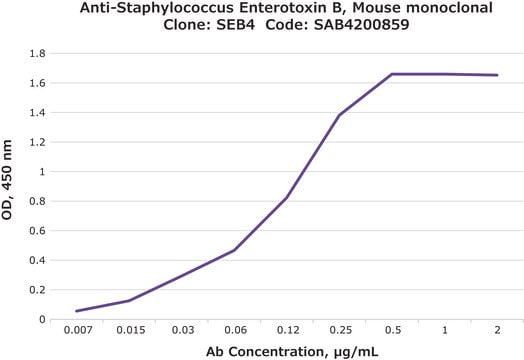
| description - | description - | description - | description clone SEB4, purified from hybridoma cell culture |
| Quality Level 300 | Quality Level 200 | Quality Level 200 | Quality Level 200 |
| application(s) metabolomics | application(s) - | application(s) - | application(s) - |
| storage temp. 2-8°C | storage temp. 2-8°C | storage temp. −20°C | storage temp. −20°C |
| impurities Staphylococcal enterotoxin A (SEA), essentially free | impurities Staphylococcal enterotoxin B (SEB), essentially free | impurities - | impurities - |
| composition Protein, ~25% Lowry | composition Protein, ~10% Lowry | composition Contains ~50% protein (Lowry); balance primarily sodium chloride and sodium phosphate buffer. | composition - |
| availability not available in USA | availability not available in USA | availability not available in USA | availability - |
signalword
Danger
Hazard Classifications
Acute Tox. 1 Dermal - Acute Tox. 1 Inhalation - Acute Tox. 1 Oral - Eye Irrit. 2 - Skin Irrit. 2 - STOT SE 3
target_organs
Respiratory system
Lagerklasse
6.1A - Combustible acute toxic Cat. 1 and 2 / very toxic hazardous materials
wgk
WGK 3
flash_point_f
Not applicable
flash_point_c
Not applicable
Hier finden Sie alle aktuellen Versionen:
Besitzen Sie dieses Produkt bereits?
In der Dokumentenbibliothek finden Sie die Dokumentation zu den Produkten, die Sie kürzlich erworben haben.
-
How can I determine the shelf life / expiration / retest date of this product?
1 answer-
Helpful?
-
-
Hi I would like to know how to store the Staphylococcal enterotoxin B after resuspend in H2O. Is it stable in aqueous? What's the recommend temperature to store them in aqueous?
1 answer-
At refrigerated or room temperature, solutions prepared in 0.05 M phosphate buffer, pH 4–7.3 were found to be stable for at least 1 week. For long term storage, aliquot and freeze stock solutions at -20°C for up to 3 months. Please see the link below to review additional information available in the product datasheet:
https://www.sigmaaldrich.com/deepweb/assets/sigmaaldrich/product/documents/126/857/s4881pis.pdfHelpful?
-
-
What is the difference in effects on T-lymphocyte proliferation between PHA and SEB? Thank you
1 answer-
T-cells stimulated with SEB produce high levels of IFN-γ, while PHA-stimulated T-cells produce little or no IFN-γ. For more information, refer to the reference at the following link: https://pmc.ncbi.nlm.nih.gov/articles/PMC1906565/#:~:text=%2Dcells%20(Fig.-,1).,compared%20to%20CD4+%20T%2Dcells
Helpful?
-
-
How is shipping temperature determined? And how is it related to the product storage temperature?
1 answer-
Products may be shipped at a different temperature than the recommended long-term storage temperature. If the product quality is sensitive to short-term exposure to conditions other than the recommended long-term storage, it will be shipped on wet or dry-ice. If the product quality is NOT affected by short-term exposure to conditions other than the recommended long-term storage, it will be shipped at ambient temperature. As shipping routes are configured for minimum transit times, shipping at ambient temperature helps control shipping costs for our customers. For more information, please refer to the Storage and Transport Conditions document: https://www.sigmaaldrich.com/deepweb/assets/sigmaaldrich/marketing/global/documents/316/622/storage-transport-conditions-mk.pdf
Helpful?
-
-
こんにちは、この商品の容量をお聞きしたいのですが、1MGと表記されている場合、1miligramということでしょうか? 溶かしてから調剤したいのですが。 溶かして調剤する際のプロトコルはあるのでしょうか?
1 answer-
Yes, the 1MG does stand for one milligram. The product is soluble in water at 4 mg/ml. It may also be dissolved in an aqueous buffer such as PBS. See the link below to the product information sheet for additional solution stability information:
https://www.sigmaaldrich.com/deepweb/assets/sigmaaldrich/product/documents/126/857/s4881pis.pdfHelpful?
-