

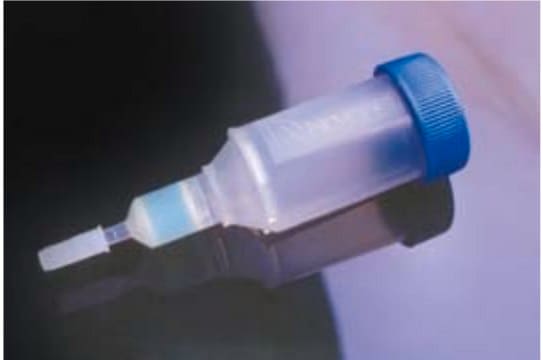

Verify the pH and composition of sample and equilibration buffers. Make sure there are no chelating or reducing agents present in the extraction buffer. If using the batch mode, remove imidazole. Run the affinity purification under denaturing conditions. Run a Western blot of the extract to verify that the recombinant protein is present.
Fortfahren mit
P6611

HIS-Select® Nickel-Affinitätsgel
(1:1 suspension in a 20% ethanol solution)
1 of 1 reviewers received a sample product or took part in a promotion
Synonym(e):
Ni-NTA resin, nickel charged agarose
Anmelden zur Ansicht der Organisations- und Vertragspreise.
Größe auswählen
Ansicht ändern
| Ihnen/SKU | Verfügbarkeit | Preis |
|---|---|---|
5 mL | Warenkorb auf Verfügbarkeit prüfen | € 153,00 |
25 mL | Warenkorb auf Verfügbarkeit prüfen | € 495,00 |
100 mL | Warenkorb auf Verfügbarkeit prüfen | € 1.410,00 |
500 mL | Warenkorb auf Verfügbarkeit prüfen | € 5.940,00 |
Über diesen Artikel
NACRES:
NA.56
UNSPSC Code:
12352200
€ 153,00
Warenkorb auf Verfügbarkeit prüfen
Technischer Dienst
Benötigen Sie Hilfe? Unser Team von erfahrenen Wissenschaftlern ist für Sie da.
Unterstützung erhaltenconjugate
magnetic beads
Quality Segment
form
(1:1 suspension in a 20% ethanol solution)
feature
hydrophilic
packaging
pkg of 1 mL, pkg of 100 mL, pkg of 25 mL, pkg of 5 mL, pkg of 500 mL
concentration
1.5-2.4 mL/mL (suspension in packed gel)
technique(s)
protein purification: suitable
color
faint blue to very dark blue
matrix
6% Beaded Agarose
capacity
>15 mg/mL, gel binding capacity (protein)(with an approx. 30 kDa protein)
transition temp
flash point 32 °C (closed cup)
storage temp.
2-8°C
General description
HIS-Select® Nickel-Affinitätsgel ist ein immobilisiertes Metallionen-Affinitätschromatographie-Produkt (IMAC-Produkt), das für die Aufreinigung von hismarkierten Proteinen verwendet wird. Während die einzigartige, nicht geladene, hydrophile Bindung der proprietären vierzackigen NTA-Chelatgruppe an die mit Nickel geladene Perlenagarose eine hohe Selektivität für die Aufreinigung von His-Tag-Proteinen im kleinen bis mittleren Maßstab gewährleistet, führt sie auch zu einer reduzierten unspezifischen Bindung anderer Proteine. HIS-Select Nickel-Affinitätsgel ist selektiv für rekombinante Proteine mit His-Tags und weist eine geringe unspezifische Bindung anderer Proteine auf. Die Selektivität kann durch den Einschluss von Imidazol während der Chromatographie moduliert werden.
Application
Das HIS-Select® Nickel-Affinitätsgel wird eingesetzt in der Aufreinigung von rekombinanten Proteinen wie dem calciumbindenden EF-Hand-Protein (S100A14), dem LIM-Homöobox-Transkriptionsfaktor-1-Alphaprotein, dem Sigma-1-Rezeptor sowie Harpin, dem Stable-Protein 1 (SP1) und dem BCR-ABL-Fusionsprotein.
Features and Benefits
- Hohe Selektivität für höhere Reinheit.
- Einzigartige nicht geladene hydrophile Bindung reduziert unspezifische Bindung.
- Die Bindungskapazität für histidinmarkiertes Protein ist größer als 15 mg/mL.
- Bindung unter denaturierenden oder nicht denaturierenden Bedingungen.
- Aufreinigung in einem Arbeitsschritt.
- Minimiert unerwünschte ionische Wechselwirkungen.
- Minimale Nickelauslaugung.
- Beadgröße: 45–165 μm.
Physical form
1:1-Suspension in einer 20%igen Ethanollösung
Preparation Note
HIS-Select Nickel-Affinitätsgel ist bei ordnungsgemäßer Lagerung mindestens ein Jahr lang stabil. Das HIS-Select Nickel-Affinitätsgel sollte nach jedem Gebrauch gereinigt und dem Lagerungspuffer sollte ein antimikrobielles Mittel wie z. B. 20 % Ethanol zugesetzt werden.
Other Notes
Es ist auch zusammen mit der EZview™-Technologie (Produktcode E3528) erhältlich.
Legal Information
HIS-Select is a registered trademark of Merck KGaA, Darmstadt, Germany
1 of 1
Dieser Artikel | |||
|---|---|---|---|
| description (1:1 suspension in a 20% ethanol solution) | description - | description (1:1 suspension in a 30% ethanol solution) | description - |
| matrix 6% Beaded Agarose | matrix Highly cross-linked 6% Beaded Agarose | matrix 6% Beaded Agarose | matrix - |
| capacity >15 mg/mL, gel binding capacity (protein)(with an approx. 30 kDa protein) | capacity 15 mg/mL, gel binding capacity (protein)(with an approx. 30 kDa protein) | capacity >15 mg/mL, agarose binding capacity (protein)(with an approx. 30 kDa protein) | capacity - |
| technique(s) protein purification: suitable | technique(s) affinity chromatography: suitable | technique(s) protein purification: suitable | technique(s) - |
| form (1:1 suspension in a 20% ethanol solution) | form suspension | form (1:1 suspension in a 30% ethanol solution) | form slurry |
| storage temp. 2-8°C | storage temp. 2-8°C | storage temp. 2-8°C | storage temp. 2-8°C |
| feature hydrophilic | feature - | feature - | feature - |
signalword
Warning
hcodes
Hazard Classifications
Flam. Liq. 3
Lagerklasse
3 - Flammable liquids
wgk
WGK 3
flash_point_f
89.6 °F - closed cup
flash_point_c
32 °C - closed cup
Hier finden Sie alle aktuellen Versionen:
Besitzen Sie dieses Produkt bereits?
In der Dokumentenbibliothek finden Sie die Dokumentation zu den Produkten, die Sie kürzlich erworben haben.
-
Why won't my recombinant protein with a histidine-containing tag bind to HIS-Select® Nickel Affinity Gel, Product P6611?
1 answer-
Helpful?
-
-
What needs to be done if the HIS-Select® Nickel Affinity Gel, Product P6611, resin turns brown on reuse?
1 answer-
During purification many protein extracts tend to discolor an affinity gel during the loading step. The original color will return after the wash or elution step. If the color is still not changing strip and recharge the affinity gel with nickel. Wash with EDTA and recharge with Nickel solution.
Helpful?
-
-
Can Tris buffers be used instead of phosphate buffer for HIS-Select® Nickel Affinity Gel, Product P6611?
1 answer-
Yes, Tris buffers should work.
Helpful?
-
-
Can I use SDS with HIS-Select® Nickel Affinity Gel, Product P6611?
1 answer-
0.1% SDS has been used with some samples, with no adverse effects on the observed protein binding. However, SDS will effectively coat proteins and may block the binding to the column. It is probably very protein-specific and an SDS concentration that works for one protein may not work for another.
Helpful?
-
-
What is the Department of Transportation shipping information for this product?
1 answer-
Transportation information can be found in Section 14 of the product's (M)SDS.To access the shipping information for this material, use the link on the product detail page for the product.
Helpful?
-
-
Can imidazole be used with HIS-Select® Nickel Affinity Gel, Product P6611?
1 answer-
For column chromatography, no more than 20 mM is suggested in the extract, equilibration, and wash buffers to prevent non-specific binding of proteins. No more than 250 mM is suggested for the elution buffers. Many proteins will elute with imidazole levels as low as 100 to 200 mM. For batch methods the imidazole concentration may have to be reduced or eliminated.When a protein is expressed at low levels, the presence of the imidazole limits the binding of the protein in the batch method but not when used in a column.
Helpful?
-