Direkt zum Inhalt
Merck

P0085

Anti-Podoplanin antibody, RAT monoclonal

clone NZ-1.2, purified from hybridoma cell culture

Synonym(e):

Anti-AGGRUS, Anti-GP36, glycoprotein, 36-KD, Anti-GP40, Anti-Gp38, Anti-OTS8, Anti-T1A, Anti-T1A-2

Anmelden zur Ansicht der Organisations- und Vertragspreise.

Größe auswählen

200 μL

€ 583,00

€ 583,00


Warenkorb auf Verfügbarkeit prüfen
Für Ihr Target ist ein rekombinanter, konservierungsmittelfreier Antikörper verfügbar. Probieren Sie ZRB2499

Großbestellung anfragen

Über diesen Artikel

NACRES:
NA.41
UNSPSC Code:
12352203
Conjugate:
unconjugated
Clone:
NZ-1.2, monoclonal
Application:
FACS, ICC, IP, WB
Citations:
7

Fortfahren mit

Technischer Dienst
Benötigen Sie Hilfe? Unser Team von erfahrenen Wissenschaftlern ist für Sie da.
Unterstützung erhalten

biological source

rat

Quality Level

conjugate

unconjugated

antibody form

purified from hybridoma cell culture

antibody product type

primary antibodies

clone

NZ-1.2, monoclonal

form

buffered aqueous solution

mol wt

antigen ~36 kDa

species reactivity

human

concentration

~1.5 mg/mL

technique(s)

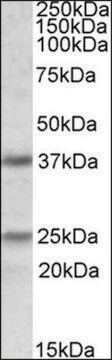
flow cytometry: suitable, immunocytochemistry: suitable, immunoprecipitation (IP): suitable, western blot: 4-8 μg/mL using U87 total cell extract

UniProt accession no.

shipped in

dry ice

storage temp.

−20°C

target post-translational modification

unmodified

Gene Information

human ... PDPN(10630)

Ähnliche Artikel vergleichen

Vollständigen Vergleich anzeigen

Unterschiede anzeigen

1 of 4

Dieser Artikel
P5374MABC117SAB2501272
Gene Information

human ... PDPN(10630)

Gene Information

human ... PDPN(10630)
rat ... Pdpn(54320)

Gene Information

human ... PDPN(10630)

Gene Information

human ... PDPN(10630)

species reactivity

human

species reactivity

human, rat

species reactivity

human

species reactivity

canine, human

biological source

rat

biological source

rabbit

biological source

rat

biological source

goat

clone

NZ-1.2, monoclonal

clone

polyclonal

clone

NZ1.2, monoclonal

clone

polyclonal

conjugate

unconjugated

conjugate

unconjugated

conjugate

-

conjugate

unconjugated

antibody form

purified from hybridoma cell culture

antibody form

affinity isolated antibody

antibody form

purified antibody

antibody form

affinity isolated antibody

General description

Monoclonal Anti-Podoplanin (rat IgG2a isotype) is derived from the hybridoma NZ-1.2 produced by the fusion of mouse myeloma cells and splenocytes from CD rat immunized with platelet-aggregation-stimulating (PLAG) domain of podoplanin. Podoplanin (Aggrus) is an integral membrane mucoprotein present on the surface of podocytes in kidney glomeruli and the parietal cells of the glomerular Bowman′s capsule. It is a single membrane-spanning protein composed of a heavily glycosylated extracellular domain and a short intracytoplasmic tail. The extracellular domain possesses a platelet aggregation stimulating (PLAG) domain. Podoplanin has been described to be present in normal, inflammatory and neoplastic lymphatic capillary endothelium.

Immunogen

platelet-aggregation-stimulating (PLAG) domain of human podoplanin.

Application

Applications in which this antibody has been used successfully, and the associated peer-reviewed papers, are given below.
Immunohistochemistry (1 paper)
Western Blotting (1 paper)
Anti-Podoplanin antibody, Mouse monoclonal has been used in:
  • immunoblotting
  • immunoprecipitation
  • flow cytometry
  • immunocytochemistry

Biochem/physiol Actions

Expression of podoplanin is regulated by the lymphatic-specific homeobox gene Prox-1 (prospero-1). It is involved in lymphatic vessel formation and might be associated with tissue development and repair. Podoplanin is detected in human angiosarcomas, lymphangiomas, and in Kaposi′s sarcomas. It is implicated in the onset of tumor invasion, metastasis or malignant progression. Podoplanin plays an important role in the maintenance of podocyte foot processes and glomerular permeability.

Physical form

Solution in 0.01 M phosphate buffered saline, pH 7.4, containing 15 mM sodium azide.

Disclaimer

Unless otherwise stated in our catalog or other company documentation accompanying the product(s), our products are intended for research use only and are not to be used for any other purpose, which includes but is not limited to, unauthorized commercial uses, in vitro diagnostic uses, ex vivo or in vivo therapeutic uses or any type of consumption or application to humans or animals.

Sie haben nicht das passende Produkt gefunden?  

Probieren Sie unser Produkt-Auswahlhilfe. aus.

flash_point_f

Not applicable

flash_point_c

Not applicable

ppe

Eyeshields, Gloves, multi-purpose combination respirator cartridge (US)

wgk

WGK 1

Lagerklasse

12 - Non Combustible Liquids


Hier finden Sie alle aktuellen Versionen:

Analysenzertifikate (COA)

Lot/Batch Number

Die passende Version wird nicht angezeigt?

Wenn Sie eine bestimmte Version benötigen, können Sie anhand der Lot- oder Chargennummer nach einem spezifischen Zertifikat suchen.

Besitzen Sie dieses Produkt bereits?

In der Dokumentenbibliothek finden Sie die Dokumentation zu den Produkten, die Sie kürzlich erworben haben.

Die Dokumentenbibliothek aufrufen

Plant lectin can target receptors containing sialic acid, exemplified by podoplanin, to inhibit transformed cell growth and migration
Ochoa-Alvarez JA, et al.
Testing, 7(7), e41845-e41845 (2012)
Hao Xue et al.
Autophagy, 12(7), 1129-1152 (2016-05-11)
Hypoxia induces protective autophagy in glioblastoma cells and new therapeutic avenues that target this process may improve the outcome for glioblastoma patients. Recent studies have suggested that the autophagic process is upregulated in glioblastomas in response to extensive hypoxia. Hypoxia
Functional glycosylation of human podoplanin: glycan structure of platelet aggregation-inducing factor
Kaneko MK, et al.
Febs Letters, 581(2), 331-336 (2007)
Peter Birner et al.
Cancer, 120(16), 2440-2447 (2014-04-29)
Recently, isocitrate dehydrogenase 1 (IDH1) was identified as a major participant in glioma pathogenesis. At present, the enzymatic activity of the protein has been the main topic in investigating its physiological function, but its signaling pathway allocation was unsuccessful. Interestingly
The potential role of podoplanin in tumour invasion
Wicki A and Christofori G
British Journal of Cancer, 96(1), 1-1 (2007)

Global Trade Item Number

SKUGTIN
P0085-200UL04061838032294

Questions

Reviews

No rating value

Active Filters

Unser Team von Wissenschaftlern verfügt über Erfahrung in allen Forschungsbereichen einschließlich Life Science, Materialwissenschaften, chemischer Synthese, Chromatographie, Analytik und vielen mehr..

Setzen Sie sich mit dem technischen Dienst in Verbindung