

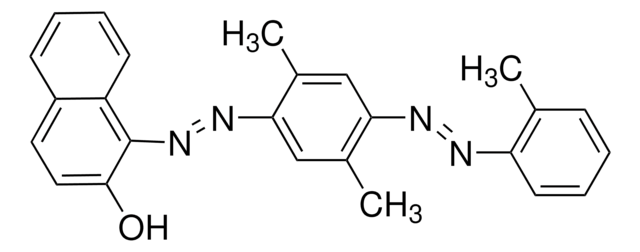


There are no definitive references or citations confirming the light sensitivity of this material. However, this product is packaged in amber glass may be susceptible to light, particularly at UV wavelengths. In bright field microscopy slides must be viewed in subdued light. While this item is not tested for use in fluorescent, it has been used on Flow Cytometry and has an emission wavelength of approximately 600 nm. There are a number of publication indicating light sensitivity. See the link below to review on such example:
https://www.ncbi.nlm.nih.gov/pmc/articles/PMC5931440/
Fortfahren mit
O1391

Ölrot O -Lösung
0.5% in isopropanol
Synonym(e):
Ceresrot 5B, Solvent Red 27
Anmelden zur Ansicht der Organisations- und Vertragspreise.
Größe auswählen
Ansicht ändern
| Größe/SKU | Verfügbarkeit | Preis |
|---|---|---|
250 mL | Ab HEUTE lieferbarvonSchnelldorf | € 48,40 |
500 mL | Ab HEUTE lieferbarvonSchnelldorf | € 89,80 |
Über diesen Artikel
Empirische Formel (Hill-System):
C26H24N4O
CAS-Nummer:
Molekulargewicht:
408.49
UNSPSC Code:
12171500
EC Number:
200-661-7
NACRES:
NA.47
Technischer Dienst
Benötigen Sie Hilfe? Unser Team von erfahrenen Wissenschaftlern ist für Sie da.
Unterstützung erhaltenform
liquid
Quality Segment
concentration
0.5% in isopropanol
technique(s)
microbe id | staining: suitable
color
dark red
εmax
0.20-0.50 at 510-517 nm
application(s)
diagnostic assay manufacturing
hematology
histology
storage temp.
room temp
SMILES string
N(\N=C3\c4c(cccc4)C=CC\3=O)c1c(cc(c(c1)C)N=Nc2c(ccc(c2)C)C)C
InChI
1S/C26H24N4O/c1-16-9-10-17(2)22(13-16)27-28-23-14-19(4)24(15-18(23)3)29-30-26-21-8-6-5-7-20(21)11-12-25(26)31/h5-15,29H,1-4H3/b28-27?,30-26-
InChI key
HJAYEODIXUYVIC-LTFAAIOASA-N
General description
Ölrot O färbt Lipidmaterial und verleiht den Lipiden eine rot-orangene Farbe. Es markiert außerdem Vakuolen, die insbesondere bei ALL-L3 (akuter lymphoblastischer Leukämie) oder Burkitt-Lymphom/Leukämie beobachtet werden. Die Färbung mit Ölrot O erfolgt auf frischen Proben, da eine Fixierung in Alkohol die Lipide entfernt.
Application
Ölrot O-Lösung wird zum Färben neutraler Lipide und Adipozyten sowie zur Visualisierung von Fetttröpfchen in Fibroblasten eingesetzt.
Ölrot O ist ein Lysochrom-Diazofarbstoff (fettlöslicher Farbstoff) zum Färben von neutralen Triglyceriden und Lipiden auf Gefrierschnitten und von einigen Lipoproteinen auf Paraffinschnitten. In der Histologie kann eine übersättigte Lösung von Ölrot O in Isopropanol verwendet werden, um Fett in Gewebe zu färben.
1 of 1
Dieser Artikel | |||
|---|---|---|---|
| description 0.5% in isopropanol | description 0.5% in propylene glycol | description certified by the BSC | description powder |
| technique(s) microbe id | staining: suitable | technique(s) microbe id | staining: suitable | technique(s) microbe id | staining: suitable | technique(s) - |
| concentration 0.5% in isopropanol | concentration 0.5% in propylene glycol | concentration - | concentration - |
| color dark red | color - | color - | color - |
| application(s) diagnostic assay manufacturing | application(s) diagnostic assay manufacturing | application(s) diagnostic assay manufacturing | application(s) diagnostic assay manufacturing |
| form liquid | form liquid | form powder | form powder |
| storage temp. room temp | storage temp. room temp | storage temp. room temp | storage temp. room temp |
Still not finding the right product?
Explore all of our products under Ölrot O -Lösung
signalword
Danger
hcodes
Hazard Classifications
Eye Irrit. 2 - Flam. Liq. 2 - STOT SE 3
target_organs
Central nervous system
Lagerklasse
3 - Flammable liquids
wgk
WGK 2
flash_point_f
53.6 °F - closed cup
flash_point_c
12.0 °C - closed cup
Hier finden Sie alle aktuellen Versionen:
Besitzen Sie dieses Produkt bereits?
In der Dokumentenbibliothek finden Sie die Dokumentation zu den Produkten, die Sie kürzlich erworben haben.
-
Hi! I'm wondering if OilRedO is light sensitive? Does the incubation need to take place in the dark? And could the staining of cells be compromized if the solution is not kept dark?
1 answer-
Helpful?
-
-
What are the differences between Oil Red O solution O1391 and OIL RED O staining solution 1.02419?
1 answer-
There are not many differences between products O1391 and 102419. O1391 is available in 250 mL and 500 mL bottles, while 102419 is available only in a 250 ml bottle. The only practical difference between the two products is the solvents used to dissolve the Oil Red O. For O1391, the solvent used is isopropyl alcohol, while the solvents used for 102419 are acetone and ethyl alcohol. Both products use Oil Red O as the dye, and the directions for use call for diluting the product with water prior to use and then filtering. The results should be identical since both products use Oil Red O as the dye.
Helpful?
-
-
Should cells or tissues be fixed before staining with Oil Red O for fats or lipids?
1 answer-
Yes, cells or tissues need to be fixed before staining with Oil Red O. It is important to avoid using fixatives that contain alcohol. Oil Red O staining can be performed on cultured cells and fresh frozen tissue. However, tissues should not be paraffin embedded and exposed to the alcohols and solvents necessary for paraffin processing tissue.
Helpful?
-
-
Hi I purchased Oil Red O solution – 0.5% in isopropanol, 01391 250mL, PCode-1003585017, Source, SLCP2956 for staining of whole mice aorta. I want to dilute it to 0.16% solution. What solution should I use for dilution? MilliQ water/methanol/isopropanol?
1 answer-
This product can be further diluted using distilled water or aqueous buffer to reach the desired concentration. Note that solution diluted with water or aqueous buffers are less stable and should not be stored for extended periods.
Helpful?
-
-
Can I use this solution for stain frozen sections ? I thought that I bought oil red in propylene glycol. What is the difference ?
1 answer-
This O1391 is a 0.5% solution in isopropanol. Product O1516 is a 0.5% solution in propylene glycol. The protocol for either product is the same. There is some evidence in the literature that the propylene glycol solution performs better on PFPP samples, however this is not definitive and may depend on conditions and technique. Each is considered a stock concentration. Stock solutions can range from 0.2 - 0.5%. Depending on the specific application the stock solution will need to be further diluted by 40 - 60%. For example, in staining frozen sections, 30ml of the O1391 would be diluted with 20ml of distilled water to reach a working concentration. Note that solution diluted with water or aqueous buffers are less stable and should not be stored for extended periods.
Please see the link below to review and article that may be helpful:
https://www.ncbi.nlm.nih.gov/pmc/articles/PMC3449473/pdf/10616_2004_Article_3903.pdfHelpful?
-
-
How do you prepare the working solution using this reagent? or is it already a prepared working solution?
1 answer-
This product is a 0.5% solution in isopropanol and is considered a stock concentration. Stock solution can range from 0.2 - 0.5%. Depending on the specific application the stock solution will need to be further diluted by 40 - 60%. For example, in staining frozen sections, 30ml of the O1391 would be diluted with 20ml of distilled water to reach a working concentration. Note that solution diluted with water or aqueous buffers are less stable and should not be stored for extended periods.
Helpful?
-