Direkt zum Inhalt
Merck

Fortfahren mit

MABC1132

Anti-PD-1 Antibody, clone G4

clone G4, from hamster(Armenian)

Synonym(e):

Programmed cell death protein 1, Protein PD-1, mPD-1, CD279

Anmelden zur Ansicht der Organisations- und Vertragspreise.

Größe auswählen

Ansicht ändern
Ihnen/SKUVerfügbarkeitPreis
25 μg
Warenkorb auf Verfügbarkeit prüfen
€ 137,00
100 μg
Warenkorb auf Verfügbarkeit prüfen
€ 345,00

Über diesen Artikel

UNSPSC Code:
12352203
NACRES:
NA.41
eCl@ss:
32160702
Conjugate:
unconjugated
Clone:
G4, monoclonal
Application:
FACS
Citations:
2

€ 137,00


Warenkorb auf Verfügbarkeit prüfen

Sonderanfertigung anfragen
Technischer Dienst
Benötigen Sie Hilfe? Unser Team von erfahrenen Wissenschaftlern ist für Sie da.
Unterstützung erhalten


biological source

hamster (Armenian)

conjugate

unconjugated

antibody form

purified immunoglobulin

antibody product type

primary antibodies

clone

G4, monoclonal

species reactivity

mouse

packaging

antibody small pack of 25 μg

technique(s)

flow cytometry: suitable

NCBI accession no.

UniProt accession no.

target post-translational modification

unmodified

Gene Information

mouse ... Pdcd1(18566)

General description

Protein PD-1, mPD-1, CD279) is encoded by the PDCD1 (also known as PD1) gene (Gene ID: 18566) in murine species. PD-1 is a monomeric inhibitory cell surface receptor involved in the regulation of T-cell function during immunity and tolerance. PD-1 is synthesized with a signal peptide (aa 1-20), which is subsequently cleaved off. The mature form contains an extracellular domain (aa 21-169), a transmembrane domain (aa 170-190), and a cytoplasmic domain (aa 191-288). PD-1 also contains a single N-terminal immunoglobulin variable region (IgV) like domain (aa 31-139). PD-1 and its ligands, PD-L1 and PD-L2 play a key role in the maintenance of peripheral tolerance, a process by which the quiescence of autoreactive mature T cells is maintained. However, tumors and pathogens that cause chronic infections can exploit this pathway to escape T-cell mediated tumor-specific and pathogen-specific immunity. The effector functions of T-cells expressing PD-1 can be downregulated by PD-L1 or PD-L2 expressed by the tumor cells. PD-1 lacks SH2- or SH3-binding motifs on its cytoplasmic tail, but contains the N-terminal sequence VDYGEL that forms an immunoreceptor tyrosine-based inhibition motif (V/I/LxYxxL), which recruits SH2 domain-containing phosphatases. The cytoplasmic tail also contains the C-terminal sequence TEYATI, which forms an immunoreceptor tyrosine-based switch motif (TxYxxL). PD-1 ligation is reported to inhibit the activation of T-cell receptor proximal kinases, which results in attenuation of Lck-mediated phosphorylation of ZAP-70 and initiation of downstream events. PD-1 is also reported to impair the activation of the MEK-ERK MAP kinase pathway by inhibiting activation of PLC- 1 and Ras.
~31.84 kDa calculated.

Immunogen

Murine PD-1Ig fusion protein.

Application

Detects Programmed cell death protein 1 using this armenian hamster monoclonal Anti-PD-1, clone G4, Cat. No. MABC1132, testted for use in Flow Cytometry and Affects Function.
Affects Function Analysis: A representative lot detected PD-1 in Affects Funtion applications (Dronca, R.S., et. al. (2016). JCI Insight. 1(6); Hirano, F., et. al. (2005). Cancer Res. 65(3):1089-96; Overacre-Delgoffe, A.E., et. al. (2017). Cell. 169(6):1130; Tsushima, F., et. al. (2006). Blood. 110(1):180-5).

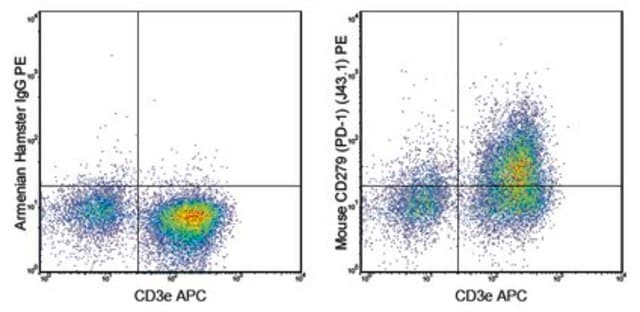
Flow Cytometry Analysis: A representative lot detected PD-1 in Flow Cytometry applications (Hirano, F., et. al. (2005). Cancer Res. 65(3):1089-96).

Biochem/physiol Actions

Clone G4 is an Armenian Hamster monoclonal antibody that specifically detects PD-1 in murine cells.

Physical form

Format: Purified

Analysis Note

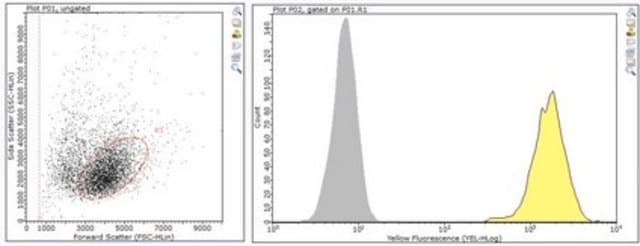
Evaluated by Flow Cytometry in EL4 T lymphoma cells.

Flow Cytometry Analysis: 1 µg of this antibody detected PD-1 in 1X10E6 EL4 T lymphoma cells.

Other Notes

Concentration: Please refer to lot specific datasheet.

Ähnliche Artikel vergleichen

Vollständigen Vergleich anzeigen

Unterschiede anzeigen

1 of 1

Dieser Artikel
MABF556MABC1122MABC1131
description

clone G4, from hamster(Armenian)

description

clone J43.1, 0.2 mg/mL, from hamster(Armenian)

description

clone EH33.1F9.G4.5, from mouse

description

clone 10B5, from hamster(Armenian)

antibody form

purified immunoglobulin

antibody form

purified antibody

antibody form

purified immunoglobulin

antibody form

purified immunoglobulin

Gene Information

mouse ... Pdcd1(18566)

Gene Information

mouse ... Pdcd1(18566)

Gene Information

human ... PDCD1(5133)

Gene Information

mouse ... Cd274(60533)

clone

G4, monoclonal

clone

J43.1, monoclonal

clone

EH33.1F9.G4.5, monoclonal

clone

10B5, monoclonal

biological source

hamster (Armenian)

biological source

hamster (Armenian)

biological source

mouse

biological source

hamster (Armenian)

species reactivity

mouse

species reactivity

mouse

species reactivity

human

species reactivity

mouse

conjugate

unconjugated

conjugate

PE

conjugate

unconjugated

conjugate

unconjugated


Still not finding the right product?

Probieren Sie unser Produkt-Auswahlhilfe, um Ihre Auswahl einzugrenzen


Hier finden Sie alle aktuellen Versionen:

Analysenzertifikate (COA)

Lot/Batch Number

It looks like we've run into a problem, but you can still download Certificates of Analysis from our Dokumente section.

Wenn Sie Hilfe benötigen, wenden Sie sich bitte an Kundensupport

Besitzen Sie dieses Produkt bereits?

In der Dokumentenbibliothek finden Sie die Dokumentation zu den Produkten, die Sie kürzlich erworben haben.

Die Dokumentenbibliothek aufrufen


Questions

Reviews

No rating value

Active Filters