Direkt zum Inhalt
Merck

Fortfahren mit

ABS551

Anti-Glucagon receptor Antibody

from rabbit, purified by affinity chromatography

Synonym(e):

GL-R, Glucagon receptor

Anmelden zur Ansicht der Organisations- und Vertragspreise.

Größe auswählen

Ansicht ändern
PackungsgrößeSKUVerfügbarkeitPreis

Über diesen Artikel

UNSPSC Code:
12352203
NACRES:
NA.41
eCl@ss:
32160702
Conjugate:
unconjugated
Clone:
polyclonal
Application:
IHC, WB
Citations:
-
Preise und Verfügbarkeit sind derzeit nicht verfügbar.
Technischer Dienst
Benötigen Sie Hilfe? Unser Team von erfahrenen Wissenschaftlern ist für Sie da.
Unterstützung erhalten


biological source

rabbit

Quality Level

conjugate

unconjugated

antibody form

affinity isolated antibody

antibody product type

primary antibodies

clone

polyclonal

purified by

affinity chromatography

species reactivity

human

species reactivity (predicted by homology)

primate (based on 100% sequence homology)

technique(s)

immunohistochemistry: suitable (paraffin), western blot: suitable

NCBI accession no.

UniProt accession no.

shipped in

wet ice

target post-translational modification

unmodified

Gene Information

human ... GCGR(2642)

General description

Glucagon receptor or GL-R (UniProt P47871) is encoded by the GCGR (also known as GGR) gene (Gene ID 2642) in human. Glucagon is a 29-amino acid peptide that stimulates glycogenolysis and gluconeogenesis in the liver to increase blood glucose. The receptor for glucagon is a class 2 (or class B) G protein-coupled receptor (GPCR) that signals through Gs to stimulate cAMP production. Mice lacking the glucagon receptor have mild hypoglycemia after fasting and exhibit hyperplasia of pancreatic alpha-cells. Because of its role in promoting hyperglycemia, the glucagon receptor presents a potential target for treatment of diabetes.
~59 kDa observed. Target band appears larger than the calculated molecular weight of 54.0 kDa (Preform) and 51.3 kDa (mature) due to glycosylation. Lower molecular weight degradation band(s) can also be seen (Iwanij, V., et al. (1990). J. Biol Chem. 265(34):21302-21308).

Immunogen

Epitope: Fourth cytoplasmic domain
KLH-conjugated linear peptide corresponding to the cytoplasmic domain of human Glucagon receptor.

Application

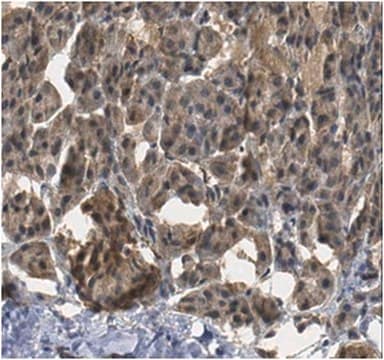
Immunohistochemistry Analysis: A 1:50 dilution from a representative lot detected Glucagon receptor in human pancreas.
This Anti-Glucagon receptor Antibody is validated for use in Western Blotting, Immunohistochemistry (Paraffin) for the detection of Glucagon receptor.

Analysis Note

Evaluated by Western Blotting in human liver tissue lysate.

Western Blotting Analysis: 0.2 µg/mL of this antibody detected Glucagon receptor in 10 µg of human liver tissue lysate.

Other Notes

Concentration: Please refer to lot specific datasheet.

Ähnliche Artikel vergleichen

Vollständigen Vergleich anzeigen

Unterschiede anzeigen

1 of 1

Dieser Artikel
SAB4501138SAB4501137SAB1410515
biological source

rabbit

biological source

rabbit

biological source

rabbit

biological source

rabbit

conjugate

unconjugated

conjugate

unconjugated

conjugate

unconjugated

conjugate

unconjugated

Quality Level

100

Quality Level

100

Quality Level

100

Quality Level

-

antibody form

affinity isolated antibody

antibody form

affinity isolated antibody

antibody form

affinity isolated antibody

antibody form

purified immunoglobulin

technique(s)

immunohistochemistry: suitable (paraffin), western blot: suitable

technique(s)

ELISA: 1:1000, immunofluorescence: 1:100-1:500, western blot: 1:500-1:1000

technique(s)

ELISA: 1:5000, immunofluorescence: 1:100-1:500, western blot: 1:500-1:1000

technique(s)

western blot: 1 μg/mL

clone

polyclonal

clone

polyclonal

clone

polyclonal

clone

polyclonal


Still not finding the right product?

Probieren Sie unser Produkt-Auswahlhilfe, um Ihre Auswahl einzugrenzen


Lagerklasse

12 - Non Combustible Liquids

wgk

WGK 1

flash_point_f

Not applicable

flash_point_c

Not applicable


Analysenzertifikate (COA)

Suchen Sie nach Analysenzertifikate (COA), indem Sie die Lot-/Chargennummer des Produkts eingeben. Lot- und Chargennummern sind auf dem Produktetikett hinter den Wörtern ‘Lot’ oder ‘Batch’ (Lot oder Charge) zu finden.

Besitzen Sie dieses Produkt bereits?

In der Dokumentenbibliothek finden Sie die Dokumentation zu den Produkten, die Sie kürzlich erworben haben.

Die Dokumentenbibliothek aufrufen


Verwandter Inhalt

A major focus of breast cancer research is to understand the mechanisms responsible for disease progression and drug resistance. Toward that end, it has been found that approximately two thirds of all human breast carcinomas overexpress the Estrogen Receptor α (ERα) protein and it remains the primary pharmacological target for endocrine therapy1,2. The normal cellular function of ERα is as a transcription factor that mediates a wide variety of physiological processes, many of which are dependent upon phosphorylation of the receptor at specific amino acid residues3,4. Indeed, ERα is known to be phosphorylated at a multitude of different sites, yet how these all correlate to disease remains unclear5. Here, we interrogated multiple sites of ERα for phosphorylation status by screening an extensive panel of different breast cancer patient samples and other non-breast cancer tissue microarray (TMA) slide samples to determine their relevance to disease.

"Mods – modifications – small alterations can have a big impact on form and function. In the motorsports world, stock vehicles are modified to enhance their performance. Modifications, or mods, to the engine, drive train, intake and exhaust components add up to provide phenomenal performance gains that can be measured as horsepower and torque increases, which yield a competitive advantage, and result in reduced run times. In biology, proteins undergo modifications that alter their function. Some proteins require the modifications in order to perform their function effectively, whether it’s a pro-protein that is cleaved to produce an active enzyme, or a protein that is phosphorylated to facilitate a signaling process. Other proteins, such as histones, undergo modifications that regulate gene expression and alter cellular function. There are several post translational modifications such as acetylation, methylation, phosphorylation, and ubiquitination that impact protein function and activity. As a result, the analysis of proteins and their post-translational modifications are particularly important for the study of normal and disease-associated processes. New antibodies to detect phospho Histidines are now available from EMD Millipore."


Global Trade Item Number

SKUGTIN
ABS55104055977277357

Questions

Reviews

No rating value

Active Filters