Direkt zum Inhalt
Merck

07-2174

Anti-Heat Shock Protein 90α Antibody

from rabbit

Synonym(e):

heat shock protein 90kDa alpha (cytosolic), class A member 1, Renal carcinoma antigen NY-REN-38, heat shock 90kD protein 1, alpha, heat shock 90kD protein, alpha-like 4, heat shock 90kDa protein 1, alpha, heat shock protein HSP 90-alpha, Heat shock 86 kD

Anmelden zur Ansicht der Organisations- und Vertragspreise.

Größe auswählen

100 μG

€ 391,00

€ 391,00


Warenkorb auf Verfügbarkeit prüfen

Großbestellung anfragen

Über diesen Artikel

eCl@ss:
32160702
UNSPSC Code:
12352203
NACRES:
NA.41

Fortfahren mit

Technischer Dienst
Benötigen Sie Hilfe? Unser Team von erfahrenen Wissenschaftlern ist für Sie da.
Unterstützung erhalten

Produktname

Anti-Heat Shock Protein 90α Antibody, from rabbit

biological source

rabbit

conjugate

unconjugated

antibody product type

primary antibodies

clone

polyclonal

species reactivity

human, rat, mouse

species reactivity (predicted by homology)

canine (based on 100% sequence homology)

technique(s)

immunocytochemistry: suitable
immunohistochemistry: suitable
immunoprecipitation (IP): suitable
western blot: suitable

NCBI accession no.

UniProt accession no.

shipped in

wet ice

target post-translational modification

unmodified

Quality Level

Gene Information

Ähnliche Artikel vergleichen

Vollständigen Vergleich anzeigen

Unterschiede anzeigen

1 of 4

Dieser Artikel
MABC1106SAB2900334SAB4501461
species reactivity

human, rat, mouse

species reactivity

human

species reactivity

human, rat, mouse, chicken, monkey, Drosophila

species reactivity

human, rat, mouse

clone

polyclonal

clone

1G6-D7, monoclonal

clone

polyclonal

clone

polyclonal

biological source

rabbit

biological source

mouse

biological source

rabbit

biological source

rabbit

UniProt accession no.

P07900

UniProt accession no.

P07900

UniProt accession no.

P07900

UniProt accession no.

P07900

Gene Information

dog ... Hsp90Aa1(480438)
human ... HSP90AA1(3320)
mouse ... Hsp90Aa1(15519)
rat ... Hsp90Aa1(299331)

Gene Information

human ... HSP90AA1(3320)

Gene Information

human ... HSP90AA1(3320)

Gene Information

human ... HSP90AA1(3320)

shipped in

wet ice

shipped in

-

shipped in

dry ice

shipped in

wet ice

Analysis Note

Control
HeLa cell lysate
Evaluated by Western Blot in HeLa cell lysate.

Western Blot Analysis: 0.0625 µg/mL of this antibody detected Heat Shock Protein 90α on 10 µg of HeLa cell lysate.

Application

Detect the Heat Shock Protein 90α protein using this Anti-Heat Shock Protein 90α validated for use in WB, IP, ICC & IHC.
Research Category
Protein Trafficking
Research Sub Category
Chaperones
Western Blot (Snap i.d.) Analysis: 1 µg/mL from a previous lot detected Heat Shock Protein 90α on 10 µg of NIH/3T3 cell lysate.

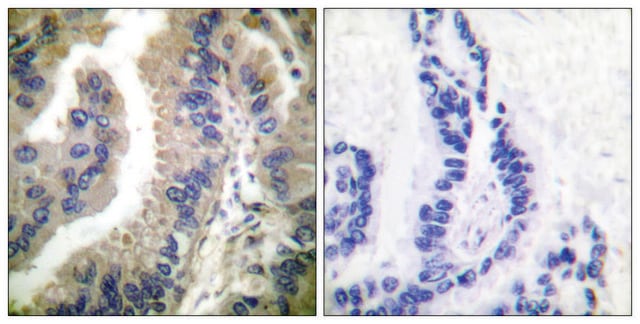
Immunohistochemistry Analysis: 1:100 dilution from a previous lot detected Heat Shock Protein 90α in human prostate adenocarcinoma tissue.

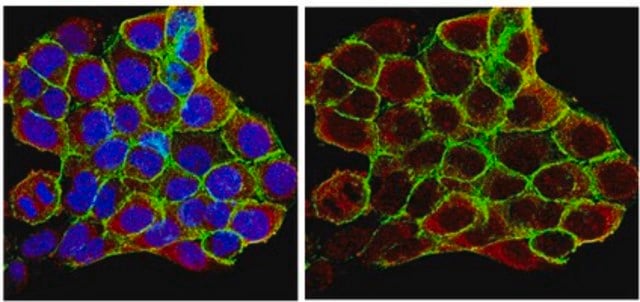
Immunocytochemistry Analysis: 1:500 dilution from a previous ot detected Heat Shock Protein 90α in A431 cells.

Immunoprecipitation Analysis: 10 µg from a previous lot immunoprecipitated Heat Shock Protein 90A from HeLa cell lysate.

Biochem/physiol Actions

This antibody recognizes Heat Shock Protein 90α at the N-terminus.

Disclaimer

Unless otherwise stated in our catalog or other company documentation accompanying the product(s), our products are intended for research use only and are not to be used for any other purpose, which includes but is not limited to, unauthorized commercial uses, in vitro diagnostic uses, ex vivo or in vivo therapeutic uses or any type of consumption or application to humans or animals.

General description

The Heat Shock Protein 90 family is known as a group of molecular chaperones involved in the regulation of maturation, degradation, and folding transport for a select, yet varied group of proteins primarily comprised of signaling molecules, but also including tyrosine kinases, G-protein subunits, transcription factors, and telomerase. Heat Shock Protein 90 has two isoforms that share a homology of 76%; Heat Shock Protein 90α (HSP90α) and Heat Shock Protein 90β (HSP90β). HSP90α contains a charged sequence linker, a C-terminal domain, and N-terminal domain and a middle domain. It is induced by oxidative stress and has been observed in exosomes where it is secreted into the extracellular environment following translocation via TGFα stimulus. Extracellular HSP90α functions to facilitate the migration of both dermal and epidermal cells through its interaction with cell surface receptors CD91 and LRP1. HSP90α interaction with TERT is a necessary component of TERT holoenzyme complex assembly and stabilization. It has also been shown to interact with a variety of other proteins such as FNIP1, HSF1, TOM34, AHSA1, SMYD3, and DNAJC7.
~ 90 kDa observed

Immunogen

Epitope: N-terminus
KLH-conjugated linear peptide corresponding to the N-terminus of human Heat Shock Protein 90α.

Other Notes

Concentration: Please refer to the Certificate of Analysis for the lot-specific concentration.

Physical form

Format: Purified
Protein A
Purified rabbit polyclonal in buffer containing 0.1 M Tris-Glycine (pH 7.4), 150 mM NaCl with 0.05% sodium azide.

Preparation Note

Stable for 1 year at 2-8°C from date of receipt.

Sie haben nicht das passende Produkt gefunden?  

Probieren Sie unser Produkt-Auswahlhilfe. aus.

Lagerklasse

12 - Non Combustible Liquids

wgk

WGK 1

flash_point_f

Not applicable

flash_point_c

Not applicable


Analysenzertifikate (COA)

Suchen Sie nach Analysenzertifikate (COA), indem Sie die Lot-/Chargennummer des Produkts eingeben. Lot- und Chargennummern sind auf dem Produktetikett hinter den Wörtern ‘Lot’ oder ‘Batch’ (Lot oder Charge) zu finden.

Besitzen Sie dieses Produkt bereits?

In der Dokumentenbibliothek finden Sie die Dokumentation zu den Produkten, die Sie kürzlich erworben haben.

Die Dokumentenbibliothek aufrufen

Koji Miyabayashi et al.
Cancer discovery, 10(10), 1566-1589 (2020-07-25)
Pancreatic ductal adenocarcinoma (PDAC) is the most lethal common malignancy, with little improvement in patient outcomes over the past decades. Recently, subtypes of pancreatic cancer with different prognoses have been elaborated; however, the inability to model these subtypes has precluded
Tobiloba E Oni et al.
The Journal of experimental medicine, 217(9) (2020-07-08)
Pancreatic ductal adenocarcinoma (PDAC) has a dismal prognosis, and new therapies are needed. Altered metabolism is a cancer vulnerability, and several metabolic pathways have been shown to promote PDAC. However, the changes in cholesterol metabolism and their role during PDAC
Shinichiro Atsumi et al.
Communications biology, 3(1), 588-588 (2020-10-18)
Despite the accumulating evidences of the significance of humoral cancer immunity, its molecular mechanisms have largely remained elusive. Here we show that B-cell repertoire sequencing of 102 clinical gastric cancers and molecular biological analyses unexpectedly reveal that the major humoral

Questions

Reviews

No rating value

Active Filters

Unser Team von Wissenschaftlern verfügt über Erfahrung in allen Forschungsbereichen einschließlich Life Science, Materialwissenschaften, chemischer Synthese, Chromatographie, Analytik und vielen mehr..

Setzen Sie sich mit dem technischen Dienst in Verbindung