Skip to Content
MilliporeSigma

Skip To

C8726

Caspase 9 human

≥90% (SDS-PAGE), recombinant, expressed in E. coli (C-terminal histidine-tagged), buffered aqueous solution, >2,000 units/mg protein

Synonym(s):

ICE-Lap6, Mch6

Sign In to View Organizational & Contract Pricing.

About This Item

UNSPSC Code:
12352204
MDL number:
EC Number:
Specific activity:
>2,000 units/mg protein
Assay:
≥90% (SDS-PAGE)
Recombinant:
expressed in E. coli (C-terminal histidine-tagged)


recombinant

expressed in E. coli (C-terminal histidine-tagged)

Quality Level

assay

≥90% (SDS-PAGE)

form

buffered aqueous solution

specific activity

>2,000 units/mg protein

mol wt

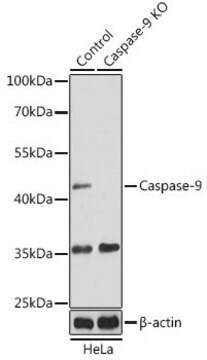
N-terminal prodomain plus the large subunit. 36 kDa (caspase 9 expressed as a C-terminal histidine-tagged protein appears as a two-subunit protein), small subunit 13 kDa (subunit containing the histidine tag)

UniProt accession no.

shipped in

dry ice

storage temp.

−70°C

Gene Information

human ... CASP9(842)

Biochem/physiol Actions

Activation of caspase-9 (CASP9) through apoptotic stimuli initiates the caspase cascade. Caspases have been implicated in many disorders including cancer, inflammatory disease, neurodegenerative diseases, stroke and myocardial infarction.
When cells receive apoptotic stimuli, such as activation of the TNFα/Fas cell surface receptor, caspase 8 activation, Bid processing and its translocation to the mitochondria ensue. As a result mitochondria release cytochrome c which then binds to Apaf-1, the mammalian Ced-4 homologue, together with dATP. The resultant complex recruits caspase 9 leading to its activation. It then cleaves downstream caspases such as caspase 3, 6, and 7, initiating the caspase cascade. Caspase 9 exhibits basal activity. It can be further activated via interaction of its N-terminal prodomain with the activator protein Apaf-1 in the presence of cytochrome c and dATP. Caspases have been implicated in many disorders including cancer, inflammatory disease, neurodegenerative diseases, stroke and myocardial infarction.

Physical form

Solution in 10% sucrose containing 50 mM HEPES, pH 7.5, 5 mM DTT, 0.1% CHAPS, 1 mM EDTA, 50 mM NaCl.

Other Notes

One unit will cleave 1.0 nmol of Ac-Leu-Glu-His-Asp-AFC per hr at 25 °C at pH 6.5.

Compare Similar Items

View Full Comparison

Show Differences

1 of 1

This Item
SAB5700785SAB5700630SAB3500405
specific activity

>2,000 units/mg protein

specific activity

-

specific activity

-

specific activity

-

Gene Information

human ... CASP9(842)

Gene Information

human ... CASP9(842)

Gene Information

human ... CASP9(842)

Gene Information

human ... CASP9(842)

assay

≥90% (SDS-PAGE)

assay

-

assay

-

assay

-

form

buffered aqueous solution

form

buffered aqueous solution

form

buffered aqueous solution

form

buffered aqueous solution

recombinant

expressed in E. coli (C-terminal histidine-tagged)

recombinant

-

recombinant

-

recombinant

-

UniProt accession no.

P55211

UniProt accession no.

P55211

UniProt accession no.

P55211

UniProt accession no.

P55211


Storage Class

12 - Non Combustible Liquids

wgk

WGK 1

flash_point_f

Not applicable

flash_point_c

Not applicable

ppe

Eyeshields, Gloves, multi-purpose combination respirator cartridge (US)


Choose from one of the most recent versions:

Certificates of Analysis (COA)

Lot/Batch Number

Don't see the Right Version?

If you require a particular version, you can look up a specific certificate by the Lot or Batch number.

Already Own This Product?

Find documentation for the products that you have recently purchased in the Document Library.

Visit the Document Library


Related Content

Instructions


K Kuida
The international journal of biochemistry & cell biology, 32(2), 121-124 (2000-02-25)
Caspase-9 is a member of caspase family of cysteine proteases that have been implicated in apoptosis and cytokine processing. When cells receive apoptotic stimuli, mitochondria releases cytochrome c which then binds to Apaf-1, the mammalian Ced-4 homologue, together with dATP.
S M Srinivasula et al.
The Journal of biological chemistry, 271(43), 27099-27106 (1996-10-25)
Recent evidence suggests that CPP32 is an essential component of an aspartate-specific cysteine protease (ASCP) cascade responsible for apoptosis execution in mammalian cells. Activation of CPP32 could lead to activation of other downstream ASCPs, resulting in late morphological changes such
H R Stennicke et al.
The Journal of biological chemistry, 274(13), 8359-8362 (1999-03-20)
The recombinant form of the proapoptotic caspase-9 purified following expression in Escherichia coli is processed at Asp315, but largely inactive; however, when added to cytosolic extracts of human 293 cells it is activated 2000-fold in the presence of cytochrome c


Questions

Reviews

No rating value

Active Filters