Skip to Content
MilliporeSigma
Get 22% off for Pi Day through March 31.Save Now

C199

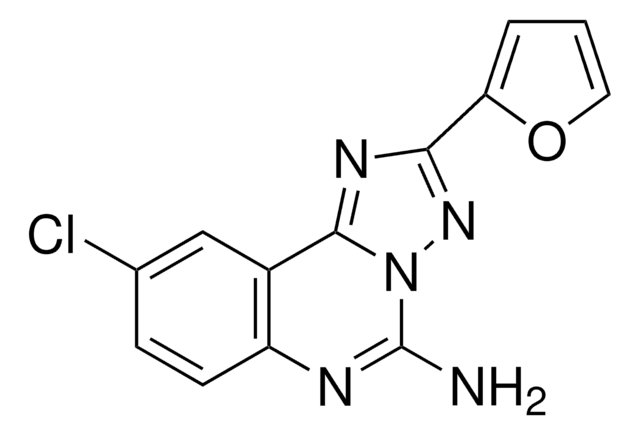
CGS-15943

≥98% (HPLC), Adenosine receptor antagonist, solid

Synonym(s):

9-Chloro-2-(2-furanyl)-[1,2,4]triazolo[1,5-c]quinazolin-5-amine

Sign In to View Organizational & Contract Pricing.

Select a Size

25 MG

$176.00

$176.00


Available to ship TODAYDetails


Request a Bulk Order

About This Item

Empirical Formula (Hill Notation):
C13H8ClN5O
CAS Number:
Molecular Weight:
285.69
UNSPSC Code:
12352202
PubChem Substance ID:
NACRES:
NA.77
MDL number:
Assay:
≥98% (HPLC)
Form:
solid
Quality level:

Skip To

Technical Service
Need help? Our team of experienced scientists is here for you.
Let Us Assist

Product Name

CGS-15943, solid

assay

≥98% (HPLC)

Quality Level

form

solid

color

white

solubility

DMSO: >10 mg/mL, H2O: insoluble

storage temp.

room temp

SMILES string

Nc1nc2ccc(Cl)cc2c3nc(nn13)-c4ccco4

InChI

1S/C13H8ClN5O/c14-7-3-4-9-8(6-7)12-17-11(10-2-1-5-20-10)18-19(12)13(15)16-9/h1-6H,(H2,15,16)

InChI key

MSJODEOZODDVGW-UHFFFAOYSA-N

Related Categories

Compare Similar Items

View Full Comparison

Show Differences

1 of 4

This Item
S4568S6451Z0153
assay

≥98% (HPLC)

assay

≥98% (HPLC)

assay

≥98% (HPLC)

assay

≥98% (HPLC)

form

solid

form

solid

form

powder

form

powder

Quality Level

100

Quality Level

100

Quality Level

100

Quality Level

100

storage temp.

room temp

storage temp.

-

storage temp.

2-8°C

storage temp.

room temp

solubility

DMSO: >10 mg/mL, H2O: insoluble

solubility

DMSO: soluble >10 mg/mL, H2O: insoluble

solubility

DMSO: ≥20 mg/mL

solubility

DMSO: >15 mg/mL

color

white

color

off-white

color

light tan to tan

color

white to tan

Application

CGS-15943 has been used as a non-selective adenosine receptor antagonist to study its effects on the proliferation of pancreatic ductal adenocarcinoma (PDAC) cells and hepatocellular carcinoma (HCC)[1]. It has also been used as a non-selective adenosine receptor antagonist to investigate the mechanism underlying adenosine inhibition on cholangiocarcinoma (CCA) cells.[2]

Biochem/physiol Actions

CGS-15943 is a potent and non-selective adenosine receptor antagonist. It exhibits anti-carcinogenic and anti-apoptotic activity.[1]

ppe

Eyeshields, Gloves, type N95 (US)

Storage Class

11 - Combustible Solids

wgk

WGK 3

flash_point_f

Not applicable

flash_point_c

Not applicable


Choose from one of the most recent versions:

Certificates of Analysis (COA)

Lot/Batch Number

Don't see the Right Version?

If you require a particular version, you can look up a specific certificate by the Lot or Batch number.

Already Own This Product?

Find documentation for the products that you have recently purchased in the Document Library.

Visit the Document Library

Soo-Kyung Kim et al.
Journal of medicinal chemistry, 46(23), 4847-4859 (2003-10-31)
A three-dimensional model of the human A(2A) adenosine receptor (AR) and its docked ligands was built by homology to rhodopsin and validated with site-directed mutagenesis and the synthesis of chemically complementary agonists. Different binding modes of A(2A)AR antagonists and agonists
J m Li et al.
The Journal of surgical research, 80(2), 357-364 (1999-01-08)
Adenosine is a potent vasodilator of vascular smooth muscle. Endothelium-derived nitric oxide (NO) elicits vasodilation. We have previously reported that adenosine stimulates the production of NO from porcine carotid arterial endothelial cells (PCAEC) via a receptor-mediated mechanism. This study was
Elise M Weerts et al.
Psychopharmacology, 168(1-2), 155-163 (2003-04-02)
Caffeine and the adenosine A(1) and A(2A) receptor antagonist CGS15943 produce many behavioral effects that are similar to those produced by classic stimulant drugs (e.g. cocaine and amphetamines). The current study evaluated whether CGS15943 would maintain self-administration and reinstate extinguished
E Ongini et al.
Naunyn-Schmiedeberg's archives of pharmacology, 359(1), 7-10 (1999-02-05)
Three structurally related non-xanthine compounds, CGS 15943, ZM 241385 and SCH 58261, are potent A2A adenosine receptor antagonists and have been used as tools in many pharmacological studies. We have now characterized their affinity and selectivity profile on human adenosine
M Williams et al.
The Journal of pharmacology and experimental therapeutics, 241(2), 415-420 (1987-05-01)
CGS 15943A, a triazoloquinazoline, is a potent and selective adenosine receptor antagonist as assessed by its effects on radioligand binding and adenosine-stimulated adenylate cyclase activity in guinea pig synaptoneurosomes. At the adenosine A-1 receptor labeled with [3H]cyclohexyladenosine, CGS 15943A had

Global Trade Item Number

SKUGTIN
C199-25MG04061833474914

Questions

Reviews

No rating value

Active Filters

Our team of scientists has experience in all areas of research including Life Science, Material Science, Chemical Synthesis, Chromatography, Analytical and many others.

Contact Technical Service