Skip to Content
MilliporeSigma

Skip To

211A-1

TSH Rabbit Polyclonal Antibody

Sign In to View Organizational & Contract Pricing.

Select a Size

Change View
Pack SizeSKUAvailabilityPrice
0.5 mL
0 left in stock
$480.00

About This Item

NACRES:
NA.41
UNSPSC Code:
12352203
Conjugate:
unconjugated
Clone:
polyclonal
Application:
IHC (p)
Citations:
7

$480.00


0 left in stock

Request a Bulk Order
Technical Service
Need help? Our team of experienced scientists is here for you.
Let Us Assist


biological source

rabbit

Quality Level

conjugate

unconjugated

antibody form

Ig fraction of antiserum

antibody product type

primary antibodies

clone

polyclonal

description

For In Vitro Diagnostic Use in Select Regions (See Chart)

form

buffered aqueous solution

species reactivity

human

packaging

vial of 0.1 mL concentrate (211A-14), vial of 0.5 mL concentrate (211A-15), bottle of 1.0 mL predilute (211A-17), vial of 1.0 mL concentrate (211A-16), bottle of 7.0 mL predilute (211A-18)

manufacturer/tradename

Cell Marque®

technique(s)

immunohistochemistry (formalin-fixed, paraffin-embedded sections): 1:100-1:500

control

pituitary

shipped in

wet ice

storage temp.

2-8°C

visualization

cytoplasmic

General description

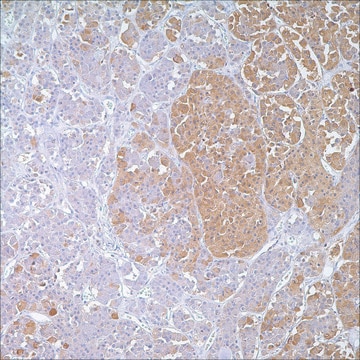
Anti-TSH is a useful marker in classification of pituitary tumors and the study of pituitary disease. It reacts with TSH-producing cells (thyrotrophs).

Physical form

Solution in Tris Buffer, pH 7.3-7.7, with 1% BSA and <0.1% Sodium Azide

Preparation Note

Download the IFU specific to your product lot and formatNote: This requires a keycode which can be found on your packaging or product label.

Analysis Note


IVD

IVD

IVD

RUO

Other Notes

For Technical Service please contact: 800-665-7284 or email: [email protected]
TSH Positive Control Slides, Product No. 211S, are available for immunohistochemistry (formalin-fixed, paraffin-embedded sections).

Legal Information

Cell Marque is a registered trademark of Merck KGaA, Darmstadt, Germany

Compare Similar Items

View Full Comparison

Show Differences

1 of 1

This Item
206A-7209A-1208A-7
antibody form

Ig fraction of antiserum

antibody form

Ig fraction of antiserum

antibody form

Ig fraction of antiserum

antibody form

Ig fraction of antiserum

clone

polyclonal

clone

polyclonal

clone

polyclonal

clone

polyclonal

conjugate

unconjugated

conjugate

unconjugated

conjugate

unconjugated

conjugate

unconjugated

biological source

rabbit

biological source

rabbit

biological source

rabbit

biological source

rabbit

species reactivity

human

species reactivity

human

species reactivity

human

species reactivity

human

form

buffered aqueous solution

form

buffered aqueous solution

form

buffered aqueous solution

form

buffered aqueous solution


Still not finding the right product?

Try our Product Selector Tool to narrow your options


Choose from one of the most recent versions:

Certificates of Analysis (COA)

Lot/Batch Number

Don't see the Right Version?

If you require a particular version, you can look up a specific certificate by the Lot or Batch number.

Already Own This Product?

Find documentation for the products that you have recently purchased in the Document Library.

Visit the Document Library


A Gessl et al.
The Journal of clinical endocrinology and metabolism, 79(4), 1128-1134 (1994-10-01)
The McCune-Albright syndrome (MAS) comprises a triad of physical signs: localized bone lesions termed polyostotic fibrous dysplasia, café-au-lait pigmentation of the skin, and autonomous hyperfunction of multiple endocrine systems, including overproduction of GH and T4. A somatic activating point mutation
J N Clore et al.
The American journal of the medical sciences, 295(1), 3-5 (1988-01-01)
A 36-year-old woman with hyperthyroidism, elevated blood thyroid-stimulating hormone (TSH) and alpha-subunit levels, amenorrhea, hyperprolactinemia and no evidence of acromegaly, was found to have a pituitary adenoma containing TSH, alpha-subunit and growth hormone by immunohistochemistry. Preoperative testing revealed elevated TSH
J J Kovalic et al.
Journal of neuro-oncology, 16(3), 227-232 (1993-06-01)
There is general agreement that postoperative radiation therapy is beneficial for patients with subtotally resected pituitary adenomas. We have identified 41 such patients treated during a 20-year period who received postoperative irradiation for a pituitary adenoma. The usual dose was


Global Trade Item Number

SKUGTIN
211A-140841683126577
211A-170841683126607
211A-160841683126591
211A-150841683126584
211A-180841683126614

Questions

Reviews

No rating value

Active Filters