
![7-Diethylamino-3-[N-(2-maleimidoethyl)carbamoyl]coumarin BioReagent, suitable for fluorescence, ≥97.0% (HPLC)](/deepweb/assets/sigmaaldrich/product/structures/341/038/a7e0c464-8abe-4eb0-b253-6537f649d89c/640/a7e0c464-8abe-4eb0-b253-6537f649d89c.png)
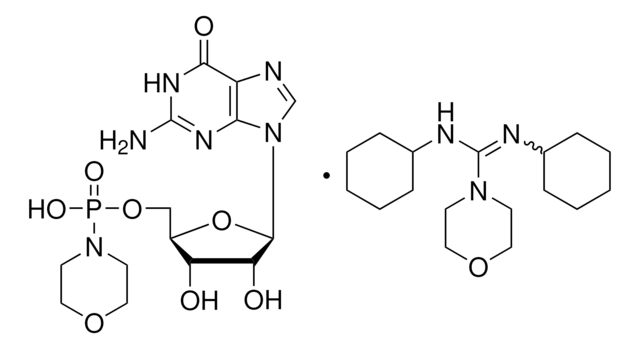


The product specification requires an emission wavelength range of 460-470nm. The product is not screened for excitation wavelength, however it is expected to fall within a range of 416 to 425 nm. The compound is typically used for real-time measurements for the release of inorganic phosphates during enzymatic reaction when MDCC is conjugated to a mutant phosphate-binding protein . Please see the link below to review a publication that may be of interest:
https://pubs.acs.org/doi/10.1021/bi9804277
05019

7-Diethylamino-3-[N-(2-maleimidoethyl)carbamoyl]coumarin
BioReagent, suitable for fluorescence, ≥97.0% (HPLC)
Synonym(s):
MDCC
Sign In to View Organizational & Contract Pricing.
Select a Size
Change View
| Pack Size | SKU | Availability | Price |
|---|---|---|---|
| 5 mg | Check Cart for Availability | $154.00 |
About This Item
Empirical Formula (Hill Notation):
C20H21N3O5
CAS Number:
Molecular Weight:
383.40
UNSPSC Code:
12352116
PubChem Substance ID:
NACRES:
NA.32
MDL number:
$154.00
Check Cart for Availability
Subscriptions are currently unavailable.
Ships Every 4 weeks
product line
BioReagent
Quality Segment
assay
≥97.0% (HPLC)
suitability
suitable for fluorescence
SMILES string
CCN(CC)c1ccc2C=C(C(=O)NCCN3C(=O)C=CC3=O)C(=O)Oc2c1
InChI
1S/C20H21N3O5/c1-3-22(4-2)14-6-5-13-11-15(20(27)28-16(13)12-14)19(26)21-9-10-23-17(24)7-8-18(23)25/h5-8,11-12H,3-4,9-10H2,1-2H3,(H,21,26)
InChI key
IXQPRUQVJIJUEB-UHFFFAOYSA-N
Application
Thiol-reactive probe for protein labelling
7-Diethylamino-3-[N-(2-maleimidoethyl)carbamoyl]coumarin is utilized as a fluoresencent biological sensing device . Used for real-time measurements for the release of inorganic phosphates during enzymatic reaction when MDCC is conjugated to a mutant phosphate-binding protein . Also, utilized for intramolecular fluorescence energy transfer (FRET) experiments .
1 of 1
This Item | |||
|---|---|---|---|
| suitability suitable for fluorescence | suitability - | suitability - | suitability - |
| Quality Level 100 | Quality Level 200 | Quality Level 100 | Quality Level 200 |
| assay ≥97.0% (HPLC) | assay ≥90% | assay - | assay - |
| product line BioReagent | product line - | product line - | product line - |
Choose from one of the most recent versions:
Already Own This Product?
Find documentation for the products that you have recently purchased in the Document Library.
Lyndon L E Salins et al.
Sensors and actuators. B, Chemical, 97(1), 81-89 (2004-03-06)
This work explores the potential use of a member of the periplasmic family of binding proteins, the phosphate binding protein (PBP), as the biorecognition element in a sensing scheme for the detection of inorganic phosphate (Pi). The selectivity of this
M Hirshberg et al.
Biochemistry, 37(29), 10381-10385 (1998-07-22)
Crystal structures are presented for the A197C mutant of Escherichia coli phosphate binding protein (PBP) and the same mutant labeled at Cys197 with N-[2-(1-maleimidyl)ethyl]-7-(diethylamino)coumarin-3-carboxamide (MDCC). Both proteins are complexed with inorganic phosphate. The latter molecule, MDCC-PBP, exhibits a large increase
M A Ferenczi et al.
Biophysical journal, 68(4 Suppl), 191S-192S (1995-04-01)
A new method for the measurement of phosphate release in contracting and relaxed permeabilized muscle fibers is described. The assay is based on a genetically engineered phosphate-binding protein labeled with a coumarin fluorescent probe, which binds inorganic phosphate tightly and
Global Trade Item Number
| SKU | GTIN |
|---|---|
| 1483185-10MG | 04061833852651 |
| 150215-5G | 04061831818727 |
| PHR3071-25MG | 04065266899955 |
| 150215-1G | 04061825583037 |
| 05019-1MG-F | 04061823353243 |
| 05019-5MG-F | 04061833488553 |
-
What do the excitation/emission peaks of this dye look like?
1 answer-
Helpful?
-