Skip to Content
MilliporeSigma

Skip To

45751

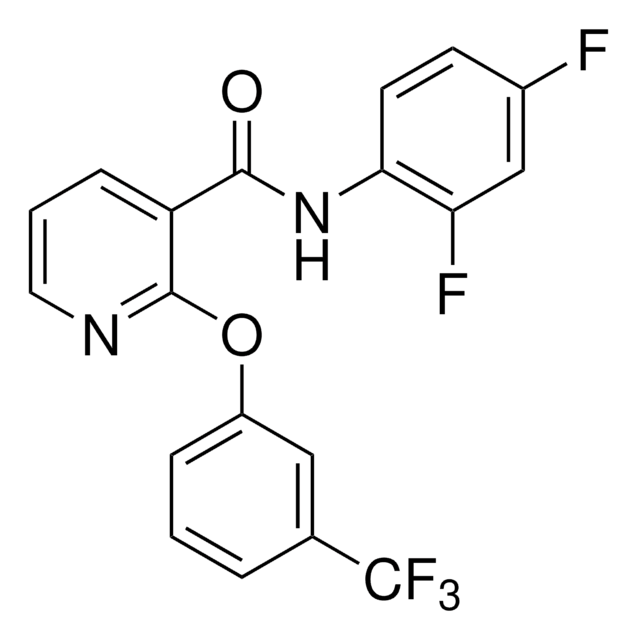
Diflufenican

PESTANAL®, analytical standard

Sign In to View Organizational & Contract Pricing.

Select a Size

Change View
Pack SizeSKUAvailabilityPrice
100 mg

Available to ship TODAYfromMILWAUKEE

$90.30

About This Item

Empirical Formula (Hill Notation):
C19H11F5N2O2
CAS Number:
Molecular Weight:
394.29
UNSPSC Code:
41116107
NACRES:
NA.24
PubChem Substance ID:
MDL number:
Beilstein/REAXYS Number:
4212494

$90.30


Available to ship TODAYDetails


Request a Bulk Order
Technical Service
Need help? Our team of experienced scientists is here for you.
Let Us Assist


grade

analytical standard

Quality Level

product line

PESTANAL®

shelf life

limited shelf life, expiry date on the label

technique(s)

HPLC: suitable, gas chromatography (GC): suitable

application(s)

agriculture
environmental

format

neat

SMILES string

Fc1ccc(NC(=O)c2cccnc2Oc3cccc(c3)C(F)(F)F)c(F)c1

InChI

1S/C19H11F5N2O2/c20-12-6-7-16(15(21)10-12)26-17(27)14-5-2-8-25-18(14)28-13-4-1-3-11(9-13)19(22,23)24/h1-10H,(H,26,27)

InChI key

WYEHFWKAOXOVJD-UHFFFAOYSA-N

General description

Diflufenican is a pre- and early post-emergence herbicide used to control dicotyledonous weeds in winter cereals, including Galium aparine, Veronica hederifolia, Veronica persica and Viola arvensis, which are resistant to substituted urea herbicides.

Application

Diflufenican may be used as a reference standard in the determination of diflufenican in water samples using solid-phase microextraction followed by gas chromatography coupled with ion trap-tandem mass spectrometry (SPME-GC-ITD-MS/MS).
Refer to the product′s Certificate of Analysis for more information on a suitable instrument technique. Contact Technical Service for further support.

Legal Information

PESTANAL is a registered trademark of Merck KGaA, Darmstadt, Germany

Compare Similar Items

View Full Comparison

Show Differences

1 of 1

This Item
317263240545430
format

neat

format

neat

format

neat

format

neat

technique(s)

HPLC: suitable, gas chromatography (GC): suitable

technique(s)

HPLC: suitable, gas chromatography (GC): suitable

technique(s)

HPLC: suitable, gas chromatography (GC): suitable

technique(s)

HPLC: suitable, gas chromatography (GC): suitable

grade

analytical standard

grade

analytical standard

grade

analytical standard

grade

analytical standard

product line

PESTANAL®

product line

PESTANAL®

product line

PESTANAL®

product line

PESTANAL®

shelf life

limited shelf life, expiry date on the label

shelf life

limited shelf life, expiry date on the label

shelf life

limited shelf life, expiry date on the label

shelf life

limited shelf life, expiry date on the label

application(s)

agriculture
environmental

application(s)

agriculture
environmental

application(s)

agriculture
environmental

application(s)

agriculture
environmental


Still not finding the right product?

Explore all of our products under Diflufenican


pictograms

Exclamation markEnvironment

signalword

Warning

Hazard Classifications

Acute Tox. 4 Dermal - Acute Tox. 4 Oral - Aquatic Acute 1 - Aquatic Chronic 1

Storage Class

11 - Combustible Solids

wgk

WGK 2

flash_point_f

Not applicable

flash_point_c

Not applicable

ppe

Eyeshields, Gloves


Choose from one of the most recent versions:

Certificates of Analysis (COA)

Lot/Batch Number

Don't see the Right Version?

If you require a particular version, you can look up a specific certificate by the Lot or Batch number.

Already Own This Product?

Find documentation for the products that you have recently purchased in the Document Library.

Visit the Document Library


Shuang Bai et al.
Pesticide biochemistry and physiology, 155, 8-14 (2019-03-13)
Myosoton aquaticum L., a widespread and competitive winter weed of wheat in China, has evolved resistance to many classes of herbicides. In one M. aquaticum population (AH03), collected from Anhui Province, where tribenuron-methyl and florasulam had been used to control
Gary D Bending et al.
Environmental pollution (Barking, Essex : 1987), 139(2), 279-287 (2005-07-27)
The extent of within field variability in the degradation rate of the pesticides isoproturon, azoxystrobin and diflufenican, and the role of intrinsic soil factors and technical errors in contributing to the variability, was investigated in sites on sandy-loam and clay-loam.
Umi S Ramli et al.
The New phytologist, 184(2), 330-339 (2009-08-07)
* Oil crops are a very important commodity. Although many genes and enzymes involved in lipid accumulation have been identified, much less is known of regulation of the overall process. To address the latter we have applied metabolic control analysis


Global Trade Item Number

SKUGTIN
45751-100MG04061832342115

Questions

Reviews

No rating value

Active Filters