
MAC123

Anti-HSV-Tag® Antibody, clone HSV 78
clone HSV 78, from mouse
Sign In to View Organizational & Contract Pricing.
Select a Size
Change View
| Pack Size | SKU | Availability | Price |
|---|---|---|---|
| 100 μg | Check Cart for Availability | $550.00 |
About This Item
UNSPSC Code:
12352203
NACRES:
NA.41
eCl@ss:
32160702
Clone:
HSV 78, monoclonal
Technique(s):
western blot: suitable
Application:
WB
Citations:
1
biological source
mouse
Quality Level
antibody form
purified immunoglobulin
clone
HSV 78, monoclonal
species reactivity (predicted by homology)
all
technique(s)
western blot: suitable
isotype
IgG1κ
shipped in
wet ice
target post-translational modification
unmodified
General description
The HSV•Tag is a mouse monoclonal antibody that has high specificity and affinity for an 11-amino acid peptide derived from Herpes Simplex Virus (HSV) glycoprotein D. The peptide is encoded by the HSV•Tag sequence in appropriate expression vectors and by the Positive Control 36mer in the Novagen NovaTope System.
HSV•Tag and NovaTope are registered trademarks of Merck KGaA, Darmstadt, Germany.
HSV•Tag and NovaTope are registered trademarks of Merck KGaA, Darmstadt, Germany.
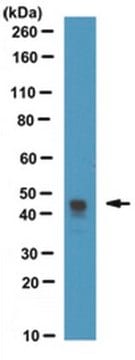
~45 kDa observed. An uncharacterized band may be observed at ~40 kDa, when using the Posi-Tag Epitope Tag Control protein. (Note: The Posi•Tag Epitope Tag Control which contains an HSV•Tag sequence, is observed at ~45 kDa)
Immunogen
Linear peptide corresponding to the HSV•Tag sequence.
Application
Research Category
Secondary & Control Antibodies
Secondary & Control Antibodies
Research Sub Category
Epitope Tags
Epitope Tags
This HSV•Tag antibody is validated for use in WB for the detection of the HSV•Tag protein.
Biochem/physiol Actions
Predicted to react with proteins containing the HSV•Tag.
Physical form
Format: Purified
Protein G Purified
Purified mouse monoclonal IgG1κ in buffer containing 0.1 M Tris-Glycine (pH 7.4), 150 mM NaCl with 0.05% sodium azide.
Preparation Note
Stable for 1 year at 2-8°C from date of receipt.
Analysis Note
Control
Posi-Tag Epitope Tag Control protein containing the HSV•Tag sequence.
Posi-Tag Epitope Tag Control protein containing the HSV•Tag sequence.
Evaluated by Western Blotting in Posi-Tag Epitope Tag Control protein containing the HSV•Tag sequence.
Western Blotting Analysis: 0.001 µg/mL of this antibody detected HSV•Tag in 50 ng of Posi-Tag Epitope Tag Control protein containg the HSV•Tag sequence.
Western Blotting Analysis: 0.001 µg/mL of this antibody detected HSV•Tag in 50 ng of Posi-Tag Epitope Tag Control protein containg the HSV•Tag sequence.
Other Notes
Concentration: Please refer to the Certificate of Analysis for the lot-specific concentration.
Replaces: 69171-4; 69171-3
Legal Information
HSV-TAG is a registered trademark of Merck KGaA, Darmstadt, Germany
Disclaimer
Unless otherwise stated in our catalog or other company documentation accompanying the product(s), our products are intended for research use only and are not to be used for any other purpose, which includes but is not limited to, unauthorized commercial uses, in vitro diagnostic uses, ex vivo or in vivo therapeutic uses or any type of consumption or application to humans or animals.
1 of 1
This Item | |||
|---|---|---|---|
| antibody form purified immunoglobulin | antibody form purified immunoglobulin | antibody form purified antibody | antibody form purified antibody |
| biological source mouse | biological source mouse | biological source mouse | biological source mouse |
| clone HSV 78, monoclonal | clone P5D4, monoclonal | clone AP33, monoclonal | clone 9E10, monoclonal |
| isotype IgG1κ | isotype IgG1 | isotype IgG1κ | isotype IgG2aλ |
| shipped in wet ice | shipped in dry ice | shipped in - | shipped in ambient |
| Quality Level 100 | Quality Level 200 | Quality Level 200 | Quality Level 200 |


Storage Class
12 - Non Combustible Liquids
wgk
WGK 1
flash_point_f
Not applicable
flash_point_c
Not applicable
Certificates of Analysis (COA)
Search for Certificates of Analysis (COA) by entering the products Lot/Batch Number. Lot and Batch Numbers can be found on a product’s label following the words ‘Lot’ or ‘Batch’.
Already Own This Product?
Find documentation for the products that you have recently purchased in the Document Library.
Yi Wang et al.
Chemical senses, 44(5), 339-347 (2019-05-09)
Divalent and trivalent salts exhibit a complex taste profile. They are perceived as being astringent/drying, sour, bitter, and metallic. We hypothesized that human bitter-taste receptors may mediate some taste attributes of these salts. Using a cell-based functional assay, we found
Global Trade Item Number
| SKU | GTIN |
|---|---|
| MAC123 | 04053252859601 |