Przejdź do zawartości
Merck

Przejdź do

T5452

Anti-TTP (C-terminal) antibody produced in rabbit

~1.0 mg/mL, affinity isolated antibody, buffered aqueous solution

Synonim(y):

Anti-G0/G1 switch regulatory protein 24, Anti-GOS24, Anti-Growth factor-inducible nuclear protein NUP475, Anti-NUP475, Anti-RNF162A, Anti-TIS11, Anti-Tristetraprolin, Anti-Zfp36, Zinc finger protein 36 homolog Protein

Zaloguj się, aby wyświetlić ceny organizacyjne i kontraktowe.

Wybierz wielkość

Zmień widok
Gabaryty przesyłkiSKUDostępnośćCena netto

Informacje o tej pozycji

NACRES:
NA.41
UNSPSC Code:
12352203
Conjugate:
unconjugated
Clone:
polyclonal
Application:
WB
Citations:
6
Informacje o cenach i dostępności nie są obecnie dostępne.
Pomoc techniczna
Potrzebujesz pomocy? Nasz zespół doświadczonych naukowców chętnie Ci pomoże.
Pozwól nam pomóc


biological source

rabbit

Quality Level

conjugate

unconjugated

antibody form

affinity isolated antibody

antibody product type

primary antibodies

clone

polyclonal

form

buffered aqueous solution

mol wt

antigen ~50 kDa

species reactivity

human

concentration

~1.0 mg/mL

technique(s)

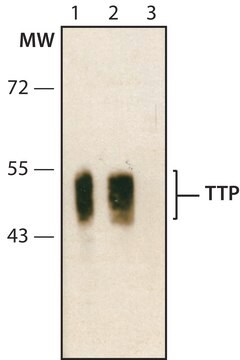
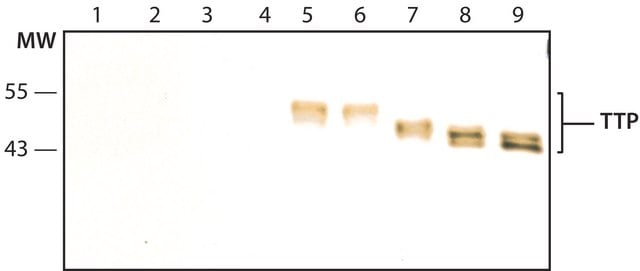
western blot: 0.5-1.0 μg/mL using lysates of HEK-293 cells overexpressing human TTP

UniProt accession no.

shipped in

dry ice

storage temp.

−20°C

target post-translational modification

unmodified

Gene Information

human ... ZFP36(7538)
mouse ... Zfp36(22695)
rat ... Zfp36(79426)

General description

TTP (C-terminal) (also known as Tristetraproline, Zfp-36, TIS11A, and Growth factor-inducible nuclear protein NUP475) is an RNA-binding protein that suppresses inflammation by accelerating the degradation of cytokine mRNA.
TTP is also known as Tristetraproline, Zfp-36, TIS11A, and Growth factor-inducible nuclear protein NUP475. TTP belongs to a family of human ARE (AU-rich element found in 3′ UTR mRNA) binding protein that contains tandem CCCH zinc finger RNA-binding domains required for interaction with ARE. TTP is a phosphoprotein. Anti-TTP (C-terminal) is produced in rabbit using as immunogen a synthetic peptide corresponding to human TTP conjugated to KLH.

Immunogen

synthetic peptide corresponding to amino acids 270-284 of human TTP conjugated to KLH. The corresponding sequence differs by one amino acid in mouse and rat.

Application

Anti-TTP (C-terminal) antibody has been used in immunoprecipitationand may be used for immunoblotting.

Biochem/physiol Actions

Tristetraprolin (TTP) is an RNA-binding protein that suppresses inflammation by accelerating the degradation of cytokine mRNA. TTP plays a role in both mRNA deadenylation and 3′ to 5′ degradation of the mRNA and helps in recruiting several factors involved in these processes. TTP acts as a substrate for multiple kinases like ERK (extracellular signal-regulated kinases), JNK (Jun N-terminal kinase) , p38, and MAPKAPK2.

Physical form

Solution in 0.01 M phos­phate buffered saline, pH 7.4, containing 15 mM sodium azide.

Disclaimer

Unless otherwise stated in our catalog or other company documentation accompanying the product(s), our products are intended for research use only and are not to be used for any other purpose, which includes but is not limited to, unauthorized commercial uses, in vitro diagnostic uses, ex vivo or in vivo therapeutic uses or any type of consumption or application to humans or animals.
Ta strona może zawierać tekst przetłumaczony maszynowo.

Porównaj podobne pozycje

Wyświetl pełne porównanie

Pokaż różnice

1 of 1

Ta pozycja
T5327T1580SAB4200565
antibody form

affinity isolated antibody

antibody form

affinity isolated antibody

antibody form

affinity isolated antibody

antibody form

tissue culture supernatant

biological source

rabbit

biological source

rabbit

biological source

rabbit

biological source

mouse

conjugate

unconjugated

conjugate

unconjugated

conjugate

unconjugated

conjugate

unconjugated

Quality Level

200

Quality Level

200

Quality Level

200

Quality Level

200

UniProt accession no.

P26651

UniProt accession no.

P26651

UniProt accession no.

Q13148

UniProt accession no.

P26651

technique(s)

western blot: 0.5-1.0 μg/mL using lysates of HEK-293 cells overexpressing human TTP

technique(s)

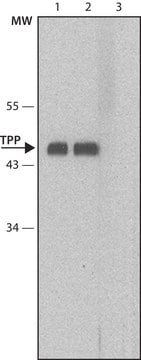
immunoprecipitation (IP): 5-10 μg/mL using lysates of RAW264 cells induced with 10 ng/mL LPS for two hours, western blot: 0.5-1.0 μg/mL using lysates of RAW264 cells induced with 10 ng/mL LPS for two hours

technique(s)

immunohistochemistry: 5-10 μg/mL using rat, mouse, and human kidney, indirect immunofluorescence: 5-10 μg/mL using human HepG2 cells, western blot: 1-2 μg/mL using human U2OS cell lysates

technique(s)

western blot: 1:4,000-1:8,000 using extracts of HepG2 cells.


Still not finding the right product?

Wypróbuj nasze narzędzie Narzędzie selektora produktów, aby zawęzić opcje.


flash_point_f

Not applicable

flash_point_c

Not applicable

ppe

Eyeshields, Gloves, multi-purpose combination respirator cartridge (US)

wgk

nwg

Klasa składowania

12 - Non Combustible Liquids


Wybierz jedną z najnowszych wersji:

Certyfikaty analizy (CoA)

Lot/Batch Number

Nie widzisz odpowiedniej wersji?

Jeśli potrzebujesz konkretnej wersji, możesz wyszukać konkretny certyfikat według numeru partii lub serii.

Masz już ten produkt?

Dokumenty związane z niedawno zakupionymi produktami zostały zamieszczone w Bibliotece dokumentów.

Odwiedź Bibliotekę dokumentów


Interactions of CCCH zinc finger proteins with mRNA non-binding tristetraprolin mutants exert an inhibitory effect on degradation of AU-rich element-containing mRNAs
Lai W S, et al.
The Journal of biological chemistry, 277(11), 9606-9613 (2002)
Dipankar Ray et al.
PloS one, 8(2), e57290-e57290 (2013-03-08)
The efficacy of radiation therapy for lung cancer is limited by radiation-induced lung toxicity (RILT). Although tumor necrosis factor-alpha (TNF-α) signaling plays a critical role in RILT, the molecular regulators of radiation-induced TNF-α production remain unknown. We investigated the role
Posttranslational regulation of tristetraprolin subcellular localization and protein stability by p38 mitogen-activated protein kinase and extracellular signal-regulated kinase pathways
Brook M, et al.
Molecular and Cellular Biology, 26(6), 2408-2418 (2006)


Numer pozycji handlu globalnego

SKUNUMER GTIN
T5452-200UL04061838174420

Questions

Reviews

No rating value

Active Filters