Przejdź do zawartości
Merck

SML0149

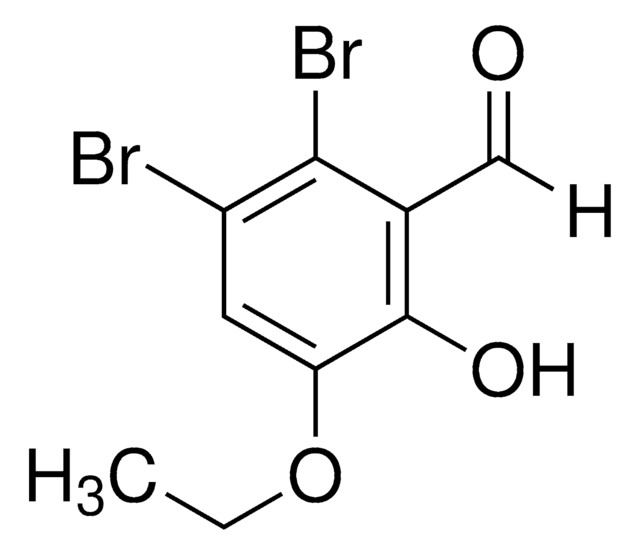
3-Ethoxy-5,6-dibromosalicylaldehyde

≥95% (HPLC)

Synonim(y):

2,3-Dibromo-5-ethoxy-6-hydroxy-benzaldehyde, 5,6-Dibromo-o-bourbonal

Zaloguj się, aby wyświetlić ceny organizacyjne i kontraktowe.

Wybierz wielkość

Informacje o cenach i dostępności nie są obecnie dostępne.

Informacje o tej pozycji

Wzór empiryczny (zapis Hilla):
C9H8Br2O3
Numer CAS:
Masa cząsteczkowa:
323.97
NACRES:
NA.77
PubChem Substance ID:
UNSPSC Code:
12352200
MDL number:
Assay:
≥95% (HPLC)
Form:
powder
Quality level:
Storage condition:
desiccated

Przejdź do

Pomoc techniczna
Potrzebujesz pomocy? Nasz zespół doświadczonych naukowców chętnie Ci pomoże.
Pozwól nam pomóc

InChI

1S/C9H8Br2O3/c1-2-14-7-3-6(10)8(11)5(4-12)9(7)13/h3-4,13H,2H2,1H3

SMILES string

CCOc1cc(Br)c(Br)c(C=O)c1O

InChI key

MZAISYPWQNBWED-UHFFFAOYSA-N

assay

≥95% (HPLC)

form

powder

storage condition

desiccated

color

yellow

solubility

DMSO: ≥15 mg/mL

storage temp.

2-8°C

Quality Level

Porównaj podobne pozycje

Wyświetl pełne porównanie

Pokaż różnice

1 of 4

Ta pozycja
SML1184H9415SML1638
form

powder

form

powder

form

solid

form

powder

assay

≥95% (HPLC)

assay

≥98% (HPLC)

assay

≥98% (HPLC)

assay

≥98% (HPLC)

Quality Level

100

Quality Level

100

Quality Level

100

Quality Level

100

storage temp.

2-8°C

storage temp.

2-8°C

storage temp.

2-8°C

storage temp.

−20°C

storage condition

desiccated

storage condition

-

storage condition

-

storage condition

-

solubility

DMSO: ≥15 mg/mL

solubility

DMSO: 5 mg/mL, clear (warmed)

solubility

DMSO: >20 mg/mL

solubility

DMSO: 10 mg/mL, clear

Application

3-Ethoxy-5,6-dibromosalicylaldehyde was used to study modulation of autophagy,[1] JNK activation[2] and NF-κB-mediated inflammation.[3]

Biochem/physiol Actions

3-Ethoxy-5,6-dibromosalicylaldehyde is a non-competitive inhibitor of Inositol-requiring enzyme 1 (IRE1). It inhibits XBP-1 splicing induced pharmacologically in human cells. 3-Ethoxy-5,6-dibromosalicylaldehyde potently inhibits the endoribonuclease of IRE1 but does not inhibit RNases A, T1, or L.
3-Ethoxy-5,6-dibromosalicylaldehyde is a non-competitive inhibitor of Inositol-requiring enzyme 1 (IRE1); potent inhibitor of endoribonuclease of IRE1
Ta strona może zawierać tekst przetłumaczony maszynowo.

pictograms

Exclamation mark

signalword

Warning

hcodes

Hazard Classifications

Acute Tox. 4 Oral - Skin Sens. 1

Klasa składowania

11 - Combustible Solids

wgk

WGK 3

flash_point_f

Not applicable

flash_point_c

Not applicable


Wybierz jedną z najnowszych wersji:

Certyfikaty analizy (CoA)

Lot/Batch Number

Nie widzisz odpowiedniej wersji?

Jeśli potrzebujesz konkretnej wersji, możesz wyszukać konkretny certyfikat według numeru partii lub serii.

Masz już ten produkt?

Dokumenty związane z niedawno zakupionymi produktami zostały zamieszczone w Bibliotece dokumentów.

Odwiedź Bibliotekę dokumentów

Y Liu et al.
Apoptosis : an international journal on programmed cell death, 22(4), 544-557 (2017-02-12)
Quercetin (3,3',4',5,7-pentahydroxyflavone, Qu) is a promising cancer chemo-preventive agent for various cancers because it inhibits disease progression and promotes apoptotic cell death. In our previous study, we demonstrated that Qu could evoke ER stress to enhance drug cytotoxicity in ovarian
Cristian González-Guerrero et al.
Toxicology and applied pharmacology, 272(3), 825-841 (2013-08-21)
The calcineurin inhibitors (CNIs) cyclosporine (CsA) and tacrolimus are key drugs in current immunosuppressive regimes for solid organ transplantation. However, they are nephrotoxic and promote death and profibrotic responses in tubular cells. Moreover, renal inflammation is observed in CNI nephrotoxicity
Yazhen Huo et al.
Virology, 444(1-2), 233-240 (2013-07-16)
Our previous study has shown that activation of JNK plays a critical role in Porcine reproductive and respiratory syndrome virus (PRRSV)-mediated apoptosis. In this follow-up study, we further investigated the mechanisms involved in modulation of PRRSV-mediated JNK activation and apoptosis.
Yoshiyasu Shinohara et al.
Biochemical and biophysical research communications, 432(2), 326-332 (2013-02-12)
Hepatitis C virus (HCV) induces endoplasmic reticulum (ER) stress which, in turn, activates the unfolding protein response (UPR). UPR activates three distinct signalling pathways. Additionally, UPR induces autophagy (UPR-autophagy pathways). On the other hand, it has become clear that some
Sachin Sharma et al.
Scientific reports, 11(1), 3089-3089 (2021-02-06)
The activated hepatic stellate cells (HSCs) are the major cells that secrete the ECM proteins and drive the pathogenesis of fibrosis in chronic liver disease. Targeting of HSCs by modulating their activation and proliferation has emerged as a promising approach

Questions

Reviews

No rating value

Active Filters

Nasz zespół naukowców ma doświadczenie we wszystkich obszarach badań, w tym w naukach przyrodniczych, materiałoznawstwie, syntezie chemicznej, chromatografii, analityce i wielu innych dziedzinach.

Skontaktuj się z zespołem ds. pomocy technicznej