Przejdź do zawartości
Merck

R1008

Monoclonal Anti-Rabbit IgG (γ-chain specific) antibody produced in mouse

clone RG-96, ascites fluid

Synonim(y):

Monoclonal Anti-Rabbit IgG (γ-chain specific)

Zaloguj się, aby wyświetlić ceny organizacyjne i kontraktowe.

Wybierz wielkość

0.2 ML

862,00 zł

0.5 ML

1820,00 zł

862,00 zł


Skontaktuj się z Obsługą Klienta, aby uzyskać informacje na temat dostępności

Zamów zamówienie zbiorcze

Informacje o tej pozycji

NACRES:
NA.46
UNSPSC Code:
12352203
Conjugate:
unconjugated
Clone:
RG-96, monoclonal
Application:
DB, ELISA (i), IHC (f), IHC (p), WB
Citations:
7

Przejdź do

Pomoc techniczna
Potrzebujesz pomocy? Nasz zespół doświadczonych naukowców chętnie Ci pomoże.
Pozwól nam pomóc

biological source

mouse

Quality Level

conjugate

unconjugated

antibody form

ascites fluid

antibody product type

secondary antibodies

clone

RG-96, monoclonal

contains

15 mM sodium azide

species reactivity

rabbit

should not react with

goat, feline, pig, guinea pig, rat, bovine, canine, human, horse, sheep, chicken

technique(s)

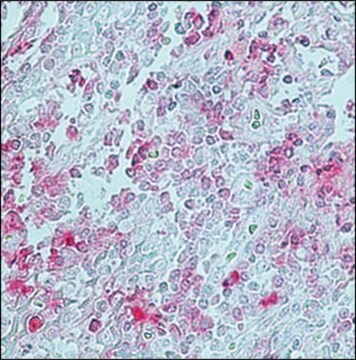
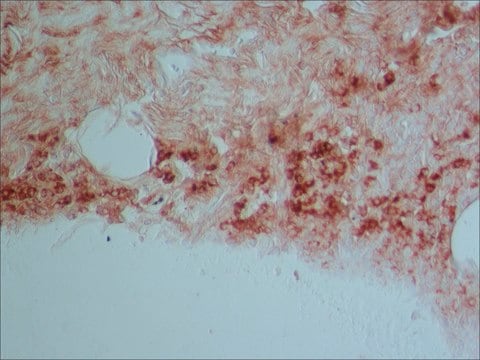
dot blot: suitable, immunohistochemistry (formalin-fixed, paraffin-embedded sections): suitable, immunohistochemistry (frozen sections): suitable, indirect ELISA: 1:2,000, western blot: suitable

isotype

IgG1

shipped in

dry ice

storage temp.

−20°C

target post-translational modification

unmodified

Powiązane kategorie

Porównaj podobne pozycje

Wyświetl pełne porównanie

Pokaż różnice

1 of 4

Ta pozycja
I0138A2556B3275
conjugate

unconjugated

conjugate

unconjugated

conjugate

alkaline phosphatase conjugate

conjugate

biotin conjugate

biological source

mouse

biological source

mouse

biological source

mouse

biological source

mouse

technique(s)

dot blot: suitable, immunohistochemistry (frozen sections): suitable, western blot: suitable, immunohistochemistry (formalin-fixed, paraffin-embedded sections): suitable, indirect ELISA: 1:2,000

technique(s)

indirect ELISA: 1:10,000

technique(s)

direct ELISA: 1:50,000, immunohistochemistry (formalin-fixed, paraffin-embedded sections): 1:100, western blot: 1:200,000-1:400,000 using total cell extract of HeLa cells

technique(s)

direct ELISA: 1:60,000, immunohistochemistry (formalin-fixed, paraffin-embedded sections): 1:1,500, western blot: 1:200,000-1:400,000 using using an assay detecting actin in total cell extract of HeLa cells (5-10 μg per well)

species reactivity

rabbit

species reactivity

-

species reactivity

rabbit

species reactivity

rabbit

antibody form

ascites fluid

antibody form

ascites fluid

antibody form

purified immunoglobulin

antibody form

purified immunoglobulin

isotype

IgG1

isotype

IgG1

isotype

IgG1

isotype

IgG1

General description

Monoclonal Anti-Rabbit IgG (mouse IgG1 isotype) is derived from the hybridoma produced by the fusion of mouse myeloma cells and splenocytes from an immunized mouse. Immunoglobulins (Igs) belongs immunoglobulin super-family. There are five different types of immunoglobulins. Each immunoglobulin has two heavy (H) and two light (L), held together by disulphide linkages. Each light comprises one variable N-terminal region and a constant C-terminal region. Heavy chain has one variable N-terminal region and three or four constant (CH1-CH4) C-terminal region.
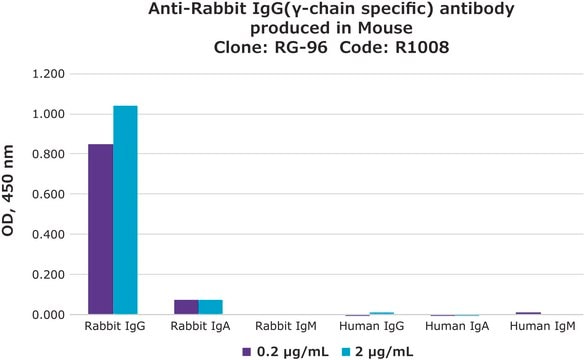
The product recognizes an epitope located on the γ (heavy)-chain of rabbit IgG. In immunoblotting, the antibody recognizes both native and denatured forms of rabbit IgG. In ELISA, the antibody is specific for rabbit IgG, and shows no cross-reactivity with rabbit IgA and IgM or human IgG, IgA, and IgM. No cross reaction is observed with IgG from the following species: bovine, cat, chicken, dog, goat, guinea pig, horse, pig, rat, or sheep.

Application

Monoclonal Anti-Rabbit IgG (γ-chain specific) antibody produced in mouse has been used in
  • enzyme linked immunosorbent assay (ELISA)
  • dot blots
  • immunohistology
  • western blotting
  • peptide mass fingerprinting (PMF)

Biochem/physiol Actions

Digestion of IgG by papain generates fragment antigen binding (Fab). Pepsin digestion of IgG results in fragment crystallisable (fc). IgG antibody has enormous therapeutic potential and the Fc region is involved in the development of therapeutic antibody.
Monoclonal Anti-Rabbit IgG is specific for an epitope located on the heavy (γ) chain of rabbit IgG, in an immunoblot of denatured, reduced rabbit IgG. The antibody does not react with rabbit IgA, IgM or light chains. No cross reactivity is observed with IgG from bovine, cat, chicken, dog, goat, guinea pig, horse, human, pig, rat or sheep.

Physical form

The product is provided as ascites fluid with 15 mM sodium azide (see MSDS) as a preservative.

Preparation Note

For continuous use, store at 2-8 °C for up to one month. For extended storage, the solution may be frozen in working aliquots. Repeated freezing and thawing is not recommended. Storage in "frost-free" freezers not recommended. If slight turbidity occurs upon prolonged storage, clarify the solution by centrifugation before use.

Disclaimer

Unless otherwise stated in our catalog or other company documentation accompanying the product(s), our products are intended for research use only and are not to be used for any other purpose, which includes but is not limited to, unauthorized commercial uses, in vitro diagnostic uses, ex vivo or in vivo therapeutic uses or any type of consumption or application to humans or animals.
Ta strona może zawierać tekst przetłumaczony maszynowo.

Nie możesz znaleźć właściwego produktu?  

Wypróbuj nasz Narzędzie selektora produktów.

Klasa składowania

10 - Combustible liquids

wgk

nwg

flash_point_f

Not applicable

flash_point_c

Not applicable


Wybierz jedną z najnowszych wersji:

Certyfikaty analizy (CoA)

Lot/Batch Number

Nie widzisz odpowiedniej wersji?

Jeśli potrzebujesz konkretnej wersji, możesz wyszukać konkretny certyfikat według numeru partii lub serii.

Masz już ten produkt?

Dokumenty związane z niedawno zakupionymi produktami zostały zamieszczone w Bibliotece dokumentów.

Odwiedź Bibliotekę dokumentów

Specificity in killing pathogens is mediated by distinct repertoires of human neutrophil peptides
Cederlund A, et al.
Journal of Innate Immunity, 2(6), 508-521 (2010)
Jeremy K Brown et al.
The American journal of pathology, 165(1), 95-106 (2004-06-25)
Peak intestinal mucosal mast cell (MMC) recruitment coincides with expulsion of Trichinella spiralis, at a time when the majority of the MMCs are located within the epithelium in BALB/c mice. Although expression of integrin-alpha(E)beta(7) by MMCs has not been formally
Andreas Cederlund et al.
Journal of innate immunity, 2(6), 508-521 (2010-09-08)
Neutrophil-derived antimicrobial peptides and proteins (AMPs) play an important role in the defense against microbes. Absence of defense is illustrated by neutropenic patients with frequent bacterial and fungal infections. However, the specificity of the antimicrobial effects has not been adequately
Rossalyn M Day et al.
Cell stress & chaperones, 8(2), 183-193 (2003-11-25)
Small heat shock/alpha-crystallin proteins function as molecular chaperones, protecting other proteins from irreversible denaturation by an energy-independent process. The brine shrimp, Artemia franciscana, produces a small heat shock/alpha-crystallin protein termed p26, found in embryos undergoing encystment, diapause, and metabolic arrest.
Presenilins are enriched in endoplasmic reticulum membranes associated with mitochondria
Area-Gomez E, et al.
The American Journal of Pathology, 175(5), 1810-1816 (2009)

Powiązane treści

Numer pozycji handlu globalnego

SKUNUMER GTIN
R1008-.2ML04061838355621
R1008-.5ML04061837518577

Questions

Reviews

No rating value

Active Filters

Nasz zespół naukowców ma doświadczenie we wszystkich obszarach badań, w tym w naukach przyrodniczych, materiałoznawstwie, syntezie chemicznej, chromatografii, analityce i wielu innych dziedzinach.

Skontaktuj się z zespołem ds. pomocy technicznej