




If this product has an expiration or retest date, it will be shown on the Certificate of Analysis (COA, CofA). If there is no retest or expiration date listed on the product's COA, we do not have suitable stability data to determine a shelf life. For these products, the only date on the COA will be the release date; a retest, expiration, or use-by-date will not be displayed.
For all products, we recommend handling per defined conditions as printed in our product literature and website product descriptions. We recommend that products should be routinely inspected by customers to ensure they perform as expected.
For products without retest or expiration dates, our standard warranty of 1 year from the date of shipment is applicable.
For more information, please refer to the Product Dating Information document: https://www.sigmaaldrich.com/deepweb/assets/sigmaaldrich/marketing/global/documents/418/501/product-dating-information-06-25-mk.pdf
Przejdź do
PF0100

Protease Fluorescent Detection Kit
high sensitivity assay
Synonim(y):
Protease Assay Kit
Wybierz wielkość
| Do Państwa/SKU | Dostępność | Cena netto |
|---|---|---|
1 kit | Skontaktuj się z Obsługą Klienta, aby uzyskać informacje na temat dostępności | 3280,00 zł |
Informacje o tej pozycji
3280,00 zł
Application
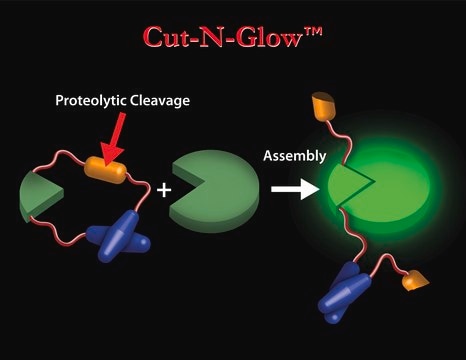
- in the detection of proteolytic activity using casein based protease assay
- for testing the extracellular proteolytic activity of fungal strains
- for quantifying mitochondrial protease activity
- for measuring the protease production from soil solution
Preparation Note
The trichloroacetic acid (TCA) component is provided as 6.1 N TCA solution. 0.6 N TCA Solutions may be prepared by a 10-fold dilution of the desired volume of T0699 with ultrapure water. It is not necessary to dilute the entire volume of T0699 for immediate use of the kit.
Analysis Note
1 of 1
Ta pozycja | |||
|---|---|---|---|
| Quality Level 200 | Quality Level 200 | Quality Level 300 | Quality Level 200 |
| shipped in dry ice | shipped in dry ice | shipped in wet ice | shipped in - |
| storage temp. −20°C | storage temp. −20°C | storage temp. −20°C | storage temp. −20°C |
Tylko elementy zestawu
- Incubation buffer 25 mL
- FITC-casein solution 5 mL
- Assay buffer 200 mL
- Protease standard (trypsin) 20 μg
- FITC control 50 mg
- Trichloroacetic acid (TCA) solution 30 mL
signalword
Danger
hcodes
target_organs
Respiratory system
Klasa składowania
8A - Combustible corrosive hazardous materials
flash_point_f
Not applicable
flash_point_c
Not applicable
wgk
WGK 3
Hazard Classifications
Aquatic Acute 1 - Aquatic Chronic 1 - Eye Dam. 1 - Resp. Sens. 1 - Skin Corr. 1 - Skin Sens. 1 - STOT SE 3
Wybierz jedną z najnowszych wersji:
Masz już ten produkt?
Dokumenty związane z niedawno zakupionymi produktami zostały zamieszczone w Bibliotece dokumentów.
-
How can I determine the shelf life / expiration / retest date of this product?
1 answer-
Helpful?
-
-
How is shipping temperature determined? And how is it related to the product storage temperature?
1 answer-
Products may be shipped at a different temperature than the recommended long-term storage temperature. If the product quality is sensitive to short-term exposure to conditions other than the recommended long-term storage, it will be shipped on wet or dry-ice. If the product quality is NOT affected by short-term exposure to conditions other than the recommended long-term storage, it will be shipped at ambient temperature. As shipping routes are configured for minimum transit times, shipping at ambient temperature helps control shipping costs for our customers. For more information, please refer to the Storage and Transport Conditions document: https://www.sigmaaldrich.com/deepweb/assets/sigmaaldrich/marketing/global/documents/316/622/storage-transport-conditions-mk.pdf
Helpful?
-
-
Is this kit able to detect protease from Pseudomonas fluorescens in milk? How many determinations can be done with one kit?
1 answer-
This kit would not distinguish between protease from P. fluorescens and protease from any other microbial source or, for that matter, from trace mammalian protease activity that might be present in the milk. While there is nothing about milk that would preclude its analysis using this kit, without knowing the bacterial load and the expression level of the protease, it is not known if the kit could detect the protease levels in the milk. Each kit contains sufficient reagents for 200 assays, including blanks and controls.
Helpful?
-
-
If RIPA lysis buffer is used for cell lysis in cultured cells without isolating the mitochondria, will it have an impact on the protease detection when utilizing the PF0100-1KT Protease Fluorescent Detection Kit?
1 answer-
The QC tests for protease in the R0278 RIPA lysis buffer show no increase in background from the data, indicating no additional breakdown of the FITC-casein substrate when mixed with RIPA buffer. It is recommended that the use of R0278 or an equivalent, as this buffer is protease-free.
Helpful?
-
-
Seeking clarity on step 7 on the procedure. Should the supernatant be collected? How should it be done without capturing any precipitate/pellet? This seems to be affecting themeasurements.
1 answer-
For kit PF0100, it's recommended to transfer the samples from the centrifuge to a secondary container before pipetting into the cuvette or well plate to ensure homogeneity and prevent false positive readouts during fluorescent detection.
Helpful?
-
-
I want to use the protease fluorescent detection kit in cultured cells without isolating the mitochondria. If I use RIPA lysis buffer for cell lysis, will it affect the protease detection?
1 answer-
RIPA lysis buffer is compatible with this kit, provided that it is protease free. Please see the link below to review product R0278, a protease free RIPA buffer option:
https://www.sigmaaldrich.com/CA/en/product/sigma/r0278Helpful?
-