Przejdź do zawartości
Merck

Przejdź do

F6928

Monoclonal Anti-FKHR (FOXO1a) antibody produced in mouse

clone FKH 117, purified immunoglobulin, buffered aqueous solution

Zaloguj się, aby wyświetlić ceny organizacyjne i kontraktowe.

Wybierz wielkość

Zmień widok
Gabaryty przesyłkiSKUDostępnośćCena netto
200 μL
Skontaktuj się z Obsługą Klienta, aby uzyskać informacje na temat dostępności
2170,00 zł

Informacje o tej pozycji

UNSPSC Code:
12352203
NACRES:
NA.41
MDL number:
Conjugate:
unconjugated
Clone:
FKH 117, monoclonal
Application:
ARR, ELISA (i), IP, WB
Citations:
22

2170,00 zł


Skontaktuj się z Obsługą Klienta, aby uzyskać informacje na temat dostępności

Zamów zamówienie zbiorcze
Pomoc techniczna
Potrzebujesz pomocy? Nasz zespół doświadczonych naukowców chętnie Ci pomoże.
Pozwól nam pomóc

biological source

mouse

Quality Level

conjugate

unconjugated

antibody form

purified immunoglobulin

antibody product type

primary antibodies

clone

FKH 117, monoclonal

form

buffered aqueous solution

mol wt

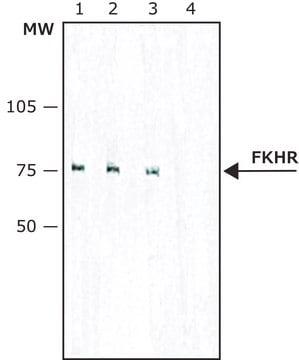
antigen 70-75 kDa

species reactivity

human

technique(s)

immunoprecipitation (IP): suitable, indirect ELISA: suitable, microarray: suitable, western blot: 0.5-1 μg/mL using total extract of COS-7 cells transfected with FKHR expression plasmid

Porównaj podobne pozycje

Wyświetl pełne porównanie

Pokaż różnice

1 of 1

Ta pozycja
WH0002309M3R5028R8903
antibody form

purified immunoglobulin

antibody form

purified immunoglobulin

antibody form

purified immunoglobulin

antibody form

purified immunoglobulin

biological source

mouse

biological source

mouse

biological source

mouse

biological source

mouse

clone

FKH 117, monoclonal

clone

1F6, monoclonal

clone

4F4, monoclonal

clone

3C2, monoclonal

species reactivity

human

species reactivity

human

species reactivity

monkey, human, chicken, hamster

species reactivity

hamster, Xenopus, bovine, human

conjugate

unconjugated

conjugate

unconjugated

conjugate

unconjugated

conjugate

unconjugated

Gene Information

human ... FOXO1(2308)

Gene Information

human ... FOXO3(2309)

Gene Information

human ... HNRNPC(3183)

Gene Information

human ... HNRNPK(3190)

General description

FKHR belongs to the superfamily of forkhead transcription factors (FOX). It is characterized by a common Forkhead (or winged helix) domain, a variant of the helix-turn-helix motif. FKHR contains three residues, Thr24, Ser256, and Ser319 that lie within consensus sequences for phosphorylation by protein kinase B (PKB).
Monoclonal Anti-FKHR (FOXO1a) (mouse IgG1 isotype) is derived from the FKH117 hybridoma produced by the fusion of mouse myeloma cells and splenocytes from BALB/c mice immunized with a synthetic peptide corresponding to human FKHR, conjugated to KLH.

Immunogen

synthetic peptide corresponding to human FKHR (amino acids 636-651), conjugated to KLH.

Application

Monoclonal Anti-FKHR (FOXO1a) antibody is suitable for immunoblot assay to study the down-regulation of both p16INK4A and p14ARF expression, and immunoblot of SKMCs and HSMM cells in a study of stable ectopic expression of PAX3-FKHR in low passage primary human skeletal muscle cells. It is also suitable for microarray and indirect ELISA.
Monoclonal Anti-FKHR antibody has been used in:
  • immunoblotting
  • enzyme linked immunosorbent assay (ELISA)
  • immunoprecipitation

Biochem/physiol Actions

FKHR plays a key regulatory roles in embryonic development, differentiation, apoptosis, and tumorigenesis. It was first identified at chromosomal breakpoints in human tumors and consequently linked to tumorigenesis. The activity of FKHR is regulated by growth factors via the PKB/PI3K pathway. The expression of FKHR is inhibited through phosphorylation by PKB. Within the nucleus, the dephosphorylated FKHRL1 induces expression of target genes such as Fas ligand, and triggers apoptosis. It is involved in apoptosis, glucose homeostasis, cell cycle regulation and as a nuclear receptor co factor. It has been found that FKHR also play a role in endometrial differentiation via the protein kinase A (PKA) pathway.

Physical form

Solution in 0.01 M phosphate buffered saline, pH 7.4, containing 15 mM sodium azide.

Disclaimer

Unless otherwise stated in our catalog or other company documentation accompanying the product(s), our products are intended for research use only and are not to be used for any other purpose, which includes but is not limited to, unauthorized commercial uses, in vitro diagnostic uses, ex vivo or in vivo therapeutic uses or any type of consumption or application to humans or animals.
Ta strona może zawierać tekst przetłumaczony maszynowo.

Nie możesz znaleźć właściwego produktu?  

Wypróbuj nasz Narzędzie selektora produktów.

Klasa składowania

10 - Combustible liquids

wgk

WGK 2

flash_point_f

Not applicable

flash_point_c

Not applicable

ppe

Eyeshields, Gloves, multi-purpose combination respirator cartridge (US)


Wybierz jedną z najnowszych wersji:

Certyfikaty analizy (CoA)

Lot/Batch Number

Nie widzisz odpowiedniej wersji?

Jeśli potrzebujesz konkretnej wersji, możesz wyszukać konkretny certyfikat według numeru partii lub serii.

Masz już ten produkt?

Dokumenty związane z niedawno zakupionymi produktami zostały zamieszczone w Bibliotece dokumentów.

Odwiedź Bibliotekę dokumentów

A Mansouri
Critical reviews in oncogenesis, 9(2), 141-149 (1999-02-11)
Pax genes consist of a family of transcription factors that are essentially required for the genesis of a variety of tissues and organs. Pax3 and Pax7 are specifically expressed in the dorsal neural tube and the developing somite. Loss-of-function mutations
Defining the Cooperative Genetic Changes That Temporally Drive Alveolar Rhabdomyosarcoma
Naini S, et al.
Cancer Research, 68(23), 9583-9588 (2008)
The PAX3-FKHR Fusion Gene of Rhabdomyosarcoma Cooperates with Loss of p16INK4A to Promote Bypass of Cellular Senescence
Linardic CM, et al.
Cancer Research, 67(14), 6691-6699 (2007)
FGFR4 Blockade Exerts Distinct Antitumorigenic Effects in Human Embryonal versus Alveolar Rhabdomyosarcoma
Crose LES, et al.
Clinical Cancer Research, 18(14), 3780-3790 (2012)
E D Tang et al.
The Journal of biological chemistry, 274(24), 16741-16746 (1999-06-08)
The FKHR gene was first identified from its disruption by the t(2;13) chromosomal translocation seen in the pediatric tumor alveolar rhabdomyosarcoma. It encodes for a member of the forkhead family of transcription factors. Recently, a homolog of FKHR in the

Powiązane treści

Numer pozycji handlu globalnego

SKUNUMER GTIN
F6928-200UL04061837771569

Questions

Reviews

No rating value

Active Filters

Nasz zespół naukowców ma doświadczenie we wszystkich obszarach badań, w tym w naukach przyrodniczych, materiałoznawstwie, syntezie chemicznej, chromatografii, analityce i wielu innych dziedzinach.

Skontaktuj się z zespołem ds. pomocy technicznej