Przejdź do zawartości
Merck

F1262

Anti-Rabbit IgG (whole molecule), F(ab′)2 fragment–FITC antibody produced in goat

affinity isolated antibody, buffered aqueous solution

Zaloguj się, aby wyświetlić ceny organizacyjne i kontraktowe.

Wybierz wielkość

0.5 ML

650,00 zł

1 ML

1250,00 zł

2 ML

2310,00 zł

650,00 zł


Skontaktuj się z Obsługą Klienta, aby uzyskać informacje na temat dostępności

Zamów zamówienie zbiorcze

Informacje o tej pozycji

UNSPSC Code:
12352203
NACRES:
NA.46
MDL number:
Conjugate:
FITC conjugate
Clone:
polyclonal
Application:
IF
Citations:
57

Przejdź do

Pomoc techniczna
Potrzebujesz pomocy? Nasz zespół doświadczonych naukowców chętnie Ci pomoże.
Pozwól nam pomóc

biological source

goat

conjugate

FITC conjugate

antibody form

affinity isolated antibody

antibody product type

secondary antibodies

clone

polyclonal

form

buffered aqueous solution

technique(s)

indirect immunofluorescence: 1:40

storage temp.

2-8°C

target post-translational modification

unmodified

Quality Level

Porównaj podobne pozycje

Wyświetl pełne porównanie

Pokaż różnice

1 of 4

Ta pozycja
F1763F2266F8888
biological source

goat

biological source

rabbit

biological source

sheep

biological source

rabbit

technique(s)

indirect immunofluorescence: 1:40

technique(s)

immunohistochemistry (formalin-fixed, paraffin-embedded sections): 1:320, indirect immunofluorescence: 1:320

technique(s)

direct immunofluorescence: 1:128

technique(s)

direct immunofluorescence: 1:320 using human peripheral blood lymphocytes, immunohistochemistry (formalin-fixed, paraffin-embedded sections): 1:320 using human tonsil

antibody form

affinity isolated antibody

antibody form

affinity isolated antibody

antibody form

affinity isolated antibody

antibody form

affinity isolated antibody

conjugate

FITC conjugate

conjugate

FITC conjugate

conjugate

FITC conjugate

conjugate

FITC conjugate

storage temp.

2-8°C

storage temp.

−20°C

storage temp.

2-8°C

storage temp.

−20°C

clone

polyclonal

clone

polyclonal

clone

polyclonal

clone

polyclonal

General description

Goat polyclonal anti-Rabbit IgG (whole molecule), F(ab′)2 fragment–FITC antibody binds all rabbit IgGs.
Immunoglobulins (Igs) are glycoprotein antibodies that modulate several immune responses. Rabbit IgGs against target proteins are often used as primary antibodies in various research applications. Thus, secondary anti-rabbit IgGs can be useful tools for the analysis of target proteins
Anti-Rabbit IgG (whole molecule), (F(ab′)2) fragment-FITC is specific for all rabbit immunoglobulins. The use of this product prevents background staining due to the presence of Fc receptors.
Rabbit IgG is a plasma B cell derived antibody isotype defined by its heavy chain. IgG is the most abundant antibody isotype found in rabbit serum. IgG crosses the placental barrier, is a complement activator and binds to the Fc-receptors on phagocytic cells. The level of IgG may vary with the status of disease or infection.
Fluorescein isothiocyanate (FITC) is a fluorescein derivative (fluorochrome) used to tag antibodies, including secondary antibodies, for use in fluorescence-based assays and procedures. FITC excites at 495 nm and emits at 521 nm.

Immunogen

Purified rabbit IgG

Application

Anti-Rabbit IgG (whole molecule), (F(ab′)2) fragment-FITC is suitable for use in flow cytometry.
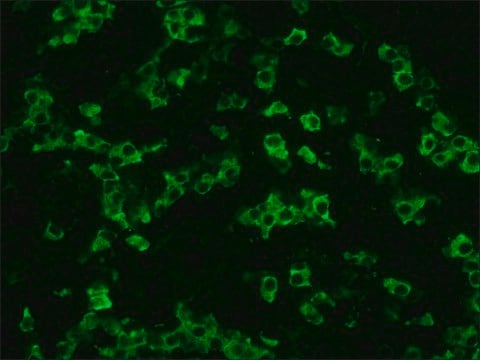
Anti-Rabbit IgG (whole molecule), F(ab′)2 fragment–FITC antibody produced in goat has also been used for fluorescence labeling and immunocytochemistry.
Goat polyclonal anti-Rabbit IgG (whole molecule), F(ab′)2 fragment–FITC antibody may be used to detect and quantitate the level of IgG in rabbut serum and biological fluids by fluorescent techniques. It may also be used as a secondary antibody in assays that use rabbit IgG as the primary antibody. F(ab′)2 fragment–FITC antibody is useful when trying to avoid background staining due to the presence of Fc receptors.

Physical form

Solution in 0.01 M phosphate buffered saline, pH 7.4, containing 1% bovine serum albumin and 15 mM sodium azide.

Disclaimer

Unless otherwise stated in our catalog or other company documentation accompanying the product(s), our products are intended for research use only and are not to be used for any other purpose, which includes but is not limited to, unauthorized commercial uses, in vitro diagnostic uses, ex vivo or in vivo therapeutic uses or any type of consumption or application to humans or animals.
Ta strona może zawierać tekst przetłumaczony maszynowo.

Nie możesz znaleźć właściwego produktu?  

Wypróbuj nasz Narzędzie selektora produktów.

Klasa składowania

10 - Combustible liquids

wgk

nwg

flash_point_f

Not applicable

flash_point_c

Not applicable


Wybierz jedną z najnowszych wersji:

Certyfikaty analizy (CoA)

Lot/Batch Number

Nie widzisz odpowiedniej wersji?

Jeśli potrzebujesz konkretnej wersji, możesz wyszukać konkretny certyfikat według numeru partii lub serii.

Masz już ten produkt?

Dokumenty związane z niedawno zakupionymi produktami zostały zamieszczone w Bibliotece dokumentów.

Odwiedź Bibliotekę dokumentów

Synergistic induction of PI-PLCβ1 signaling by azacitidine and valproic acid in high-risk myelodysplastic syndromes
Follo MY, et al.
Leukemia, 25(2), 271-271 (2011)
Petri Elo et al.
Journal of neuroinflammation, 15(1), 128-128 (2018-05-03)
Vascular adhesion protein-1 (VAP-1) is an inflammation-inducible endothelial cell molecule and primary amine oxidase that mediates leukocyte entry to sites of inflammation. However, there is limited knowledge of the inflammation-related expression of VAP-1 in the central nervous system (CNS). Therefore
Edith Terrenoire et al.
BMC genetics, 16, 44-44 (2015-05-01)
Using metaphase spreads from human lymphoblastoid cell lines, we previously showed how immunofluorescence microscopy could define the distribution of histone modifications across metaphase chromosomes. We showed that different histone modifications gave consistent and clearly defined immunofluorescent banding patterns. However, it
Differentiation of human alveolar epithelial cells in primary culture: morphological characterization and synthesis of caveolin-1 and surfactant protein-C
Fuchs S, et al.
Cell and Tissue Research, 311(1), 31-45 (2003)
Anne Rosbjerg et al.
Frontiers in immunology, 7, 473-473 (2016-11-20)
Aspergillus fumigatus infections are associated with a high mortality rate for immunocompromised patients. The complement system is considered to be important in protection against this fungus, yet the course of activation is unclear. The aim of this study was to

Powiązane treści

Instructions

Questions

Reviews

No rating value

Active Filters

Nasz zespół naukowców ma doświadczenie we wszystkich obszarach badań, w tym w naukach przyrodniczych, materiałoznawstwie, syntezie chemicznej, chromatografii, analityce i wielu innych dziedzinach.

Skontaktuj się z zespołem ds. pomocy technicznej