Przejdź do zawartości
Merck

C1728

Anti-Calcium Channel (α1D Subunit) (L-type of Voltage-gated Ca2+ Channel) antibody produced in rabbit

affinity isolated antibody, lyophilized powder

Synonim(y):

Anti-CACH3, Anti-CACN4, Anti-CACNL1A2, Anti-CCHL1A2, Anti-Cav1.3, Anti-PASNA, Anti-SANDD

Zaloguj się, aby wyświetlić ceny organizacyjne i kontraktowe.

Wybierz wielkość

0.2 ML

3950,00 zł

3950,00 zł


Skontaktuj się z Obsługą Klienta, aby uzyskać informacje na temat dostępności


Informacje o tej pozycji

UNSPSC Code:
12352203
NACRES:
NA.41
MDL number:
Conjugate:
unconjugated
Clone:
polyclonal
Application:
ICC, IP, WB CL
Citations:
9

Przejdź do

Pomoc techniczna
Potrzebujesz pomocy? Nasz zespół doświadczonych naukowców chętnie Ci pomoże.
Pozwól nam pomóc

biological source

rabbit

conjugate

unconjugated

antibody form

affinity isolated antibody

antibody product type

primary antibodies

clone

polyclonal

form

lyophilized powder

species reactivity

mouse, rat

technique(s)

immunocytochemistry: 1:30-1:150, immunoprecipitation (IP): suitable, western blot (chemiluminescent): 1:100-1:200

UniProt accession no.

storage temp.

−20°C

target post-translational modification

unmodified

Quality Level

Gene Information

human ... CACNA1D(776)
mouse ... Cacna1d(12289)
rat ... Cacna1d(29716)

Porównaj podobne pozycje

Wyświetl pełne porównanie

Pokaż różnice

1 of 4

Ta pozycja
C1868C1353C5105
biological source

rabbit

biological source

rabbit

biological source

rabbit

biological source

rabbit

antibody form

affinity isolated antibody

antibody form

affinity isolated antibody

antibody form

affinity isolated antibody

antibody form

affinity isolated antibody

Quality Level

100

Quality Level

200

Quality Level

100

Quality Level

100

conjugate

unconjugated

conjugate

unconjugated

conjugate

unconjugated

conjugate

unconjugated

UniProt accession no.

Q99246

UniProt accession no.

Q9EQ60

UniProt accession no.

P54282

UniProt accession no.

P54289

clone

polyclonal

clone

polyclonal

clone

polyclonal

clone

polyclonal

Immunogen

synthetic peptide corresponding to amino acids 859-875 of rat α1D (Accession P27732). This epitope is highly conserved in human and hamster.

Application

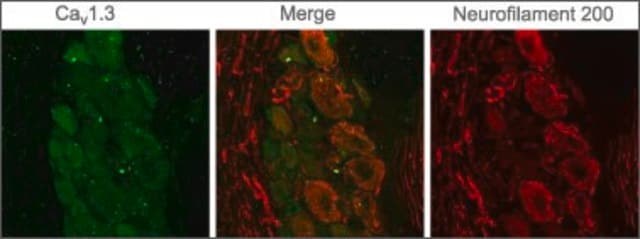
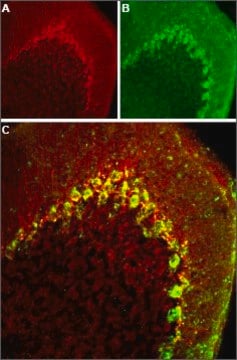
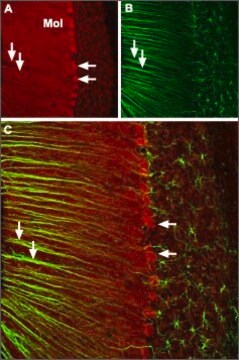
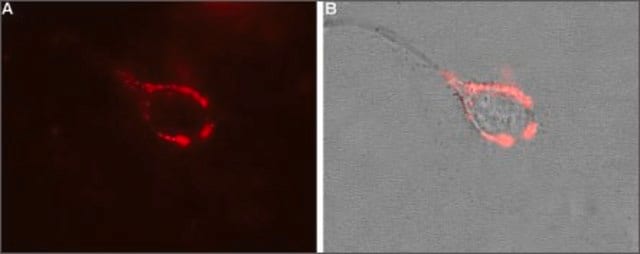
Anti-Calcium Channel (α1D Subunit) (L-type of Voltage-gated Ca2+ Channel) antibody produced in rabbit is suitable for the following applications:
  • immunocytochemistry at a dilution of 1:30-1:150
  • immunoprecipitation
  • western blot (chemiluminescent) at a dilution of 1:100-1:200

Biochem/physiol Actions

Cav1.3 also known as the calcium channel, voltage-dependent, L type, α1D subunit (CACNA1D), is a human gene. It responds more sensitively to depolarization than those of Cav1.2 or Cav3.1. Cav1.3 is required for proper hearing as well as sinoatrial node and brain function. It undergoes extensive alternative splicing. Alternative splicing in the C terminus and drastically modifies gating properties of the channel. The L-type calcium channel Cav1.3 is important in human glucose-induced insulin secretion and common variants in CACNA1D may contribute to type 2 diabetes.

Physical form

Lyophilized from phosphate buffered saline, pH 7.4, containing 1% BSA and 0.05% sodium azide

Disclaimer

Unless otherwise stated in our catalog or other company documentation accompanying the product(s), our products are intended for research use only and are not to be used for any other purpose, which includes but is not limited to, unauthorized commercial uses, in vitro diagnostic uses, ex vivo or in vivo therapeutic uses or any type of consumption or application to humans or animals.
Ta strona może zawierać tekst przetłumaczony maszynowo.

Nie możesz znaleźć właściwego produktu?  

Wypróbuj nasz Narzędzie selektora produktów.

Klasa składowania

11 - Combustible Solids

wgk

WGK 3

flash_point_f

Not applicable

flash_point_c

Not applicable


Wybierz jedną z najnowszych wersji:

Certyfikaty analizy (CoA)

Lot/Batch Number

Nie widzisz odpowiedniej wersji?

Jeśli potrzebujesz konkretnej wersji, możesz wyszukać konkretny certyfikat według numeru partii lub serii.

Masz już ten produkt?

Dokumenty związane z niedawno zakupionymi produktami zostały zamieszczone w Bibliotece dokumentów.

Odwiedź Bibliotekę dokumentów

Hua Huang et al.
Molecular pharmacology, 84(4), 643-653 (2013-08-09)
The transcripts of L-type voltage-gated calcium channels (CaV) 1.3 undergo extensive alternative splicing. Alternative splicing, particularly in the C terminus, drastically modifies gating properties of the channel. However, little is known about whether alternative splicing could modulate the pharmacologic properties
Andreas Lieb et al.
Biophysical journal, 106(7), 1467-1475 (2014-04-08)
Activity of voltage-gated Cav1.3 L-type Ca(2+) channels is required for proper hearing as well as sinoatrial node and brain function. This critically depends on their negative activation voltage range, which is further fine-tuned by alternative splicing. Shorter variants miss a
T M Reinbothe et al.
Diabetologia, 56(2), 340-349 (2012-12-12)
Voltage-gated calcium channels of the L-type have been shown to be essential for rodent pancreatic beta cell function, but data about their presence and regulation in humans are incomplete. We therefore sought to elucidate which L-type channel isoform is functionally
Jan Salomonsen et al.
Proceedings of the National Academy of Sciences of the United States of America, 102(24), 8668-8673 (2005-06-09)
CD1 molecules play an important role in the immune system, presenting lipid-containing antigens to T and NKT cells. CD1 genes have long been thought to be as ancient as MHC class I and II genes, based on various arguments, but
Allison Sargoy et al.
PloS one, 9(1), e84507-e84507 (2014-01-15)
Aberrant calcium regulation has been implicated as a causative factor in the degeneration of retinal ganglion cells (RGCs) in numerous injury models of optic neuropathy. Since calcium has dual roles in maintaining homeostasis and triggering apoptotic pathways in healthy and

Questions

Reviews

No rating value

Active Filters

Nasz zespół naukowców ma doświadczenie we wszystkich obszarach badań, w tym w naukach przyrodniczych, materiałoznawstwie, syntezie chemicznej, chromatografii, analityce i wielu innych dziedzinach.

Skontaktuj się z zespołem ds. pomocy technicznej