
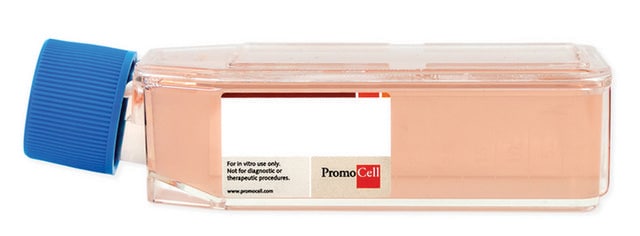

Pericyte isolation generally starts with enzymatic digestion of tissue with Trypsin EDTA, usually followed by the isolation of microvessel fragments via successive filtration steps. Pure pericyte cultures can be obtained through either positive or negative immuno-selection via the use of magnetic beads or flow cytometry using the antibody markers above.
Przejdź do
C-12981

Ludzkie perycyty z łożyska (hPC-PL)
500,000 proliferating cells
Zaloguj się, aby wyświetlić ceny organizacyjne i kontraktowe.
Wybierz wielkość
Zmień widok
| Do Państwa/SKU | Dostępność | Cena netto |
|---|---|---|
1 ea | Skontaktuj się z Obsługą Klienta, aby uzyskać informacje na temat dostępności | 6670,00 zł |
Informacje o tej pozycji
NACRES:
NA.81
UNSPSC Code:
41106514
Biological source:
placenta
Morphology:
( pericytes)
6670,00 zł
Skontaktuj się z Obsługą Klienta, aby uzyskać informacje na temat dostępności
Pomoc techniczna
Potrzebujesz pomocy? Nasz zespół doświadczonych naukowców chętnie Ci pomoże.
Pozwól nam pomócbiological source
placenta
packaging
pkg of 500,000 cells
morphology
( pericytes)
technique(s)
cell culture | mammalian: suitable
shipped in
ambient
storage temp.
room temp
General description
Zamówienia dotyczące konkretnych partii nie mogą być składane przez Internet. Aby uzyskać więcej informacji, skontaktuj się z lokalnym przedstawicielem handlowym.
Application
Ludzkie perycyty są izolowane z ludzkiej tkanki łożyska i dostarczane w formacie proliferacyjnym. Perycyty to multipotencjalne komórki mezenchymalne występujące w połączeniu ze ścianami małych naczyń krwionośnych. Są one ważne dla angiogenezy, integralności strukturalnej mikrokrążenia i regulacji przepływu krwi. Mogą one jednak również przekształcić się w nowotwory złośliwe zwane hemangiopericytoma. Do tej pory perycyty wykazały zdolność do różnicowania się w adipocyty, osteoblasty, fibroblasty, komórki mięśni gładkich i fagocyty (makrofagi).
Biochem/physiol Actions
Łożysko
Preparation Note
Kliknij tutaj, aby uzyskać więcej informacji.
Analysis Note
Rigid quality control tests are performed for each lot of Pericytes. The cells are tested for morphology, adherence rate, and viability. Furthermore, they are characterized by flow cytometric analysis for a comprehensive panel ofmarkers, e.g. CD31, CD34, CD105, and CD146. In addition, all cells have been tested for the absence of HIV-1, HIV-2, HBV, HCV, and microbial contaminants (fungi, bacteria, and mycoplasma).
Other Notes
Zalecana gęstość pożywki: 4000 komórek na cm2Testowane markery: CD146+, CD105+, CD31-, CD34-
Recommended Primary Cell Culture Media:Link
Disclaimer
Chociaż testy na obecność wirusów HIV-1, HIV-2, HBV, HCV, HTLV-1 i HTLV-2 dały wynik ujemny, komórki - podobnie jak wszystkie produkty pochodzenia ludzkiego - należy traktować jako potencjalnie zakaźne. Żadna procedura testowa nie może całkowicie zagwarantować braku czynników zakaźnych.
Ta strona może zawierać tekst przetłumaczony maszynowo.
1 of 1
Ta pozycja | |||
|---|---|---|---|
| description 500,000 proliferating cells | description 500,000 cryopreserved cells | description 1 million cells per pellet | description 500,000 cryopreserved cells |
| morphology ( pericytes) | morphology ( pericytes) | morphology (pericyte) | morphology (fibroblast) |
| technique(s) cell culture | mammalian: suitable | technique(s) cell culture | mammalian: suitable | technique(s) - | technique(s) cell culture | mammalian: suitable |
| biological source placenta | biological source human placenta | biological source human placenta | biological source human lung |
| shipped in ambient | shipped in dry ice | shipped in dry ice | shipped in dry ice |
| storage temp. room temp | storage temp. −196°C | storage temp. −20°C | storage temp. −196°C |
| packaging pkg of 500,000 cells | packaging pkg of 500,000 cells | packaging pkg of 1,000,000 cells | packaging pkg of 500,000 cells |
Still not finding the right product?
Explore all of our products under Ludzkie perycyty z łożyska (hPC-PL)
Klasa składowania
12 - Non Combustible Liquids
wgk
WGK 3
flash_point_f
Not applicable
flash_point_c
Not applicable
Wybierz jedną z najnowszych wersji:
Masz już ten produkt?
Dokumenty związane z niedawno zakupionymi produktami zostały zamieszczone w Bibliotece dokumentów.
-
How are pericytes isolated?
1 answer-
Helpful?
-
-
How long do pericytes grow in culture?
1 answer-
PromoCell’s human pericytes derived from microvessels of the human placenta are cryopreserved at the end of secondary culture (P1) and after thawing are considered P2. The number of populations doublings is not determined for each individual cell lot, however they are guarenteed to be grown for at least 15 population doublings.
Helpful?
-
-
What markers are used to characterize pericytes?
1 answer-
Pericytes are positive for CD146, PDGFRβ, αSMA, CD13, NG2, Desmin, and negative for CD31, CD34, CD45, and CD56.
Helpful?
-