Przejdź do zawartości
Merck

A2859

Monoclonal Anti-ATG5 antibody produced in mouse

clone ATG5-18, purified immunoglobulin, buffered aqueous solution

Synonim(y):

Anti-APG5, Anti-APG5L, Anti-ASP, Anti-ATG5 autophagy related 5 homolog, Anti-hAPG5

Zaloguj się, aby wyświetlić ceny organizacyjne i kontraktowe.

Wybierz wielkość

Informacje o cenach i dostępności nie są obecnie dostępne.

Informacje o tej pozycji

UNSPSC Code:
12352203
NACRES:
NA.41
MDL number:
Conjugate:
unconjugated
Clone:
ATG5-18, monoclonal
Application:
IP, WB
Citations:
34

Przejdź do

Pomoc techniczna
Potrzebujesz pomocy? Nasz zespół doświadczonych naukowców chętnie Ci pomoże.
Pozwól nam pomóc

biological source

mouse

Quality Level

conjugate

unconjugated

antibody form

purified immunoglobulin

antibody product type

primary antibodies

clone

ATG5-18, monoclonal

form

buffered aqueous solution

mol wt

antigen ~56 kDa

species reactivity

human, mouse, rat

concentration

~1.0 mg/mL

technique(s)

immunoprecipitation (IP): suitable, western blot: 2.5-5.0 μg/mL using whole extract of human K562 cells

isotype

IgG2a

UniProt accession no.

shipped in

dry ice

storage temp.

−20°C

target post-translational modification

unmodified

Gene Information

human ... ATG5(9474)
mouse ... Atg5(11793)
rat ... Atg5(365601)

Szukasz podobnych produktów? Odwiedź Przewodnik dotyczący porównywania produktów

Porównaj podobne pozycje

Wyświetl pełne porównanie

Pokaż różnice

1 of 4

Ta pozycja
SAB4200508WH0064422M6SAB1403532
Gene Information

human ... ATG5(9474)
mouse ... Atg5(11793)
rat ... Atg5(365601)

Gene Information

human ... ARG1(383)

Gene Information

human ... ATG3(64422)

Gene Information

human ... AGT(183)

conjugate

unconjugated

conjugate

unconjugated

conjugate

unconjugated

conjugate

unconjugated

clone

ATG5-18, monoclonal

clone

ARG1-3, monoclonal

clone

1F7, monoclonal

clone

3C10, monoclonal

biological source

mouse

biological source

mouse

biological source

mouse

biological source

mouse

antibody form

purified immunoglobulin

antibody form

purified from hybridoma cell culture

antibody form

purified immunoglobulin

antibody form

purified immunoglobulin

species reactivity

human, mouse, rat

species reactivity

rat, human, mouse

species reactivity

human

species reactivity

human

General description

Monoclonal Anti-ATG5 (mouse IgG2a isotype) is derived from the hybridoma ATG5-18 produced by the fusion of mouse myeloma cells and splenocytes from BALB/c mice immunized with human Atg5, conjugated to keyhole limpet hemocyanin (KLH). The autophagy related 5 (ATG5) gene is mapped to human chromosome 6q21 and encodes a 32 kDa protein.

Application

Monoclonal Anti-ATG5 antibody produced in mouse has been used in western blotting and immunoprecipitation
Omegasomes were shown to localize to autophagosomes by immunohistochemistry using rabbit anti-ATG5 antibody.

Biochem/physiol Actions

Atg5 (also known as Apg5) is a 32kDa protein that is required for mediating autophagy. Studies have reported that the Atg12-Atg5-Atg16 complex localizes to autophagosome precursors and plays an important role in autophagosome formation. Furthermore, a fragment of Atg5 fragment produced by calpain cleavage is known to have pro-apoptotic properties.
Autophagy related 5 (ATG5), also known as Apg5, is essential for autophagy, a major pathway for bulk degradation of cytoplasmic constituents and organelles. In this process, portions of the cytoplasm are sequestered into double membrane vesicles, the autophagosomes, and subsequently delivered to the lysosome for degradation and recycling. Autophagy is required for normal turnover of cellular components during starvation. It plays an essential role in cellular differentiation, cell death and aging. Defective autophagy may contribute to certain human diseases such as cancer, neurodegenerative diseases, muscular disorders and pathogen infections. Autophagy is an evolutionary conserved pathway seen in all eukaryotic cells.
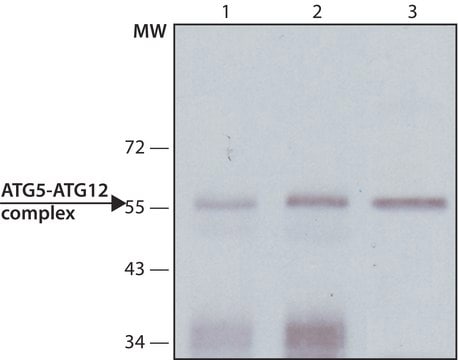
Mouse monoclonal anti-ATG5 antibody reacts with human, rat, and mouse Atg5-Atg12 complex by immunoblotting (∼56kDa) and immunoprecipitation.

Physical form

Solution in 0.01 M phosphate buffered saline, pH 7.4, containing 15 mM sodium azide.

Disclaimer

Unless otherwise stated in our catalog or other company documentation accompanying the product(s), our products are intended for research use only and are not to be used for any other purpose, which includes but is not limited to, unauthorized commercial uses, in vitro diagnostic uses, ex vivo or in vivo therapeutic uses or any type of consumption or application to humans or animals.
Ta strona może zawierać tekst przetłumaczony maszynowo.

Nie możesz znaleźć właściwego produktu?  

Wypróbuj nasz Narzędzie selektora produktów.

Klasa składowania

10 - Combustible liquids

wgk

WGK 2

flash_point_f

Not applicable

flash_point_c

Not applicable


Wybierz jedną z najnowszych wersji:

Certyfikaty analizy (CoA)

Lot/Batch Number

Nie widzisz odpowiedniej wersji?

Jeśli potrzebujesz konkretnej wersji, możesz wyszukać konkretny certyfikat według numeru partii lub serii.

Masz już ten produkt?

Dokumenty związane z niedawno zakupionymi produktami zostały zamieszczone w Bibliotece dokumentów.

Odwiedź Bibliotekę dokumentów

Allan Sauvat et al.
EBioMedicine, 30, 261-272 (2018-04-03)
Depending on the length of their carbon backbone and their saturation status, natural fatty acids have rather distinct biological effects. Thus, longevity of model organisms is increased by extra supply of the most abundant natural cis-unsaturated fatty acid, oleic acid
Mireia Niso-Santano et al.
The EMBO journal, 34(8), 1025-1041 (2015-01-15)
To obtain mechanistic insights into the cross talk between lipolysis and autophagy, two key metabolic responses to starvation, we screened the autophagy-inducing potential of a panel of fatty acids in human cancer cells. Both saturated and unsaturated fatty acids such
Xian Jiang et al.
Molecular cell, 63(2), 229-239 (2016-07-23)
In response to apoptotic stimuli, mitochondria in mammalian cells release cytochrome c and other apoptogenic proteins, leading to the subsequent activation of caspases and apoptotic cell death. This process is promoted by the pro-apoptotic members of the Bcl-2 family of
Shida Yousefi et al.
Nature cell biology, 8(10), 1124-1132 (2006-09-26)
Autophagy-related gene (Atg) 5 is a gene product required for the formation of autophagosomes. Here, we report that Atg5, in addition to the promotion of autophagy, enhances susceptibility towards apoptotic stimuli. Enforced expression of Atg5-sensitized tumour cells to anticancer drug
Sujan Piya et al.
Blood, 128(9), 1260-1269 (2016-06-09)
Autophagy is a cellular adaptive mechanism to stress, including that induced by chemotherapeutic agents. Reverse phase protein array suggested that high expression of the essential autophagy-related protein, Atg7, was associated with shorter remission in newly diagnosed acute myeloid leukemia (AML)

Powiązane treści

Instructions

Numer pozycji handlu globalnego

SKUNUMER GTIN
A2859-100UL04061838029560
A2859-200UL04061838029577

Nasz zespół naukowców ma doświadczenie we wszystkich obszarach badań, w tym w naukach przyrodniczych, materiałoznawstwie, syntezie chemicznej, chromatografii, analityce i wielu innych dziedzinach.

Skontaktuj się z zespołem ds. pomocy technicznej