Przejdź do zawartości
Merck

Przejdź do

MABC202

Anti-APC Antibody, clone FE9

clone FE9, from mouse

Synonim(y):

Adenomatous polyposis coli protein, Protein APC, Deleted in polyposis 2.5

Zaloguj się, aby wyświetlić ceny organizacyjne i kontraktowe.

Wybierz wielkość

Zmień widok
Gabaryty przesyłkiSKUDostępnośćCena netto
100 μg

Przewidywany termin wysyłki21 maja 2026zKuehne + Nagel Sp. z o.o.

1800,00 zł

Informacje o tej pozycji

UNSPSC Code:
12352203
NACRES:
NA.41
eCl@ss:
32160702
Conjugate:
unconjugated
Clone:
FE9, monoclonal
Application:
WB
Citations:
8

1800,00 zł


Przewidywany termin wysyłki21 maja 2026Szczegóły


Zamów zamówienie zbiorcze
Pomoc techniczna
Potrzebujesz pomocy? Nasz zespół doświadczonych naukowców chętnie Ci pomoże.
Pozwól nam pomóc


biological source

mouse

Quality Level

conjugate

unconjugated

antibody form

purified immunoglobulin

antibody product type

primary antibodies

clone

FE9, monoclonal

species reactivity

human

technique(s)

western blot: suitable

isotype

IgG1κ

NCBI accession no.

UniProt accession no.

shipped in

wet ice

target post-translational modification

unmodified

Gene Information

human ... APC(324)

General description

Adenomatous polyposis coli protein (APC) is a ubiquitous multidomain protein that has a well documented role as a tumor suppressor. The mechanism of APC-mediated tumor suppression is still an area of active investigation; however, several studies suggest that APC is a negative regulator of the Wnt signaling pathway as it downregulates β-catenin via interactions with Axin/GSK3-β complex, thereby preventing transcription of genes such as MYC that contribute to cell proliferation. Defective APC proteins contribute to the initiation and proliferation of various types of cancers, including familial adenomatous polyposis. However, other studies have shown that APC interacts with a range of other proteins such as the EB1 microtubule-binding proteins, to regulate other processes such as cell migration.
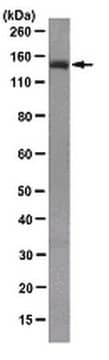
~147 kDa observed. Uniprot describes the full length protein at ~312 kDa This antibody was shown to detect the truncated form at ~147 kDa

Immunogen

Linear peptide corresponding to the N-terminus of human APC.

Application

Anti-APC Antibody, clone FE9 is an antibody against APC for use in Western Blotting.

Biochem/physiol Actions

This antibody recognizes the N-terminus of APC.

Physical form

Format: Purified

Analysis Note

Evaluated by Western Blot in SW480 cell lysate.

Western Blot Analysis: 0.5 µg/mL of this antibody detected APC in 10 µg of SW480 cell lysate.

Other Notes

Concentration: Please refer to the Certificate of Analysis for the lot-specific concentration.
Ta strona może zawierać tekst przetłumaczony maszynowo.

Porównaj podobne pozycje

Wyświetl pełne porównanie

Pokaż różnice

1 of 1

Ta pozycja
SAB4501438WH0000324M1SAB4200594
Gene Information

human ... APC(324)

Gene Information

human ... APC(324)

Gene Information

human ... APC(324)

Gene Information

human ... APC(324)

biological source

mouse

biological source

rabbit

biological source

mouse

biological source

rabbit

antibody form

purified immunoglobulin

antibody form

affinity isolated antibody

antibody form

purified immunoglobulin

antibody form

affinity isolated antibody

conjugate

unconjugated

conjugate

unconjugated

conjugate

unconjugated

conjugate

unconjugated

clone

FE9, monoclonal

clone

polyclonal

clone

3E2, monoclonal

clone

polyclonal

species reactivity

human

species reactivity

rat, mouse, human

species reactivity

human

species reactivity

human


Still not finding the right product?

Wypróbuj nasze narzędzie Narzędzie selektora produktów, aby zawęzić opcje.


Klasa składowania

12 - Non Combustible Liquids

wgk

WGK 1

flash_point_f

Not applicable

flash_point_c

Not applicable


Certyfikaty analizy (CoA)

Poszukaj Certyfikaty analizy (CoA), wpisując numer partii/serii produktów. Numery serii i partii można znaleźć na etykiecie produktu po słowach „seria” lub „partia”.

Masz już ten produkt?

Dokumenty związane z niedawno zakupionymi produktami zostały zamieszczone w Bibliotece dokumentów.

Odwiedź Bibliotekę dokumentów


Weiran Feng et al.
Proceedings of the National Academy of Sciences of the United States of America, 118(32) (2021-08-07)
The increasing complexity of different cell types revealed by single-cell analysis of tissues presents challenges in efficiently elucidating their functions. Here we show, using prostate as a model tissue, that primary organoids and freshly isolated epithelial cells can be CRISPR
Thai Q Tran et al.
Nature cancer, 1(3), 345-358 (2020-08-25)
Genetic-driven deregulation of the Wnt pathway is crucial but not sufficient for colorectal cancer (CRC) tumourigenesis. Here, we show that environmental glutamine restriction further augments Wnt signaling in APC mutant intestinal organoids to promote stemness and leads to adenocarcinoma formation
Maria Paz Zafra et al.
Nature biotechnology, 36(9), 888-893 (2018-07-04)
CRISPR base editing enables the creation of targeted single-base conversions without generating double-stranded breaks. However, the efficiency of current base editors is very low in many cell types. We reengineered the sequences of BE3, BE4Gam, and xBE3 by codon optimization


Numer pozycji handlu globalnego

SKUNUMER GTIN
MABC20204053252439049

Questions

Reviews

No rating value

Active Filters