
8.03129

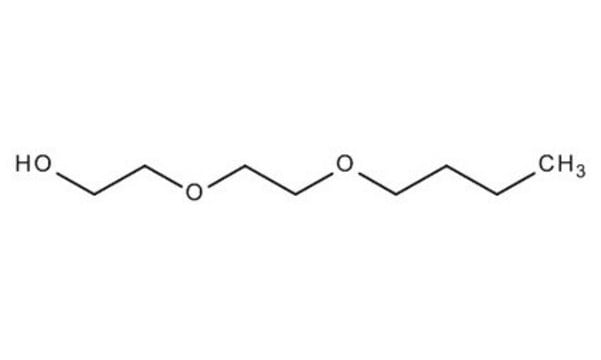
Diethylene glycol monobutyl ether
for synthesis
Synonim(y):
Diethylene glycol monobutyl ether, Butyl carbitol, 2-(2-Butoxyethoxy)ethanol, Butyl diglycol
Wybierz wielkość
| Do Państwa/SKU | Dostępność | Cena netto |
|---|---|---|
1 L | Skontaktuj się z Obsługą Klienta, aby uzyskać informacje na temat dostępności | 169,00 zł |
2.5 L | Skontaktuj się z Obsługą Klienta, aby uzyskać informacje na temat dostępności | 337,00 zł |
25 L | Skontaktuj się z Obsługą Klienta, aby uzyskać informacje na temat dostępności | 1520,00 zł |
Informacje o tej pozycji
169,00 zł
grade
synthesis grade
Quality Segment
vapor pressure
<1 hPa ( 20 °C)
assay
≥98% (GC)
form
liquid
autoignition temp.
210 °C
potency
5660 mg/kg LD50, oral (Rat), 4120 mg/kg LD50, skin (Rabbit)
expl. lim.
0.7-5.9 % (v/v)
dilution
(for synthesis)
pH
7 (20 °C)
kinematic viscosity
6.1 cSt(20 °C)
bp
226-234 °C/1013 hPa
mp
-68 °C
transition temp
flash point 105 °C
density
0.95 g/cm3 at 20 °C
storage temp.
2-30°C
SMILES string
O(CCOCCCC)CCO
InChI
1S/C8H18O3/c1-2-3-5-10-7-8-11-6-4-9/h9H,2-8H2,1H3
InChI key
OAYXUHPQHDHDDZ-UHFFFAOYSA-N
Application
- Biopolymeric Anticorrosion Coatings from Cellulose Nanofibrils and Colloidal Lignin Particles.: This study describes the development of a novel anticorrosion coating made from biopolymers, including a discussion on the use of diethylene glycol monobutyl ether as a solvent to disperse components uniformly (Dastpak et al., 2021).
- The investigation of structural and thermosensitive properties of new phosphazene derivatives bearing glycol and amino acid.: This research article explores the properties of phosphazene derivatives that incorporate glycol structures, detailing methods like NMR and IR spectroscopy where diethylene glycol monobutyl ether may be employed as a solvent in the synthesis process (Uslu and Güvenaltın, 2010).
- Diethylene glycol mono butyl ether concentrations in room air from application of cleaner formulations to hard surfaces.: This study measures the air concentrations of diethylene glycol monobutyl ether in indoor environments following its application in cleaning agents, demonstrating its volatility and potential inhalation exposure during use (Gibson et al., 1991).
Analysis Note
Density (d 20 °C/ 4 °C): 0.951 - 0.954
Water (K. F.): ≤ 0.20 %
Peroxide (as H₂O₂): ≤ 0.05 %
Identity (IR): passes test
1 of 1
Ta pozycja | |||
|---|---|---|---|
| Quality Level 200 | Quality Level 200 | Quality Level 200 | Quality Level 200 |
| grade synthesis grade | grade synthesis grade | grade synthesis grade | grade synthesis grade |
| assay ≥98% (GC) | assay ≥98% (GC) | assay ≥99% (GC) | assay ≥98% (GC) |
| form liquid | form liquid | form liquid | form liquid |
| density 0.95 g/cm3 at 20 °C | density 0.99 g/cm3 at 20 °C | density 0.902 g/mL at 25 °C (lit.) | density 0.91 g/cm3 at 20 °C |
| vapor pressure <1 hPa ( 20 °C) | vapor pressure 0.13 hPa ( 20 °C) | vapor pressure <1 mmHg ( 20 °C), 10 mmHg ( 81 °C) | vapor pressure 0.5 hPa ( 20 °C) |
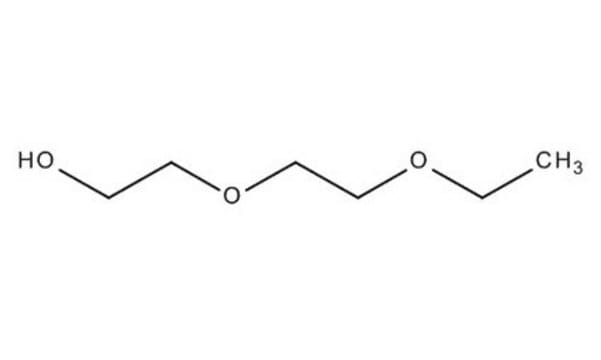


Still not finding the right product?
Explore all of our products under Diethylene glycol monobutyl ether

signalword
Warning
hcodes
Hazard Classifications
Eye Irrit. 2
Klasa składowania
10 - Combustible liquids
wgk
WGK 1
flash_point_f
210.2 °F - closed cup
flash_point_c
99 °C - closed cup
Wykazy regulacyjne
Wykazy regulacyjne dotyczą głównie produktów chemicznych. Można w nich podawać ograniczoną liczbę informacji na temat produktów niechemicznych. Brak wpisu oznacza, że żaden ze składników nie znajduje się w wykazie. Użytkownik odpowiada za zagwarantowanie bezpiecznego i zgodnego z prawem stosowania produktu.
112-34-5
Certyfikaty analizy (CoA)
Poszukaj Certyfikaty analizy (CoA), wpisując numer partii/serii produktów. Numery serii i partii można znaleźć na etykiecie produktu po słowach „seria” lub „partia”.
Masz już ten produkt?
Dokumenty związane z niedawno zakupionymi produktami zostały zamieszczone w Bibliotece dokumentów.