
39441

Nitrate Reagent B
suitable for microbiology
Synonym(s):
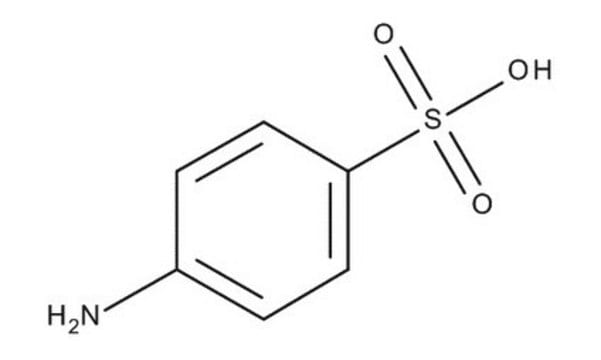
Sulfanilic acid solution, 4-Aminobenzenesulfonic acid
Select a Size
| Pack Size | SKU | Availability | Price |
|---|---|---|---|
| 100 mL | Please contact Customer Service for Availability | PLN 291.00 |
About This Item
PLN 291.00
shelf life
limited shelf life, expiry date on the label
Quality Level
composition
acetic acid (30%), 1000 mL , sulfanilic acid, 8.0 g
technique(s)
microbe id | metabolite detection: suitable
application(s)
agriculture
clinical testing
environmental
food and beverages
pharmaceutical, microbiology
suitability
Enterobacter spp., Escherichia coli, Neisseria spp., anaerobic bacteria, coliforms
SMILES string
Nc1ccc(cc1)S(O)(=O)=O
InChI
1S/C6H7NO3S/c7-5-1-3-6(4-2-5)11(8,9)10/h1-4H,7H2,(H,8,9,10)
InChI key
HVBSAKJJOYLTQU-UHFFFAOYSA-N
Application
1 of 1
This Item | |||
|---|---|---|---|
| Quality Level 100 | Quality Level - | Quality Level 100 | Quality Level 200 |
| composition acetic acid (30%), 1000 mL , sulfanilic acid, 8.0 g | composition - | composition - | composition - |
| application(s) agriculture | application(s) pharmaceutical (small molecule) | application(s) - | application(s) - |
| shelf life limited shelf life, expiry date on the label | shelf life - | shelf life - | shelf life - |
| technique(s) microbe id | metabolite detection: suitable | technique(s) - | technique(s) - | technique(s) - |
| suitability Enterobacter spp., Neisseria spp., coliforms | suitability - | suitability - | suitability - |


signalword
Danger
hcodes
Hazard Classifications
Eye Dam. 1 - Skin Corr. 1B
Storage Class
8A - Combustible corrosive hazardous materials
wgk
WGK 1
flash_point_f
Not applicable
flash_point_c
Not applicable
ppe
Faceshields, Gloves, Goggles, type ABEK (EN14387) respirator filter
Choose from one of the most recent versions:
Already Own This Product?
Find documentation for the products that you have recently purchased in the Document Library.
Articles
For microbiologists the most fundamental stain was developed in 1884 by the Danish bacteriologist Hans Christian Gram.
Dla mikrobiologów najbardziej fundamentalny barwnik został opracowany w 1884 r. przez duńskiego bakteriologa Hansa Christiana Grama.
Większość wibrysów wykorzystuje proste źródło C, takie jak glukoza, jako źródło energii i wymaga 2-4% NaCl lub innych soli i pierwiastków śladowych obecnych w wodzie morskiej dla optymalnego wzrostu. Niektóre gatunki mogą wykorzystywać różne źródła energii.
Related Content
Global Trade Item Number
| SKU | GTIN |
|---|---|
| 39441-100ML-F | 04061831982336 |